Category: Fr. Mario Masangcay, CSsR

  • Musta na? Howdy?

    Musta na? Howdy?

    June 27, 2021 – 13th Sunday in Ordinary Time

    Click here for the readings (https://bible.usccb.org/bible/readings/062721.cfm)

    “O, Kamusta na? How are You? Are You Ok?”

    Usually whenever we meet each other, we greet one another with these words. Through these words, we commonly express our concern for each other’s health and wellbeing. We acknowledge as well that human as we are, we are all prone to hurts, diseases, and sicknesses. Even the healthiest of us live with fear of accidents and diseases that can suddenly render us limited on the sidelines. Nobody likes to get sick. But nobody can claim that he/she has never got sick before. Easy for us to say “Bawal magkasakit? (It is not allowed to get sick), but tayo ay nagkakasakit (we do get sick). Sickness cannot be denied. To get sick is part of our human nature. So, since we are subject to sickness, it is natural for us to ask about the health and wellbeing of others, especially those we have not seen for awhile.

    But what does it mean to be sick? Based from our experience, to be sick is more than just an experience of physical illness but a wide range of emotional, mental, psychological, and spiritual diseases and discomforts. Whenever we get sick, we become incapacitated. Normal for us to feel limited, dependent, depressed, irritable, helpless, and sometimes alienated or outcasted from God and others whenever we are sick. We know that it is not easy to get sick, especially when we are used to live our life independently and always in-control. Sickness is indeed a dreadful experience, as what was also described in our Gospel today.

    Our gospel today shows us as well that to be sick may be a horrible human experience but could also be opportunities for growth and a chance for life anew.

    First, sickness can be the opportunity to be converted. Jairus and the woman with hemorrhage came to Jesus. Coming to Jesus is an experience of conversion – a humble turning toward instead of turning away from Jesus. Whenever we get sick, we usually cease from our usual routine, go home and take a rest. It is in sickness that we break from our selfish ways and turn back towards God’s love and concern. Others would say that when we are sick, we desire and come to acknowledge God’s presence and appreciate God’s love in our lives. When we are healthy, we say, “Disco, Disco” but when sick, we say, “Dios ko, Dios ko”.

    Sickness can also be the opportunity to have faith and trust in God and others. Jairus begged to Jesus, “Please come lay your hands on her, that she may get well and live”. The woman aspired “If only I could touch his cloak, I shall be cured”.  To be helpless and dependent of others are not normal for us. We rather be in-control and not needing others. But to be sick is humbling for you really need and have to trust on others. In sickness, we surrender ourselves and humbly ask for God’s mercy and rely on God’s providence, and the help of others.

    Sickness can also be the opportunity to be cleansed and be healed by God. In sickness, we witness God’s mercy, love, goodness, and miracles working in us. That through our faith and Jesus’ concern for us, God’s power and love is made known to all. In our weakness and sickness, God’s power and glory is revealed to you & to all.

    Sickness can be also opportunity to hear once again & anew our vocation and mission life. When the woman was healed, Jesus calls her to “go in peace and be cured of your affliction” which means to be reconciled with herself and others who may have caused her afflictions. The girl is called to “arise” which mean to stand up from despair and have hope in life. Being healed from your sickness is a reminder that you are given another life – another new chance in life to make things right and better than before.

    And lastly sickness can be an opportunity to proclaim our faith. Just like the cured woman and girl, our healing from sickness makes us express and share our faith to others, and through our healing, others will see and witness God’s love revealed through us and come to believe more in Him. 

    To be sick then can be the opportunity to be converted, to have faith and trust in God, to be cleansed and be healed, to renew life-commitments and mission, and to proclaim our faith for others to believe.

    Yes, no one wants to get sick. But whenever you got sick, take it not as disgrace but opportunity for God’s glory to be revealed in You. In other words, “A blessing in disguise”. So, Kamusta na? How are you coping? Perhaps God is healing us & through us, God is revealing something better for all of us in life.

    During these pandemic times, in times of sickness, discomforts, & distress, let our prayer be like that of Jesus, saying: “Father, take this cup of suffering away from me, However, not my will, but Your will be Done.” Always & Forever.

    Siya Nawa. Hinaut pa unta. So be it. Amen.

  • Travel with Him

    Travel with Him

    June 20, 2021 – 12th Sunday in Ordinary Time

    Click here for the readings (https://bible.usccb.org/bible/readings/062021.cfm)

    As a Redemptorist missionary, traveling is a big part and parcel of my life and work. As we all know, to journey around the Philippine islands would entail a lot of travel by land, sea or air. This would mean taking the car, bus, tricycle, boat, walk, bike, horse, fast ferry or plane and/or combination of all.

    Once at the pre-departure area of Cebu SuperCat terminal, it was announced that our trip to Dumaguete on that day was cancelled due to incoming typhoon. A number of us were grumbling as we lined up ourselves to get our ticket refunded. It happened that one of the passengers recognized me and chatted with me. Expressing her disgust, she suggested to me, “Father, why don’t you pray like Jesus did, for the storm to pass us by.” I replied to her, “It never and will never cross my mind that I am Christ, or I am the Christ. I am a Christian, just a mere follower of Christ.”

    Our Gospel today about calming of the storm, I think, teaches us about our life as Christians. It tells us what it means to be a Christian. The word Christian comes from the proper noun “Christ”, which means Messiah or Savior and the suffix “ian” which mean a follower of, a fan of. Meaning, to be a Christian is not to be Christ, but to be a disciple or follower of Christ. It is like if one is a follower of Vilma, they are called “Vilmanian,” and “Noranians” for Nora. The suffix “ian” could have an acronym. If we attached IAN to Christ, IAN could mean I Am Now with Christ. But if we detach or separate “ian” from Christ, IAN could mean I Am Nothing without Christ. Meaning, if we only remain in Him, we are assured of our salvation and eternal life. Apart from Him, we are nobody. With Him, we are blessed.

    In our world today, we could recognize that there are people who claim that they are Christ, who promised that they will save us, thinks that only them who can save us, and through their own efforts, on their own, they can save themselves and others – in other words, people with messianic complex. There are also people nowadays who expect others to be their Christ who will do and save the day for them. Just like people, who wants and expects others, like their priests & government officials to heal them from sickness, forgive their sins and faults, solve their problems, fix their mess, help them financially and even perform miracles like calming the storm, exorcised their demons, and others.

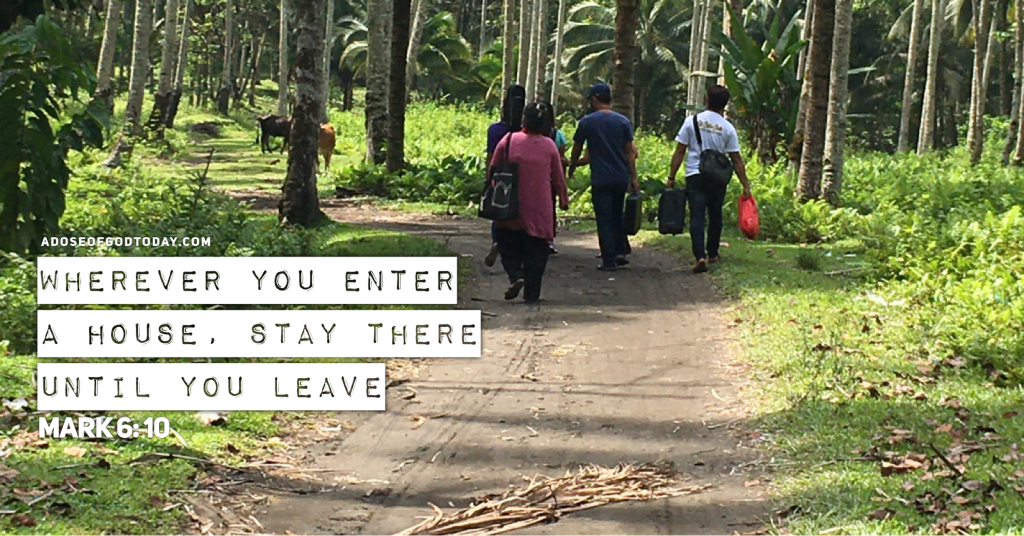
    Our Gospel is a clear reminder that Jesus is the Christ, and we are Christians – His mere follower. As Christians then, we need Christ – we need to be and live life with Him for without Him we can do nothing. We thus need to travel & journey with Him in our day to day lives.

    Jesus also is teaching us today about PEACE, COURAGE, and FAITH. First of all, Peace is not the absence of war, conflict, storms or turmoil in life, but Peace is the sense of Calmness in the midst of life-storms, and the sense of Serenity despite wars, conflict, and difficulties in life. We cannot avoid storms in life, but what is required of us is the calmness and serenity of Jesus who says: “Quiet” amid these storms, and difficulties.  He also teaches us that Courage is more than just moving on – moving fighting forward, but more on holding our ground, facing the odds, still holding on standing, and asking for help.

    Jesus who says: “Be Still” shows us courage in the midst of the storm not by fighting or controlling it, but by facing the storm without being overwhelmed by it. In the same way, courage in the midst of life-storms and difficulties would mean the Christ-like attitude of not only “no retreat, no surrender”, but also “don’t fight nor flee but face it and ask for help”. Facing life-adversities is not about getting rid and getting out, but more so getting through life-challenges.  And lastly, Jesus who asks: “Do you not yet have faith?” is also teaching us that Faith is not more than just the absence of fear and doubt, but to remain steadfast and trusting in the Lord’s will and ways, even when in fear and doubt.

    In life, then, as His followers, we travel with the Lord in peace, courage & faith. Via con Dios. Go with God, Walk with Jesus.

    As Christians, followers of Christ we pray that we may always recognize His presence and help in our life journey and so bless us with peace, courage, and faith in the midst of storms in life, most especially during these pandemic times. Amen.

  • LAMBING

    LAMBING

    June 17, 2021 – Thursday of the 11th Week in Ordinary Time

    Click here for the readings (https://bible.usccb.org/bible/readings/061721.cfm)

    Prayer is an essential dimension of our Christian life & spirituality. Our gospel today invites us to reflect upon our prayer life as followers of Christ & God’s beloved children. And, in teaching us the Lord’s prayer, Jesus reminds us not only what to pray but also how to pray & why we pray.

    First, to pray is to be present before God’s presence – being present before God’s presence. When we call our God as our Father, we personally present ourselves before our God and address Him as our beloved Father (Tatay, Amahan, Papa, Aboji). Because of this, second, prayer is all about God and less about ourselves. When we pray, we do tend to be more concerned about the gifts than the Giver. Valid may our present needs and wants be, but before God’s presence, we are more than just what we need, but we pray as His Children. So, pray to the Giver, and less for the gifts. Aspire for His kingdom to come & His will be done now & always in life. Only then & after being present & hoping for God’s will that, third, we ask from Him. And we ask not for what we want but what we need because what we want might not be really what we need & better for us. Again, His will – not ours, be done. Jesus, rather teaches us to ask for three things that we really need in life now: our daily bread, forgiveness, & faith in the midst of life-difficulties.

    To pray then is to be present before God’s presence, to long for His Kingdom & Will to be with us, & to ask for what we really need now than just what we want from Him. In other words, praying is our pamaraig, lambing, tenderness with our Father: a loving conversation with the Giver rather than just asking for gifts & favors.

    Tatay, May Your Kingdom & Will be upon us now & grant us what we really need now – food for the journey, forgiveness for our shortcomings & strength in faith as we follow Jesus, your son in our daily struggles with life.

    So Help Us, Tatay. So May it be. Amen.

  • Me & We: Seed for the Kingdom

    Me & We: Seed for the Kingdom

    June 13, 2021 – 11th Sunday in Ordinary Time

    Click here for the readings (https://bible.usccb.org/bible/readings/061321.cfm)

    A newly-graduated but non-working young millennial, while hanging-out at home and playing with his X-Box video games, was once asked by his mom to buy some fruits for meals. Though he prefers to go to a mall for convenient–sake, hesitantly he went to a nearby market. He tried to find his way looking for the fruit-stand since he was never been to this market before. Eventually he found the fruits he needed to buy at a particular fruit-stand. While paying, he jokingly said to the vendor: “Sir, I cannot help but notice you do look like Jesus Christ.” The fruit-vendor reply: “Others would say the same. But assuming I am who you seem I look alike. Do you have any questions for me?” Up for the challenge, he asked: “If you are said-to be the Christ, the savior of the world, how come the world is still a mess? Have you and God done and is doing something about these mess?” After giving much thought, the vendor answered, “For sure God has and is doing something about these mess – He created YOU.”

    Defensively, he countered: “Me, who am I to fix these mess? I am not rich, not  successful, still no-job. I am nobody, no hero. I am limited”. So the vendor further challenged him, “So what do YOU need then now to fix these mess?” He dreamingly replied, “Well if only I have more power, resources and opportunities, perhaps like in a computer game, I can be who I am and wish to be”. “That’s all?” the vendor disturbed him and then handed him something, “Take this. It got all what you need.” As he received it, he confusingly asked, “A seed? What am I do to with this seed?” The vendor replied, “Well, God has already done and doing something in creating You, and you have the seed now to do your part. It is up to you then whether to plant your seed and work out with God doing your part and growing your seed, OR do nothing with your seed, but complain, and let your world and our world still a mess.

    After Christmas, Lenten, Easter seasons where we celebrate our faith – what we believe, we are now in the Ordinary times of our liturgical year where we celebrate our life in faith, i.e. how we live, practice and witness what we believe. Jesus have much to teach us not only what we believe (Dogma) but how to live & practice what we believe (Moral). We have celebrated our Faith, but now we are celebrating our Faith-Life – our Faith & Life.

    To offer us meaning, inspiration and directions in our faith-life journey, Jesus made use of parables and our common life-experiences as life-lessons to live by. Like in our gospel today, by sharing us the parable of the growing seed and mustard seed, Jesus taught us not only about the Kingdom of God but also HOW to live our present lives along with our faith & mission in God’s kingdom.

    Here Jesus reminds us that nature and our usual human labor or work teach us that “Big things comes from small beginnings”. Yes, the sower & planter might have planted the seed and harvested the fruit but he does not know how the plant grows. And definitely he is not responsible for the seed to grow into full grain & for the smallest mustard seed to be the largest plant with large branches. It takes a lot of work on our part, AND working in partnership with God for us to fully enjoy the fruits of our labor with God. Yes, we can be the sower & planter, but God is the grower.

    With our advanced technology nowadays, we also tend to prefer to have things easy, instant, fast, disposable and convenient. In effect, we become impatient and intolerant with details and processes. We tend to value more the goals, and fruits that we undervalue & even become heartless to the growth-process, labor, and journey it takes. Like the young millennial, we tend to look at and concern more on the end-product and destination, without considering the process to make it and the travel-journey to get there.

    Never satisfied of what we have accomplished now, we rather tend to criticize & complain about our present mess without doing something about it except criticizing and complaining about it.  While we should enjoy & be satisfied to the advantages of what we have today, let us not forget the whole process-journey it takes to reach at this stage of advancement. Same as saying: While you and others enjoys and be satisfied with the fruits of your labor, let us not disregard and undervalue the efforts, work and sacrifices you have done as well as God’s work of creating you and with you for life to be better than before, better than the usual.

    In other words, to do away with the mess in life and to fully enjoy what God has given and can offer us in life now, we have to be RESPONSIBLE participants for God’s grace and work of creating and redeeming our life anew. As a wise man once penned, “Who & what you are is God’s gift to you & the world, who & what you BECOME is your gift to God & the world”.

    Especially during these pandemic times, teach & lead us Lord to cooperate with Your will & plans for us these days so that we may humbly recognize & fully enjoy the fruits of Your works for our betterment & the glory of Our Father’s Kingdom.

    So May it Be. Hinaut pa unta. Siya Nawa. Amen.

  • Bonded by the Lord’s meal

    Bonded by the Lord’s meal

    June 6, 2021 – Solemnity of the Most Holy Body and Blood of Christ

    Click here for the readings (https://bible.usccb.org/bible/readings/060621.cfm)

    In almost every Filipino homes there is a picture of Last Supper near the dining table. Have you ever wondered why in all places such picture of the Lord’s last supper is hanged near the dining table?

    This is because we, Filipinos love celebrations. We like to be part of big party or fiesta. Basically, we are meal-oriented people. We like to eat, and mealtimes are important and meaningful activity for us. Yes, we like to eat, but we like to eat together. We eat not only for nourishment but for companionship as well. For us, eating is not only a usual routine of nourishing our own physical body, but also a common activity of strengthening relationship and bonding. That is why we eat together not for the food, but for the companionship and covenant it brings. Mealtime for us is not only the time to eat, but also the opportunity to encounter – to experience one another.  This is why we don’t like to eat alone. We like to eat with companion, because for us, meals, eating, tables would mean celebrations, table-fellowship, sharing, bonding, rituals, and communion.

    The word ‘companion’ is an interesting word. It comes from two Latin words: cum which means “with”, and panis which means bread. So a ‘companion’ literally means someone whom I share bread with. And it is only a few (not all) you enjoy having meal with. There has to a bonding – a relationship first, which is deepened by the sharing of food and drink. Usually, by inviting a person to a meal, we seal our contracts, we show acceptance and approval. We know that once you are invited to take part in their table – to eat with them, it would mean that you are already accepted.  You become one of them. You belong to them.

    This is why we like the picture of the Last Supper hanging on near our dinner table because we want to be part of Lord’s celebration of life.  Taking our meals in front of the picture of the Last Supper, whatever the food is, whether lechon or bulad or ginamos, would mean we want to be a companion of Jesus and his disciples in their party celebration. This is why it is also particularly difficult for us to not able to attend Holy Mass during these pandemic times, & how insufficient it is, just to take part of the Holy Mass through the live-streaming. In other words, we do like to renew and strength our faith-relationship with Him. We want to be accepted and belong to His community. We like to be part of His family-banquet, His party. And All of these are greatly done and signified until now in our table-fellowship in the Lord’s Eucharist, in our celebration of the Holy Mass. 

    Today, we celebrate the feast of Corpus Christi, the Body and Blood of Christ. Today, we recognize and celebrate Christ’s continuing Presence and His binding promise of love and redemption to us, through His gift of Himself in a form of bread and wine. Our readings today remind us that as in life we feed ourselves with food, the Lord also feed us with His food, not only to nourish us but also to strengthen our covenant relationship with Him. Jesus in our gospel today specially has offered us His body and blood, as our inheritance of God’s manna in the Holy Eucharist. By sharing us Himself in body and blood, Jesus sealed us new covenant-relationship with God. And because of this, we are continually nourished by God’s graces and we are in communion with Christ’s eternal life. In other words, through His body and blood, Jesus is offering us not only God’s food for our faith-life journey but also a meal-time party (or a food trip) with God. That is why every time we celebrate the Holy Eucharist, we are in covenant or in companionship with God, with Jesus, and with one another. Thus, through our table-fellowship as family and community in our celebrations of the Lord’s Eucharist every Sunday and also as Filipino in front of the picture of the Lord’s Supper, we are united with the Lord and we take part with His glory and work of redemption. 

    Perhaps if we say nowadays, “We are what we eat and who we eat with” (Tayo ay ang Anong kinain at sino ang kasama), in attending Eucharist, we as Christian proclaim that through the body and blood of Jesus we are having party-meal (food trip/ breaking bread) with God now and always.

    For those who are not able to receive communion during live-stream Masses, nowadays they pray Act of Spiritual Communion of St. Alphonsus, saying “I desire to receive you into my soul. Since I cannot now receive you sacramentally, come at least spiritually into my heart… Never permit me to be separated from You. Amen.” Such words express our deep desire to be in communion with Jesus, to be part and companion of His eucharistic sacred life.

    During these pandemic times, we pray that we may always be in communion & in companion with our risen Lord, be nourished by His body & blood, and be always united & bonded, not separated from His love & mercy.

    So Help Us God, So May it be. Amen.