Category: Fr. Mario Masangcay, CSsR

  • To whom shall we Go?

    To whom shall we Go?

    August 22, 2021 – 21st Sunday in Ordinary Time

    Click here for the readings (https://bible.usccb.org/bible/readings/082221.cfm)

    During the revolution in Nicaragua, it is said that a group of Catholics seeks refuge inside a big cathedral. While praying inside the cathedral as the war between rebels and army progressed, a gun-toting rebel came inside and barked at them, “Those who believed in Jesus Christ, stay and stand up for your faith. Those who don’t believe in Jesus Christ, you may now go free.” Hearing this, more than two-third of the refugees immediate went out and left the church, while the rest stayed behind trembling. The rebel then, closed the cathedral’s door and said, “Brothers and sisters, please continue to pray. We all need your prayers. But I rather pray with true believers than with hypocrites.”

    In his book Conversations with God, Neale Donald Walsch said: “Your decision today is a statement of who you are & a testament of who you choose to be.” True indeed, whatever decisions we make in life reflect our very own identity as well as life-choices. Whatever circumstances we are in – whether free or limited, we do have a choice in life. What makes it difficult for us nowadays is not the lack, but rather because of the many choices & options we have. And even not to choose may also been a good choice. However, not making a choice in life now & in our life-hereafter makes our life miserable & meaningless. Thus, whatever your choice & what you decide mirrors your own identity & attitude towards life.

    In today’s reading, we hear Joshua, the successor of Moses challenging the Israelites once and for all, to make a choice. Although the Israelites were the chosen people and had experienced the mighty works of Yahweh, still some of them had worshipped idols and other gods. They were very influenced by the religious practices of their ancestors and of the natives who worshipped idols. Before the people, Joshua proclaimed his faith in Yahweh that he and his house decide that they would serve only the Lord. Seeing this, the people also accepted Yahweh as their Lord and God.

    In the gospel, we also hear Jesus challenging his disciples to make a choice. Many followed Jesus, some out of curiosity, some for healing and for other favors, and some out of conviction that he was the Messiah. But when Jesus began to teach them about participating in his very life and mission, by accepting his word and partaking in his body and blood as food and drink, many could not accept it. Many disciples withdrew and no longer followed him. They deserted him and stopped following him. That is the time Jesus asked his twelve apostles, “Will you also go away?” He asked them whether they too would leave him. He did not want to force anyone to accept him.

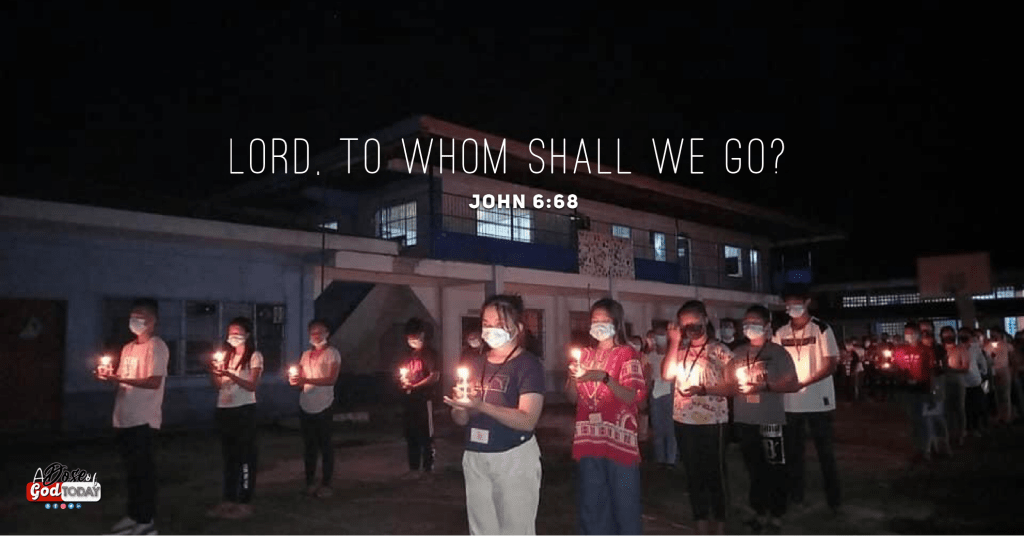
    He has shown the way. Now they had to make a decision, a choice. And Peter proclaimed his and their choice: “Lord, to whom shall we go? You have the message of eternal life. We now believe and know that you are the Holy One of God.”

    Joshua, Peter & the apostles made their choice. Dear friends in Christ: “what about us?” “How about you?”

    In today’s readings, we are also challenged to make a decision. We are asked to make a choice, whether do you believe in Jesus, as the words of eternal life or not. “Are you for Jesus or against Jesus?” We know that although most of Filipinos are Catholics, some have left the Church. Some become cold or lukewarm with their faith in God and His Church. We know some of our relatives or friends have stopped going to mass, leave the church and/or joined this group or that sect.

    If Jesus now asks you: “How about you? Do you want to go away too?” What will your answer be? Will it be a definite, convincing “Yes or No”.  Or will it be a hesitant “Yes or No”?

    During Eucharist, as we recite the Apostle’s creed, we say: “I believe. I believe in God the Father Almighty. I believe in Jesus Christ, the only son of our Lord.” But do we really believe in God? Especially during these trying pandemic times, do we really believe and accept Jesus Christ as our Savior? Or in other words, do we say what we mean & mean what we say?

    Our faith then is not a matter of saying words or formula out of convention, convenience, or obligation, but a matter of professing, proclaiming our own free and voluntary decision or choice to follow Christ.

    Remember: Your decision today is a statement of who you are and a testament of who you choose to be.

    Like the Apostle, Lord, we do say: “Asa pa man diay: to whom shall we go? You have the words of eternal life. We have come to believe and are convinced that you are the Holy One of God.” May we never be separated from you. Amen.

    Please stand, let us now proclaim our choice, our decision…

  • Life is pregnant with Life eternal.

    Life is pregnant with Life eternal.

    August 15, 2021 – Solemnity of the Assumption of Mary

    Click here for the readings (https://bible.usccb.org/bible/readings/081521-Day.cfm)

    How fascinating it is to see two or more pregnant women meet. Familiar or stranger they might be to one another, whenever pregnant women cross path with each other, we could readily sense their excitement & anticipation of their coming child birthing. Regardless of the circumstances of their pregnancy, whether of teenage, out of wedlock, menopausal or planned pregnancy, pregnant women by instinct know not only the difficulties & challenges but also the great promise pregnancy can bring into their very lives. Deep inside, pregnant women know how blessed they are to bear & rear a child, and sense their joys & blessing are not only for them to keep, but is to be shared to everybody and all. That is why how infecting and life-giving it is for us to see meetings of pregnant women.

    This is what happened to Mary & Elizabeth in our gospel today. Under questionable situation, Mary on teenage pregnancy & out of wedlock, & her cousin Elizabeth, barren for many years, now pregnant on her old age met & shared their joys & gratitude as they found themselves on the way pregnant. They both cannot contain themselves to be happy for each other & to praise God in thanksgiving for the blessing of the promise of a new & better life ahead, not only for themselves, but for all humanity. Whatever their circumstance they are in, pregnant as they are, they believe that through their pregnancy, great grace & blessings are in store ahead for all of us.    

    Be as it may. While we are dealing nowadays with increasing numbers of casualties due to death & sickness during these pandemic times, we cannot help but wonder about our life now & hereafter. While we are still in our survival mode, coping with large amounts of uncertainties & insecurities, somehow we ponder not only on the sense & meaning of what is happening in our lives now, but also on what our future will be. We have already loss and still losing number of lives in these pandemic times, and we do find ourselves asking these hard questions: What’s next? To those who have gone before us, what happen to them next? And what’s next for us who are still here? Is there Life after Death? If death is upon us, what’s the point of life then? Is there a life here-after?

    In God’s plan of salvation – our history of salvation, we Christian faithful followers believe in the resurrection of the body & life everlasting. By His death & resurrection, our Lord Jesus Christ has offered us the promise & given us the hope for eternal life with our Father. For us who believes Jesus as our resurrection & life, our life in faith with God is not ended but transformed, improved, upgraded, & above all eternal. Thus we believe that there is more to life for us Christian, than what we are going through now & even more than our inevitable death. In other words, we believe that our faith in Jesus Christ has given us meaning & purpose in life here & now &  life here-after.

    For us believers, there is life after death for our faith life in Christ now is pregnant with life eternal. By faith, we believe that our life now can be better & sacred at present & hereafter. And whenever God & us cooperate and collaborate, salvation is assured and heaven-life eternal is possible for us now & always.

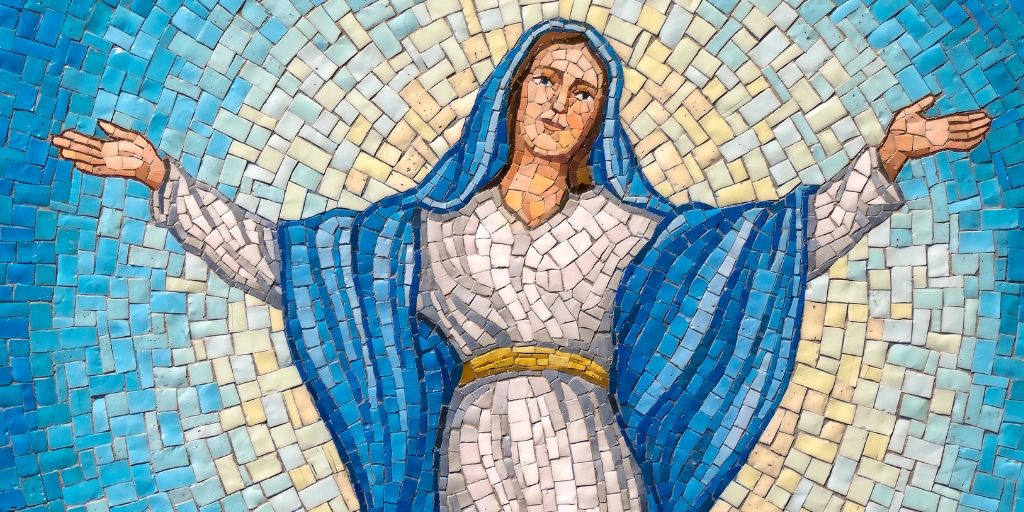
    Today we celebrate the solemnity of the Assumption of our Blessed Virgin Mary. Today the whole church gives importance to the entry of the BVM into heaven at the end of her life on earth. We recognize that through her assumption, Mary is the forerunner and archetype of our faith journey in life. Salvation begun when Mary took responsibility for God’s word into our lives. Human life is now pregnant with God’s salvation, as Mary collaborated and journey with God’s will for humanity. As Mary’s faith in God assured her of eternal life, we now also assured that at the end of our life-journey, with God there is the promise of life hereafter & eternal.

    The assumption of our Blessed Virgin Mary simply reminds us that there is life after death & there is life before death as well, whenever like Mary, we consent & participate in God’s will of salvation for us. Our life now & hereafter is pregnant with God’s salvation…And that is how Blessed are we, and how joyful & grateful we should be.

    With Mary, in this Eucharist, we praise the Almighty God for He has done great things for us. Holy is His Name. May we always be blessed in Life same way as Mary has been blessed now and forever. Amen.

  • FILIPINO CHRISTIAN FOODIE

    FILIPINO CHRISTIAN FOODIE

    August 8, 2021 – 19th Sunday in Ordinary Time

    Click here for the readings (https://bible.usccb.org/bible/readings/080821.cfm)

    We Filipinos love to eat. Western people could not understand that why we Filipinos (usually with such small stature/build) love to eat. It is said that we eat at least seven times a day. With the usual breakfast, lunch, and dinner, we also have snacks, merienda, timo-timo before dinner, and midnight snacks. This is because eating for us is not only about food but also about sharing. Meaning, we eat not only for the sake of the food-intake but also for the companionship, togetherness, fellowship, relationship, and community it brings.

    We gain a lot of wisdom about life from our eating activities. For instance, we hear people saying: “You are what you eat”. This does not mean literally – that if you eat pork, you are a pig; or if you eat vegetables, you are vegetable. No, it simply means that our food-intakes influence and affect not only our blood chemistry and physical health, but also our lifestyle. Meaning, what we eat mirrors our lifestyle and our lifestyle is revealed in our diet. So, healthy people most likely eat healthy food; sick people are most likely lived with poor diet. In the same way, diabetic, arthritic, or hypertensive must follow low-sugar, low-salt, or low cholesterol diet and eat healthy food; otherwise, they remain diabetic, arthritic or hypertensive with consequent complications. So, there is some wisdom in the saying: “Be careful of what you eat, because you are what you eat.”

    In our gospel today, Jesus says: “I am the living bread that came down from heaven; whoever eats this bread will live forever. Here Jesus clearly proclaims and reveals Himself as the Bread of Life – thus, he is the very bread or manna from heaven that nourished and sustained the Israelites during their exodus in the desert, as well as the very angel that took care and restored the physical and moral strength of Elijah in the time of his persecution.

    For the Jews, the word: Bread of Life is very important to their Jewish faith because it signifies the manna from heaven – the very food that maintains, sustains, and nourishes them during exodus and times of persecution. It also represents Yahweh’s direct interventions and mediations in their lives. Meaning, the Bread of Life is the whole dynamic between the food, the giver of the food, and the giving of the food.

    Photo from https://www.atlantaeats.com/blog/fantastic-filipino-food-around-atlanta/

    Based from their faith in the Bread of life, Jesus before them claims himself and proclaims that HE is the bread of life. This means that He, Jesus is now the whole dynamic of God’s salvation for humanity. Thus, He is our food – the manna from heaven; also our giver of the food; and God’s giving of the food. He is the Way – savior; Truth – salvation; Life – dynamic sharing of God’s salvation. He is our Gift, Giver, and the Giving-sharing of Salvation.

    Moreover, as he proclaims that He is the Bread of Life, he also offers Himself to them and to us now: Take this bread and eat “for whoever eats this bread will live forever.” As bread of life, Jesus wants us to take Him, i.e. to receive, accept and believe in Him for in Him we inherit eternal life. At the same time, he wants us to eat Him, i.e. to assimilate and integrate Him in communion into our lives. If in eating, we are what we eat, in salvation, we become in and with Jesus Christ when we integrate and commune with Him. In others words, we are Christian because we together at the Lord’s Eucharist, receive & eat (take on) Jesus always, as our bread of Life into our very lives now.

    By believing in Jesus as the Giver of the salvation, as well as by integrating Him as the Gift of salvation, and by us taking part in the Giving of the salvation – by the agape, (taking, sharing, and eating) of the Bread of Life, Jesus brings and grants us eternal life, now & always.

    Lord, pandemic times have rendered us hungry and deprived of our Eucharistic food. Lockdowns, isolations & quarantine limit our movements and participation in the celebration of the Holy Eucharist. Not only for our daily food nourishment, we are also hungry nowadays for our spiritual food & nourishments. May our hunger now for You, as our bread of life, inspire us to value, long and hope for your ever-present offer of eternal life for us.

    So Help us, God. So May it be. Amen.

  • Enough

    Enough

    August 1, 2021 – 18th Sunday in Ordinary Time

    Click here for the readings (https://bible.usccb.org/bible/readings/080121.cfm)

    It could happen that once in a while some wayward beggars would come to us & ask for some “bahaw” or left-over food to eat. Once I gave some enough food for a day to a beggar. As he received the food, he asked: “Walay kape ug saging man lang?” (How about some coffee & fruits for extra?). Though this irritated me, it also made me think: “If I’m going to give, why not give all – the full package deal with all the extras? Why only give enough for the day? Why not for the whole week?

    But as we all know, human as we are, we are not easily contented. Hard for us to be fully satisfied. We want more. We need more than we already have. Like that wayward beggar, we want some extra: extra rice, sauce, toppings, privileges, discount, bonus, payment and others, but effortless & easily, if possible, quickly. So, when is the limited resources that I have now, enough for me? When is the less that I have, enough for me to share with others who are in need? So, when is enough is enough?

    Somehow at the very heart of our readings today is the question about ENOUGH.

    In Exodus, we hear that after escaping slavery from Egypt, the people of Israel found themselves free but hungry in the desert. They needed food for the journey & they grumbly complained about their predicament. To the point of blaming Moses &  even preferring to be slave again in Egypt but nourished, rather than free but starving in the wilderness. Yahweh heard their cries & addressed their needs. God rained down bread from heaven for them, and they only have to gather enough bread for their daily portion.  Great! But they also asked: “What’s this?”. And perhaps may also have asked: “only this, fine flakes?” It might be from heaven, but why only biscuits/flakes? Why not pizza or burger? No extra drinks? And why gather only enough for the day? Why not save & reserve for tomorrow?

    In the same way in our gospel today, after they were fed and have their fill at the multiplication of loaves, the people followed Jesus because they want more. They never had enough. They need more extra from Jesus. In their mind, they would think: “Since you, Jesus have already fed us, what more can You offer us? What shall we do to have what You can give us? Do we need to work for food?

    Over and beyond our human need for survival & God’s saving act is the question of our Faith and Trust in God. The manna from heaven and the miracle of feeding thousands of people is not about the Gift, but about our faith in the Giver. What matter most then is not having enough or more than enough Food and blessings to receive, but more so about us believing & trusting in God’s way of taking care of us. It is all about having enough faith & trust in God’s work of giving us life to its fullness.   

    Through the manna from heaven, Yahweh gave the people enough manna provision for the day – not  pizza for the whole week, because as Yahweh said, “I will test them, to see whether they follow my instructions or not”. The graces before us now then is a test in our faith with God rather than rescue operation to satisfy our immediate & urgent needs. In the same way, there is more to the miracle of Jesus than just the feeding of the multitude. It is a challenge for the people-then & us-now, as Jesus said: to “BELIEVE in the one God sent”. In the same way as God sent manna from Heaven, God sent us His son, Jesus not just to satisfy our cravings, our needs & hunger for more, but more so to offer us fullness & meaningful life. Here, Jesus clearly proclaiming to us now: “I am the bread of life; whoever comes to me will never hunger, and whoever believes in me will never thirst.”

    Simply put: In life , Jesus is Enough for Us. He is all that we need in life, nothing more, nothing less. Only required of us now is to accept Him, as God-sent  bread of Life, and believe His life & witness as God’s work of salvation, is enough and more than enough for us, and for all.

    This is what St. Alphonsus de Liguori, the founder of the Redemptorists whom we also honor today believes. For St. Alphonsus, “With Him, there is fullness of redemption” – with Jesus, we got & have abundance grace & blessing. In other words, Jesus is enough & more than enough for us. And Jesus & all his offer of graces are given for all and not only for the few. All has a share in God’s blessing of Redemption – and this is what St. Alphonsus and we Redemptorists, & all of us Christian, believe & proclaim to all people in the world, most especially to the poor, neglected & most abandoned: Jesus, the bread of Life is enough for us & for all.

    When Jesus taught us to pray “Give us each day our daily bread”, he doesn’t want us just to express our needs, since the Father knows already what we need. But he wants us to express our faith in God that we believe and abide with whatever the Father wills for us. Thus, when all is said and done, it was not the manna that sustained the Israelites in the desert, it was not the bread and fishes in the Jesus’ time, it was not our daily bread that sustains us today. What sustained them and us today is our faith and trust in God.

    No matter how difficult life may be, for those who trust in God, and live a day at a time, rest assured, God’s blessing of manna from heaven falls everyday with Jesus always with us. Lord, our bread of life, Your Love & your grace is Enough for us. Continue to nourish & give us life especially now during these trying times of pandemic. Amen.

  • THE POWER OF LESS

    THE POWER OF LESS

    July 25, 2021 – 17th Sunday in Ordinary Time

    Click here for the readings (https://bible.usccb.org/bible/readings/072521.cfm)

    Our gospel today is surely something familiar and already known to us all. How could we miss one of the best stories of Jesus’ miracles ever told?  All four gospel evangelists (Matthew, Mark, Luke & John) have each own version of the story of this miracle. However one call this miracle-story – whether as “the multiplication of loaves & fishes”, or “the feeding of the multitude, these unique versions & diverse interpretations share the same plot.

    Basically it is about Jesus & His disciples with crowds of people gathered & now stranded in a far-distant mountain field, perhaps already during midday. Concerned about the people, Jesus ask his disciples for resources to tend & feed these multitude of people. With the less food-resources that they can collect & muster, Jesus instructed the disciples to organize people into small groups, took & blessed the less that they got, and have it broken & shared to the groups. People began to share what they got & have to each other, that in effect, had each other & one-another fed. And eventually made all filled & satisfied, and even able to garner twelve basketful of left-overs. Crisis-solved. Five thousand men (perhaps including or excluding women & children) were fed. A miracle happens. All are happy. Jesus saves the day.

    Perhaps there is more to the story than we may realize. Somehow the story have more lessons now to teach us than it has taught us before & always. Perhaps, we can learn here something about the Power of Less.

    What can Less do to All? What & how can the only Less we can have contribute for many (if not for all)? Ano at Paano ang magagawa ng kakaunti para sa karamihan at kalahatan? We may have something, but how it can help all? Like the man in our first reading, we also raised the practical question: “How can I set this (20 barley loaves & fresh grain) set up for a hundred people?” And somehow like the disciples, common sense tells us that “200 days’ wages worth of food is not enough for each of them to have a little.” And somehow in our pandemic times, we ponder: What & how can my little inconveniences (like wearing mask, face shield, quarantine, social distancing, or vaccine) can contribute in healing our infected & life-threatening world?

    Somehow our condition and reality of LESS may bring us to these realizations.

    First, with less resources, we come to grip with our vulnerability. Suddenly, we come to experience how poor, fragile, limited, dependent & needy we are & we can  be. When we get what we want & have what we need – Fast, easy, accessible, instant & convenient life gives  us an illusion of power, independence & invulnerability in life. But when resources are scarce & abilities are limited, we are humbled to realize our own poverty & neediness.

    With such humility, second, we begin to be thankful & to make the best of what we already have. We become “madiskarte sa buhay”. We learn to cope & live with what less resources we have. We get to know what is enough from what is too much. We know now what is essential & important things in life as well as what we can live & do without. In other words, with less, we become resilient as well as resourceful.

    Third, with less, we are moved to feel with & feel for one another. As we become conscious of our own poverty & our little resources, we come to empathize & sympathize with one another, and we try to help & contribute what little we have with others. In our gospel, Jesus did not only make a miracle of feeding the people. He also makes an example & witness of sharing the little we have with others. What meant to be a relief operation of feeding the people, now turned-out to be an agape, salu-salo because what they have received & got is also shared with others & one another. Less makes us kind & compassionate with one another.

    And yet still, fourth, less makes us rely on the help of others & trust in God’s mercy. In our poverty & humility, we come to realize that without God, we can do nothing. On our own we cannot live. We need God & each other to be & live in a much better & meaningful life.

    LESS can be powerful. It can humbly render us poor, bring us to resiliency & resourcefulness, make us kind & compassionate to share with others, and above all, impels us to rely & trust in God and one another. Though not much, LESS can make a BIG DIFFERENCE in life.

    Perhaps some of us are familiar with the 2007 comedy movie entitled: “Evan Almighty”. It is about a TV-anchorman turned politician Evan Baxter, not unlike Noah, inspired by God, built a big ARK to fulfill his promise campaign to change the world. The story-line evolved around how spectacular & comedic it is to literally build an ark in these modern times in order to change & save our world. Perhaps a primitive & crazy solution for our complicated world. At the end, Evan’s ARK may have saved his city (animals & people) from landslide & flooding. But he realized that what God meant for Evan to build an Ark is not literally a big physical structure of an ark, but as an acronym A.R.K., which means Acts of Random Kindness.

    ARK can change the world. Our little Acts of Random Kindness can make a Big difference. Less can change our world for the better.  With LESS, God can be & we can be.

    Take, Lord, the little resources we have. Bless & share these to others, as we are also needy of their help & of our Father’s mercy. Let these be our small contribution & acts of random kindness that we may have a share of our agape in God’s kingdom now & always.

    So Help us God, So may it Be. Amen.