Lately, we could say we suffered great losses during these pandemic times. Somehow almost all of us have lost in one way or the other, someone or something significant in life. And usually, our experience of great loss could dishearten, discourage & even disorient us in life. Losing someone & something significant in life could somehow cause us to lose our heart and our way in life.
Mary Magdalene must have also felt the same way when she lost her beloved Lord Jesus in her life. Somehow when Jesus died on the cross, Mary Magdalene lost also her heart and her way to a point where she did not & cannot anymore recognize the presence of the risen Lord with her.
However, in our great loss & suffering, Mary Magdalene could also teach us how to experience resurrection in our lives. Amidst her suffering & loss, eventually Mary Magdalene also have witnessed & experienced anew the calling, presence, & challenge of our risen Lord with her. By allowing herself to weep & grieve over her losses, and persevering in love in times of losing her heart & way, Mary have experienced anew the voice, the heart & the way of the risen Lord. In the same way, in times of great loss & suffering, like Mary Magdalene, we may also witness anew the presence & life of resurrection with the risen Lord by not denying, but allowing our grieving over our losses while persevering in our faith & love with our Lord.
Remember Mary Magdalene renewed her heart, her ways & her faith, because she witnessed Lord’ resurrection & the presence of the risen Lord anew, as she allowed herself to weep & grieve over her losses and persevere & keep her love & faith in Jesus Christ. In effect, Mary Magdalene became not only the “Apostle of the Apostles” but also the first witness, sharer & proclaimer of the Lord’s resurrection & the presence of our risen Lord in our midst today.
So also, whatever we are grieving over these days caused by the losses & sufferings of pandemic times, like Mary Magdalene, let us be open with our persevering love & faith to go through our weeping & grieving, as so make us recognize & witness what better life has our risen Lord in store for our life ahead.
Once, a mother approached and asked me for advice regarding her growing children. She was so worried about her children who according to her becoming irresponsible. One comes home late at night without any permission. Her teenage daughter doesn’t anymore go to mass with them, but spend more time with her non-Christian boyfriend. One likes to go out often, as if not anymore living with them. She even suspects that her son is involved now with drugs and drinks. All her children now know how to answer back and not so serious with their studies. In her frustration, she asked me “Father, what have I done wrong? We do everything for them to have a better life. My husband and I work seriously to provide them good nourishment, education, and lifestyle. But how come it happened this way?”
As for my advice, I told her: “yes, it is true, Maam that it is hard to parent growing children. A number of families nowadays are into such difficulty. But may I ask you, do you have common activities as family?” She was so confused with the question, so I asked her: “Do you have meals, pray, and recreation together as family?” She replied, “That’s impossible for us because we are busy with our work. Our children also have their own different schedules and friends that is why usually we cannot be together during meals, prayers, or activities.” Then I told her, “Maam maybe that is what is missing in your family life. You don’t give time to one another. You become so busy with your own individual activities in serving one another that you forget to whom and why are you serving. You have wasted the time and opportunity to intimately experience and know one another as family.”
If we reflect deeply in our lives today, it could happen that we become so pre-occupied with our concerns FOR our family, that we don’t have anymore time WITH one another. Yes, it is true that whatever we do is for God and others, especially for our family. But it could happen that we hide ourselves with our work and activities, so that our relationship becomes cold and shallow. It could happen, like that mother, because of our own individual concerns and responsibilities in life, our relationships with others becomes cold and shallow, no more bonding and love for one another.
Just like in our gospel today. Martha and Mary must have felt great joy and privilege when Jesus paid them a home-visit. Martha was right to do what should be done – to do things right in order to welcome and accommodate their honored guest. However, because of her great worry and concern to do things right for Jesus, Martha missed the right thing to do before the Lord’s presence, which is to be with Jesus: to listen to the Good News the Lord is intending to share with them in his visit, and to have a quality and common time with them. Meaning, beyond their hospitality, Jesus expects from them an opportunity for friendship and bonding with them. He needs more than just their humble service and hospitality but to enjoy and celebrate their love and friendship with Jesus. Thus, Jesus rebuked Martha when she complained about Mary, to remind her that what matters is not her lack or excess of service, or her responsibility or Mary’s irresponsibility, but such humble service and responsibility to Him should be born out of their intimate relationship with Jesus and with one another.
As Christians, in the same way, our humble service to others, our responsibility to one another must grow out of our faith relationship in Jesus, not of our human endeavors. Our salvation then is primarily God’s grace or gift to us that doesn’t only require our response of humble service, but more so gives us the opportunity to experience, unite and be intimate and one with God and one another. Yes, to follow Christ is indeed a responsibility. But responsibilities are built out of and based on our relationships. What matters in life, then are our relationships with God and one another over & above than our responsibilities to each other. And doing the right thing in our relationship is more noble and important than doing things right responsibly.
In every relationship there is corresponding responsibilities. But fulfilled responsibilities are meaningless if and when it is not grounded on our quality and intimate relationship.
Perhaps, we ask ourselves: “if and when God pay you a home visit, what would you do? How would you respond? Will you be listening to Him and of His agenda for His visit? Or will you be busy or occupied with responsibilities to do things right than to do the right things with Him?
Perhaps our life amidst Covid Pandemic nowadays challenge us to improve the Quality of our family, social & faith life as we cope & do our part in rebuilding of our lives during these trying times.
Brothers and sisters, as we follow Jesus in our lives anew, like Mary, may we build up & strengthen our common relationships with Him and one another by spending quality time to listen, experience and grow intimately with one another, as Filipino Christian family, nation, & church. So May it Be. Amen.
Once a man happened to fell on a rather deep manhole. He really had a hard time to escape from his difficult situation. So he called for help. It happened that a lawyer passed by, so the man shouted out: ‘Help’. The lawyer replied: ‘Sorry I cannot help you now. I’m on a hurry for a court hearing. Here is my calling card. Call me later and we will sue the company who dug this pit – Pro bono/ for free.’ And so the lawyer took off. Then a doctor came by, but said, ‘Hey, I cannot help you now since I have a scheduled operation. Here are some prescriptions for your bruises. I will call for help. Surely I will help you at the hospital.’ And then the doctor left. A priest also came and said, ‘Sorry, so, I cannot help you right now. My mass is about to start. Here is a rosary, pray till the rescue arrived. We will pray for you also.’ And the priest rushed off.
Now, the man got a lawyer’s calling card, a doctor’s prescription and a priest’s rosary, but still trapped in a manhole. Eventually his poor neighbor came, and right then and then, jumped into the pit. The man said to his neighbor, ‘How stupid you are. Now both of us are trapped in this pit’. Then replied the poor neighbor, ‘Yes, but I know a way out.’
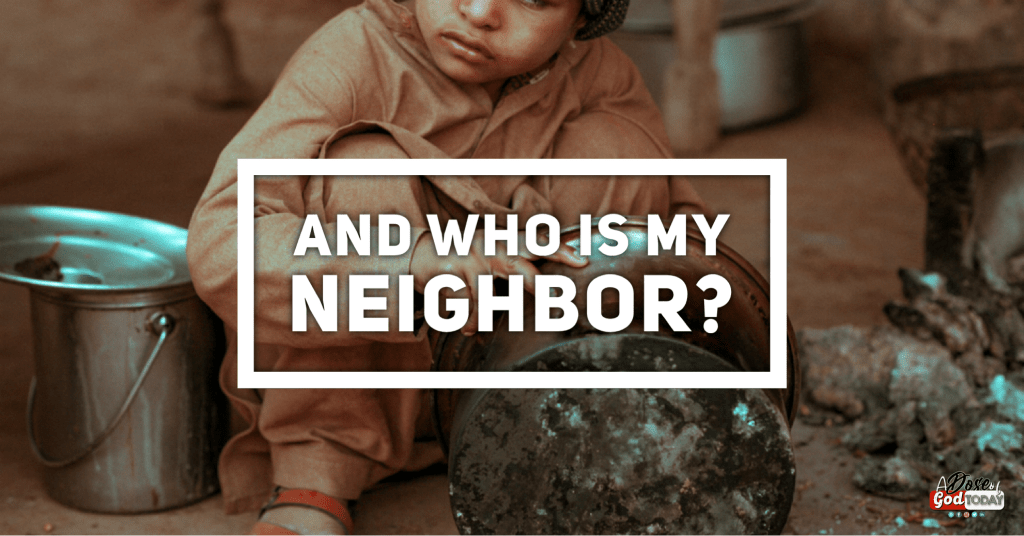
Once again we hear the Lord’s commandment to Love the Lord our God and our neighbor as we love ourselves. However, based on our experience, this commandment to Love… are nice words to hear but hard to follow, especially on loving our neighbor as ourselves.
That is why, not satisfied knowing the commandment the teacher of the law raised the question: ‘And who is my neighbor?’ Like him, we know the commandment to love but we also like to know who is our neighbor worthy of our love.
In response to this question, Jesus told us the parable of the Good Samaritan. For Jesus, the neighbor who is worthy of our love is our immediate neighbor. The very person we are with – in the here and now, is the very neighbors in your midst who we should love. We don’t need for someone absent and far to be our neighbor to love. But the very persons before and with us now, who need our help and love is our very neighbor we ought to love.
To help and love our neighbor, then, we don’t need to look for them somewhere. Just be aware and conscientious of the people around with you in the here and now, and respond lovingly as you can.
Once in our Redemptorist parish in Dumaguete, we had a program where we give Christmas gifts to poor parishioners. What makes this program unique is that we arranged the gift-giving wherein the donors themselves go and visit the home of the poor beneficiaries nearby, and give their gifts. A donor once told me: ‘Many Thanks, Father! It is only now I become fully aware of the poverty of our neighbors nearby, especially of Nong Berto’s family who used to drive me to school when I was a little girl.’ Our neighbors worthy of our love are the very people amongst us nearby we immediately see, smell, feel and hear.
Through the parable, Jesus also teaches us the proper way to help our neighbor: Before we try to help others, we should immerse and be in solidarity with their difficult situation. In helping others, dole-outs, give-aways, and reaching-outs are not enough. We need to dive in, get wet or dirty along the way, and journey with them, to free one another from the situation.
The Samaritan is good because he fully involved himself in helping the needy. He knew the best way to respond because perhaps he was also once needy and in such worse situation himself. Like, the poor neighbor of our story can help the man because he may have been in the same situation before, but he knows a way out. Others (lawyer, doctor, priest or levites) cannot and was not able to help because they don’t want to be involved and they cannot sympathize because they were not in that situation before, and don’t know a way out. In other words, only swimmers can rescue a drowning person. So, love your immediate neighbor in your midst as lovingly as you can.
The Lord in our first reading however reminds us that: This command is not too mysterious and remote for you, not up in the sky nor across the sea. It is something near to you, already in your mouths, and in your hearts : you have only to carry it out.’ Meaning, we CAN love the Lord and our neighbor as ourselves because we are also loved by the Lord and our neighbor as ourselves. We can love because we are loved by God and others. We can help and take care of our neighbor because we are also helped and taken care of by God and neighbor. We can rescue and save others because we are rescued and saved by God and others.
For us to inherit eternal life, God directs us to do what needs to be done: “Love your God and your neighbor as you love yourself.” So, let us do our part in Loving Him and our Neighbor, as He and our neighbor loved us since before, until now & may always be as ourselves. So Be it. Siya Nawa. Kabay pa. Amen.
Here in our gospel today, Jesus summoned his disciples, gave them authority to heal every disease and sickness. He made his disciples share his authority and mission to preach the good news of salvation to all. He commissioned them and gave them the tasks to be preachers and evangelizers of God’s kingdom. Jesus added however that they should start, not elsewhere, but at home.
Since then and until now, as followers of Christ, we share the same authority and commission with the disciples to preach and witness the reign of God’s kingdom to all in our world today. And in the same way, we are to begin in our own homes, families, and communities.
In doing our tasks and mission as evangelizers and preachers of God’s kingdom, there is always a tendency or even a temptation for us to blame the evil in the world on others, and to reach out for our poor brothers and sisters in need who are far-away from us. But as Jesus would insist, we start to live our faith and practice what we preach in our own homes, in our own neighbors and communities. In other word. Charity begins at home.
For who are our neighbors? Our neighbor is the immediate person we live with, who needs our immediate attention and care. We don’t have to go out to help others; we start with our kasambahay, kapamilya. We start to correct and clean the evils and sinfulness in our homes before we deal with our world outside. Remember it was only later, during Jesus’ ascension that the disciples where sent to all the nations of the world. Start locally and then globally. Begin in your own homes nearby and then, into the world.
Being called & sent to be His missionaries today, with Our Mother of Perpetual Help, let this be our prayer : “Lord, grant me the grace to be what You want me to be, and to do what You want me to do, not there & later, but here & now at this very moment.” Amen.
Exercising authority in our community gives us the opportunity and capacity to serve others. This is how we understand it in a Christian perspective. This means that when we have authority over other people, this does not give us the right to belittle or put people down just because we have power over them.
Thus, in any community, organization or even in our workplaces, when we are given authority, it is rather meant to give us the ability in empowering others and facilitating others to be more productive, growing and maturing.
The giving of authority is what we have also heard in today’s Gospel. Jesus gave authority to his Twelve disciples. This authority has two functions. First, to drive out unclean spirits that terrifies and imprisons people. Second, to cure every disease and every illness of the people to whom they were sent. Through the authority given by Jesus to the Twelve disciples, the Lord gave them the opportunity and capacity to serve others by setting people free and bringing healing to the sick.
The Gospel tells us now that authority is a gift. It is given to us as an opportunity and giving us the capacity to serve others and not to serve ourselves or to serve those who are only close to us. Thus, exercising authority is a form of a loving-service. And we will know that it is a loving-service when in exercising authority it sets people free, inspires freedom, brings healing and creates a space for growth.
However, when authority is also used as a means to serve oneself by manipulating and overpowering others, then, authority discourages and oppresses people just like unclean spirits or demons would do. Moreover, in this case, authority will also be the cause of divisions, wounds and toxicity in our community or organization just like a disease or illness would bring suffering to a person.
Hence, Jesus calls us today that as we exercise authority in our own context and life-situations whether at home, at work or in our communities and organizations, we may always be able to inspire freedom, to allow others to be free and be agents of healing and growth. Kabay pa.







 A DOSE OF GOD TODAY