Category: Fr. Mario Masangcay, CSsR

  • GIFTED

    GIFTED

    May 28, 2023 – Pentecost Sunday

    Click here for the readings (https://bible.usccb.org/bible/readings/052823-Day.cfm)

    We do know how it feels to receive a gift from someone special. Receiving a simple token of gift and/or few words of call or posts from someone special could really make our day and even help us get through the day. Because we know behind each gift-received is not only the given-gift but also the giver of the gift, and the act of giving itself. Meaning, significant in receiving gift is more than just what we received but also the one who gave it and how it was given. (Gift-Giver-Giving) We really appreciate then even just the simple thought and action of gift-giving from someone special in our life. Such gift-receiving given by someone special could surely offer us inspiration, love and faith in our day to day life.

    For these coming three Sundays we will come to appreciate and value the Gifts of the Risen Lord to us now His disciples. Today, the Gift of the Holy Spirit, next Sunday is the gift of the Most Holy Trinity, and the Sunday after next is the gift of the His Body and Blood. These are His special gifts to us and inheritances for us to live through and persevere with our faith-life journey in our day to day lives as His witnesses to the world. Remember Jesus said: “I am the Way, the Truth and the Life”. The gift of Holy Trinity as our Way, the gift of the Holy Spirit as our Truth, & the gift of the Body and Blood is our Life.

    In the gospel today, we hear Jesus saying: “Receive the Holy Spirit”. Church tradition has it that fifty days after His resurrection (ten day after His ascension), on the day of Pentecost, the disciples received the promised gift of Holy Spirit to the church, and inspired them to speak in different languages to proclaim the Good News of God’s salvation. Through the gift of the Holy Spirit, people from different cultures then and until now are able to speak, hear and understand each other’s faith in their own native tongues. Because of such experience, today marks the birthday of the Church – the day of birth, the day when the church becomes alive. The gift of the Holy Spirit is thus very essential in the life of the Church. Like a soul to a body, the church is dead without the movements of the spirit, as well as the spirit cannot inspire our faith-life without the church. We, the church needs the Holy Spirit to live as well as the Holy Spirit needs our Church to offer us salvation, meaning and direction in life.

    As we celebrate today Pentecost Sunday, the day when Lord has given us His gift of Holy Spirit & the birthday of our Church, we might ponder as well on the meaning of the Lord’s offer and gift of Holy Spirit into our lives now. In other words, what does it mean for us today to receive & live with His Holy Spirit?
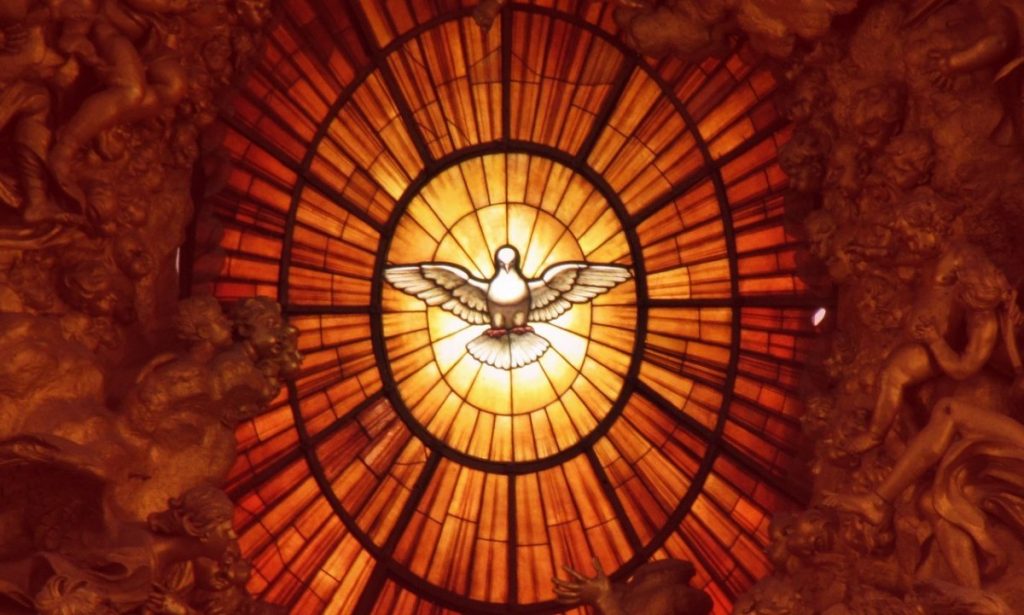
    Receiving the Holy Spirit, first of all, is to be IN the Spirit of Jesus, for through the Holy Spirit we acquire the Lord’s inspiration and we are now In the God’s mind. In the Holy Spirit, we are also motivated by the Lord – mindful and inspired (i.e. In-spirit) to believe and follow Him in our lives today. Blessed are we then for through the Holy Spirit, we are one in His Spirit. Sa DIWA, tayo ay nasa kanya at Siya ay nasa atin. Sa diwa, kita Iya, ug ato Siya.

    Receiving the Holy Spirit is also to be WITH the Spirit of Jesus for through the Holy Spirit we enjoy the Lord’s love and we are now in the God’s heart. With Holy Spirit, we come to know love and to be in love, for He loves us in our lives. Beloved are we then for through the Holy Spirit, we are one in His Heart. Sa PUSO, tayo ay Kanyang kasama at siya ay kasama atin. Sa kasingkasing, kita Iyang kauban, ug ato Siyang kauban.

    Receiving the Holy Spirit is to be FOR the Spirit of Jesus too, for through the Holy Spirit we partake in the Lord’s mission, and we are now in the God’s will and way. For the Holy Spirit, we come to be steadfast and faithful in our missions in life, for He appointed and sent us to be His witnesses in the world. Encouraged are we then for through the Holy Spirit, we are one in His Will. Sa KALOOBAN, tayo ay para kanya at siya ay para atin.  Sa Kinaiya, kita alang Niya ug Siya alang nato.

    Like receiving a gift from special someone, receiving the gift of the HS offers us inspiration, love and faith in our daily lives. Blessed, Beloved and Encouraged are we then to receive the Holy Spirit – as our Advocate in our lives, for through the HS, we are in one Spirit, Heart and Will of the Lord. Kaisa sa Diwa, Puso at Kalooban ng Panginoon. Usa sa diwa, kasingkasing ug kinaiya sa atong Ginoo.

    Our liturgy today reminds us that the Lord has already given and offered, as well as, will continually give and offer us His gift of Holy Spirit. The challenge for us now is to invite & receive the Holy Spirit into our daily lives these days. Same as way as Easter season calls us to invite the risen Lord to “Come and Stay with us”, Pentecost challenges us to Invite and Be a Host to the Holy Spirit in our daily ordinary lives, and allow the Holy Spirit to bless, love and encourage us and in effect, Recreate, Renew and Recharge us always.

    As people of Lord’s resurrection and of the Holy Spirit, we now invoke and invite the Holy Spirit into our lives as we pray:

    Come Holy Spirit, fill the hearts of your faithful and Enkindle in us the fire of your love. Send forth your spirit and we shall be created. And You shall renew the face of the earth. Amen.

  • LDR – Long-Distance Relationships

    LDR – Long-Distance Relationships

    May 21, 2023 – Solemnity of the Ascension of the Lord

    Click here for the readings (https://bible.usccb.org/bible/readings/052123-Ascension.cfm)

    For those who are into (LDR) Long-Distance relationships, especially with migrants who have lived and worked abroad away from our families and loved ones, separation and homesickness have been a constant struggle in their daily lives. Experiences of separation and homesickness are indeed never been easy to deal and content with in our journey through life. Difficult it may be, but we also know that our day to day wrestling with separation and homesickness could also provide us opportunities for growth in meaning and values in life. Because at times, in our separation and homesickness, we may become more in touch and conscious of who are most important people in our own life, and what, why and how are they valuable in one’s life. Separation and homesickness could be a chance for us to discover, claim and commit once again to what is important and essential in our own lives.

    At times in life, like “one cannot see the forest for the trees” we need then to detach, separate and be distant from our attachments in order to see and discover once again for ourselves the values, principles and meanings that are most dear to us now and in effect inspire us to move on forward with life. As Henri Nouwen would say: “What is most close, most intimate, most present often cannot be experienced directly but only with a certain distance.” In other words, separation and homesickness can move us to be more appreciative, responsible and hopeful in life. Thus, “Absence makes the heart grows fonder”. Ang mawalay nakakabusog rin ng puso. Ang mabulag makatambok pud og kasingkasing. This can be the upside of life-separation and homesickness.

    However, the downside of separation and homesickness is “Out of sight, out of mind”. Ang mawalay nakakawala ng landas at nakakasira ng ulo rin. Ang mabulag makasaag ug makabuang pud. If you don’t see, you don’t mind, and you even don’t care. Separation and homesickness can also render us directionless, meaningless and hopeless in life.

    Crucial then in our experience of separation and homesickness is the once-again & always search, giving importance and making a promise to our values, meanings and missions in life.

    Today, we celebrate the 2nd Glorious Mystery, the Ascension of the Lord. Tradition has it that forty days after the risen Lord appearances before his disciples, the Lord has ascended back to Our Father, leaving behind and separated away from us His disciples. This would mean that separation and homesickness share in our life as well as in our faith, as part of our life-story and our salvation history as well. Like the experience of the two disciples in Emmaus where the Lord appeared to them and then disappeared when they recognized Him, Salvation also requires the Lord’s resurrection and departure (His coming and going into our own lives) – that part and parcel of our faith and life story is the paradox of homecoming and separation, of the hellos and goodbyes. And during moments of departure and distance, separation and homesickness – though with a downside of pain, anguish & of losing direction, could also be the upside and opportunity to discover and claim once again what is importance and valuable in our life as well as what is our mission in life now, that is, our life-values and life-missions.

    Our readings remind us that in the Lord’s ascension, the Lord empowered and gave his disciples the task and mission to be His witnesses in the world, saying “Go, therefore, and make disciples of all nations, baptizing and teaching them” with the assurance “I am with you always forever.” This explains why the Lord’s ascension is more than just about the Lord’s departure, separation and disappearances but more so about once again and anew finding, claiming, committing and fulfilling our life-missions.

    We pray then, that like the two disciples of Emmaus, may our usual departure and distance from our loved ones and the usual Lord’s departure and distance from us, move and inspire us to go on discovering and upholding our values, principles, and meanings in life, as well as fondly reclaim and actively fulfill our hopes and missions in life. Amen. 

  • Grow Up In Love

    Grow Up In Love

    May 14, 2023 – Sixth Sunday of Easter

    Click here for the readings (https://bible.usccb.org/bible/readings/051423.cfm)

    “They said if you love someone, you set them free. If they come back again, till the end, you are meant to be.”

    Does it ring a bell? Sounds familiar? That is a line from a popular song sung by Barbara Streisand and Barry Manilow called “Some good things never last.” Such line tells us more about love. It is also telling us about growing up in life.

    Because we all know, big part of life is GROWING UP. We ourselves grow up – hopefully. And we help others to grow up as well. And we have surely seen how we and others have grown up all these years. Growing up is about really helping oneself and others to help us and them grow up in maturity.

    And the commandment of Jesus to love one another has a lot of things to do with growing up. Same as helping others grow is love, to love also means to help oneself and others to grow up in life. Loving would entail giving oneself and each other a chance to GROW, i.e. to allow each other to stand in one’s feet, and be responsible for one’s own and other’s growth.

    Loving yourself means not only pampering yourself but letting go of your securities and giving yourself a chance to grow. Loving others would also mean trusting others enough to be on their own so that they can make a stand for their lives. That’s why, in loving others, set fee – let go, let be & let grow.

    This is very true in a Parent – Child relationship. Because and out of their love for their children, a parent must learn how to stand back, (not to abandon or reject them) but in order to help and give the children a chance – an opportunity to stand on their own and be responsible for their own life-growth. Just like, a child cannot stand in his own two feet and walk, if & when the parent does not allow the child to stand up and walk.

    Experiences of standing back, letting go, saying goodbye, setting free have never been an easy part of growing up as well as loving others. Imagine how hard it was for you and your parent when you had your first step, your first day in school, your first jeepney ride on your own, your first camping, your first date, your first boyfriend/girlfriend, your first job, your wedding day, as well as your first child. But we all know that we must be given a chance and to go through those experiences in order for us to grow up and learn how to live life and love life, because we know deep inside that loving is not about falling in love but growing up in love. We love not because we fall in love, but because we grow in love.

    This is what Jesus is trying to teach us in our gospel today. As his paalam, panamilit, last farewell, mi ultimo adios to his apostles, Jesus is trying to tell them that because of his love for them, he should leave them behind, not to forsake them, but to give them a chance to grow in His love – to practice the love he has taught them and to experience for themselves the Father’s love he had preached them. In other words, as he goes back to the Father, Jesus has given them then & us now the opportunity to grow in our faith, and to witness and share that faith to others, just like what happened to the apostles in our first reading. Out of love and in order for us to grow in that love, Jesus – as parent, guide, leader, good shepherd, true vine Himself has to step back, let go, say goodbye, set us free to love God for ourselves and help others love God for themselves.

    It is just like Jesus is saying his farewell panamilit to us now, “Guys, I have already taught you, guided you what to do. I have already done my part. Now is your time to do your part. Just carry out what I have told and taught you: Love God with all your heart and love one another as yourself, same as I have loved you. By the way, don’t worry. I will never abandon you. I will be always with you in the Holy Spirit.”

    Allowing the risen Lord to be part of our daily lives has always been an invitation and challenge of Easter for us. It is both a call and a dare to leave behind to our comfort zones and say goodbye to our usual normal ways, to detach and set ourselves from our attachments, and to engage into an exodus with the Lord towards growth in faith and life – in other words, to grow up in love.

    We pray then that as we grow to become responsible disciples for the Lord, may we also grow up responsibly in our faith and life, and in love for Him and others.

    So. May it be. Amen. 

  • Bahala Na

    Bahala Na

    May 7, 2023 – Fifth Sunday of Easter

    Click here for the readings (https://bible.usccb.org/bible/readings/050723.cfm)

    For us, Easter people to fully appreciate the meaning and benefit from the fruits of the mystery of the Lord’s resurrection, we must reflect and try to discover how the Lord has resurrected and can be resurrected in our daily ordinary lives now. Somehow someway during this Easter Season we ponder on the question: Sa unsang pamaagi nabanhaw ug mabanhaw ang Ginoong Dios sa akong kinabuhi karon? In what ways the risen Lord has & may be truly resurrected in our very lives at this very moment?

    As we have recently experienced during the pandemic times, we cannot deny that there are moments in our life that we experience crises and distress. Yes, we do have moments in life when everything seems to fall apart, gets very dark and uncertain, when we are down and at lost, when things get bad, when trouble, sickness, suffering and death strike, when we are left behind and find ourselves on our own, when things have no meaning and doesn’t make sense anymore. These are critical moments in our lives, where usually moments when we have nothing else but faith, have no one else but God, and can do nothing anything anymore but just to trust in God.

    We, Filipinos usually express this faith through the words: “Bahala na”. Usually in moments of crises in life, we articulate our faith in God and in Jesus by saying “bahala na.” Others have criticized such Filipino faith as our fatalistic or defeatist mentality. But for us Filipino, praying and saying, “Bahala na” is more than an expression of resignation to fate or “kapalaran” but articulations of our deep trust and faith in God in times of crisis in life. Because for us, “bahala na” means more than just “come what may” (o pawala nalang), but it is our way of saying, that when after we have already done our part, but things are not complete or finish yet, now “Bathala na” “sumadios nawa”, “gipaka-dios ko na”, “gitugyan ko na sa Ginoo”. “I now entrust to Him.” All now is in God’s.

    This has the same meaning with the word “Amen” “Kabay pa”. “Hinaut pa Unta”. So be it.” This is our expression of deep trust in God, saying, “after all I have done… with God, all will be well. So be it. Siya Nawa. Amen. Bahala na”.

    Here in our gospel today, we hear Jesus saying to his apostles, “do not let your hearts be troubled. You have faith in God, have faith also in me.” These are the farewell words – the ‘mi ultimo adius’ of Jesus to his apostles said during his despidida party – the Last Supper. After he had warned them of the crisis that lies ahead for Him and his disciples, Jesus have also felt the heartbrokenness his apostles must have felt of the coming loss and crisis. Here, at their crisis moment, Jesus consoles and directs his friends to trust in God and in Him – an invitation to: “Bahala na.” He said to them & to us now: “Don’t let your heart’s be troubled. Believe in God. Believe in me.”

    This is Jesus’ way of saying: “Don’t worry, Me & Our Father got this. Have faith in us. Entrust this to Us”. “Ayaw na kabalaka. Kami sa akong Amahan ang bahala. Salig lang kanamo. Isalig, ipasa-Ginoo, ipasa-bahala, ipasa-Dios na kanamo”.

    The same words of consolations and directions are being preached to us today. Jesus feels for us. He feels and knows the heartbreak we feel, and the difficulties we are in – in our every moment of our life-crises. He also invites us to always trust always in God and in Him. When he said “I am the Way, the Truth and Life”, he is also leading us that it is God and Him, not ourselves who will bring and deliver us to our salvation and eternal life. And only when we always follow and persevere in the Lord’s way, which is the way of the suffering and cross, as well as keep on trusting in God – “bahala na” not only during crisis moments of life, we eventually share and enjoy our life and salvation at Home with God, Our Father and Jesus.

    In other words, the Lord has and can be truly resurrected in our daily ordinary lives now, if and when we learn how to trust and have faith in Him, who is our Way, Truth and Life. Thus, by saying Bahala na, Amen to His Way, Truth and Life, and allowing His Way, Truth and Life in our ordinary lives, He has indeed risen and can be truly risen.

    In every moment of our ordinary lives then, as we do our part, we pray that we must always have faith and trust in God and in Jesus. For we know, without the way there is no going, without the truth there is no knowing, without the life there is no growing. Thus, we seek the way that we may go, the truth that we may know, and the life that we may grow eternally, only to discover and realize that Our Way, our Truth and Our Life is the Risen Lord himself in daily ordinary lives now.

    In other words, and simply said, our prayer is  Bahala na. Amen.

  • GOD-Struck

    GOD-Struck

    April 30, 2023 – Fourth Sunday of Easter

    Click here for the readings (https://bible.usccb.org/bible/readings/043023.cfm)

    During the time of the desert monks, around 450 AD, a young monk went to an old and holy monk and asked him, “Father, how is it that so many today leave the monastery? The old monk answered him, “When a good hunting dog sees a rabbit, he will immediately run after it, howling, and barking with excitement. This will, of course, attract other dogs, and they in turn will run and bark and howl like the one that saw the rabbit, although they have not actually seen it themselves. After a while the ones who did not really see the rabbit, but relied only on barking and howling of the first dog, will get tired and give up the chase, because they are no longer interested. They drift off and go home. Only the dog that really saw the rabbit will go on running and eventually catch up with it. That is the way with many who enter the seminary,” the old monk concluded. “Only the one who has his or her eyes on Christ and has seen Him will and can survive. The others, who came only because the enthusiasm of others had drawn them, will lose interest and leave.

    Once I had been involved with the formation of our seminarians as assistant Postulancy director in my years of priesthood. As of those who had been with me, only one out of nine in the first batch, one out of six in the 2nd batch, and three out of seven the last batch are still in the seminary. Meaning, only 5 out of 22 seminarians have persevered in their formation in the seminary. With this, we cannot help but think if there is hope in religious life or priesthood. Some would even blame us, their directors or formators for being too strict. I say, as the story suggests, it is not the Formators but the dynamic and intimate relationship between the seminarian and the Lord Jesus Christ. I believe growth and perseverance in vocation to priesthood or religious life must be based on the personal faith relationship of the person with the Lord Jesus Christ.

    Jesus in our gospel today claims himself as the Good Shepherd, who knows His sheep. He is a Good Shepherd who has a deep personal relationship with His sheep. He knows His sheep and His sheep knows Him. We, Christians proclaim that Jesus is our Good Shepherd not only because we believe that He is the Shepherd but He is OUR very OWN Shepherd. Our faith moves us to proclaim that Jesus is yours and ours Good Shepherd. He is not like any other shepherd but He is your personal shepherd, who knows and loves you. We believe in Jesus as our Good Shepherd, because we choose Him to be our own shepherd. 

    If Jesus is our Good Shepherd, and we are His sheep, what does it mean to be His sheep? There are three important things.

    First, to be His sheep is to believe in Him. The basic message of Easter is to have faith in the risen Christ. Like the hunting dog to the rabbit, we must believe in what we have encountered & witnessed Him, as Jesus reveals himself to us in our day to day life-experiences.

    Next, we must listen. Jesus said, “My sheep listens to my voice.”  We ought to be sensitive to hear and listen to His words in the Scriptures and in the movements of the Holy Spirit in our midst. Meaning, we should lead a life of prayer to nurture our faith.

    And lastly, to be His sheep is to follow Him. Jesus said, “My sheep follows me.” We must heed His voice, i.e. we must live what we believe and practice what we preach. We must be like the hunting dog that is persistent in its following and fulfilling what it believes.

    While our world today promotes the Star Struck motto: “Dream – Believe – Survive”. Jesus, our Good Shepherd calls us today to God Struck motto: Believe – Listen – Follow. If seminarians want to grow and persevere in their vocation, they must believe, listen, and follow their calling. And if as Christian, we want to grow and persevere in Faith, we must believe, listen, and follow Jesus our Good Shepherd.

    Particularly for us Filipino Catholic, we do have special or unique take in knowing our Good Shepherd. We know Him not only because Kilala natin siya but because Dama natin siya. Culturally sense-feeling perceptions are important to us. Like,… I may know you, but I may not feel you. I may feel you though I may not know you. (Kilala kita, pero di kita ramdam. Ramdam kita kahit di kita kilala). This is how we distinguish real from fake, depth from superficial, good from bad.

    Same way as we Filipinos have this natural felt-instinct & sense, we also come to be familiar with & know more the shepherd’s voice through our gut-sense and feelings. We do come to know the risen Lord as our true Good Shepherd in life not only by our volition, consent & reasonings, but most of all through our sense & feeling perception (damdamin at kalooban).

    By our sense-perception & feeling-gut insights, we come to know the risen Lord with us – in person & in flesh. Like the hunting dog who first sees the rabbit, knowing the Shepherd is thus not only for us a cognitive familiarity or herd-mentality but more so a deep felt-sense knowledge and insight of His presence, love & blessing.

    We pray then that during this Easter Season may be our moments to be God-Struck in believing, listening & following Jesus, and so enhance and improve our special felt-sense of knowing our True & Good Shepherd, & ensure that we may not be gone astray from His fold but rather have a much deeper relationship with Him, and be always attuned with His will & plan for us now, especially these new normal times. So Help Us, God. So May it Be. Amen.