Category: Fr. Jom Baring, CSsR

  • TO HOPE AND FIND SECURITY IN THE LORD

    TO HOPE AND FIND SECURITY IN THE LORD

    March 17, 2022 – Thursday of the Second Week of Lent

    Click here for the readings (https://bible.usccb.org/bible/readings/031722.cfm)

    In the first reading, Jeremiah highlights the choices put before each of us – either, to trust only in the goods of this created world OR to hope in the Lord, who is Creator and Provider of all good. A reminder for us in our Psalm.

    Where do we turn now for our inner security, peace, and forgiveness? Remember, the human heart can be devious. Despite our best intentions, self-interest would always immediately come first! Only God can give us a “new heart and new spirit”, cleanse our inner most intentions and being; changing our hardened and stony hearts with hearts of flesh. [Ez. 34:5].[1]

    This is something being elaborated to us in today’s Gospel. The rich man in the Gospel story enjoyed his life and trusted only the goods of this world while the poor Lazarus suffered very much outside his gate. However, there was a turn of events when both of them died. The rich man, who pretended not to see the poor situation of Lazarus ended in hell while Lazarus was carried by the angels.

    The Gospel reminds us that indeed, success and security in life is not about being what we have accumulated or about the material possession that we have amassed. We are only truly successful and secured when we have built lasting and true relationships with people around us and with God.

    Yet, the sin of the rich man was not by being materially rich but by becoming indifferent and blind to the suffering of people around him. He was blinded by his possessions and was not able to see and recognize that Lazarus was suffering. He did not even offer any help to the poor man. The rich man had no relationship whatsoever with Lazarus. He was only being possessed by his possessions. He hoped and trusted only his wealth and himself.

    This was how the rich man had grown ungrateful to God for the gifts he received in his lifetime. He was ungrateful because he felt entitled that only him should enjoy the richness in his life. He did not open his eyes and hands to give others a chance to live a better life through his help.

    Thus, when we become ungrateful we also take for granted the giver of gifts, and thus, the presence of God in our life. Jeremiah puts this in this way, “Cursed is the man who trusts in human beings, who seeks his strength in flesh, whose heart turns away from the LORD.”

    This happens to us as well when we remain ungrateful and refuse to recognize that everything we have is a gift. Be cursed to us, indeed, when we become ungrateful for we also become self-entitled, demanding in our relationships. Yet, stingy of our time and energy and ungenerous of our resources and presence to those who are asking for our help. And most of all, we become indifferent to people around us and indifferent to God, the source of true hope and security in our life.

    Thus, as Jeremiah reminds us, let us find security and assurance in God’s goodness and faithfulness. This is what it means to hope in the Lord that makes our heart grow and be filled with gratitude. Hinaut pa.


    [1] From the homily of Fr. Manoling Thomas, CSsR

  • TO BE A DISCIPLE IS TO BE A SERVANT

    TO BE A DISCIPLE IS TO BE A SERVANT

    March 16, 2022 – Wednesday Second Week of Lent

    Click here for the readings (https://bible.usccb.org/bible/readings/031622.cfm)

    There was a friend of mine who applied to a government agency for a job. Though, he had the best qualifications being a graduate with honors in college, being competent in his field and being creative, he could not secure the position that he was applying. There was something lacking in him. He had no “connection” inside that office. There was no one who could recommend him or somebody from the higher office who could be his “backer.”

    This is known as the “Padrino System” or patronage in our Filipino culture and politics. It is a value system where a person gains favor, or promotion, or political appointment through family affiliation (called as nepotism) or through friendship (called as cronyism), as opposed to one’s merit.[1]

    This kind of culture tells us that we use our relationships to advance or to secure a particular job or position in an office. Thus, people have to secure a good connection with those who are above so that they too shall be accepted or promoted. Such culture also can be very problematic since the basic qualification of the hiring or promotion is not according to the one’s merit, quality of work, capacity and potential of the person. With this kind of culture, the quality of work may be compromised and corruption and dishonesty would most likely happen.

    Well, such attitude was also heard in our Gospel reading today. we were told that the mother of James and John, who was believed to be Salome, was a sister of Mary, the Mother of Jesus. She expressed her desire for her two sons. She asked Jesus to make James and John sit at the side of Jesus when he becomes king. Being a close relative to Jesus, she used that relationship to secure what she wanted for her sons.

    As a mother, she was thinking of the future of her two sons and concerned of the honor that she will enjoy as mother to them. The brothers were surely not ignorant to this request from their mother. They must have liked this idea very much. However, this request had a selfish intention.

    This was of total self-centeredness. They wanted security for their future and wanted to be placed first among the rest of their group. They thought on what they can gain from Jesus and on what Jesus can give to them. They were only concerned about their personal promotion. This was the reason why the other 10 disciples were angry because of their unjust intention.

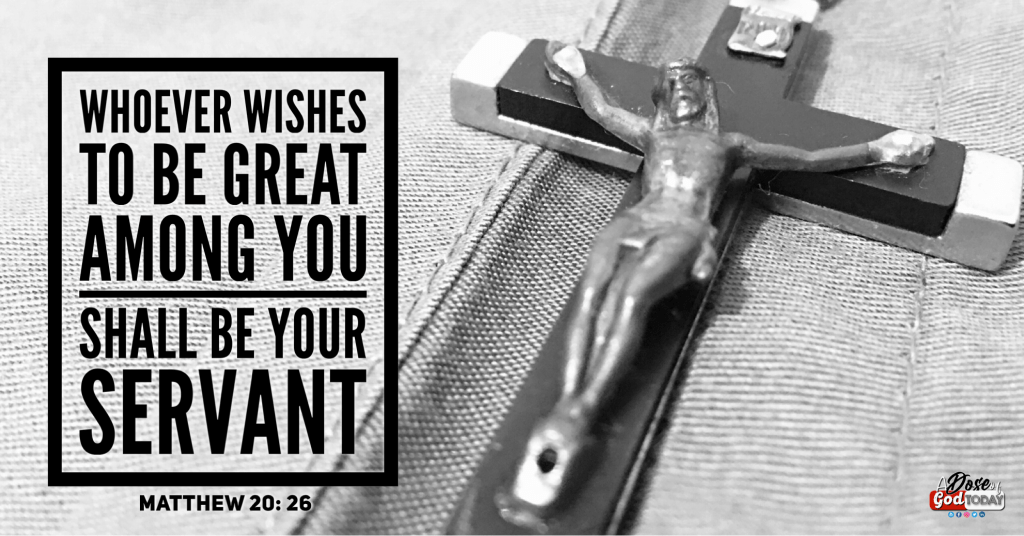
    However, this attitude of the two and their mother was criticized by Jesus because of its selfish and self-entitled mentality. Discipleship is not about to be served or to enjoy a privileged status or to be above others. It is neither about being able to enjoy riches, influence and power. Being a disciple of Jesus is not about self-promotion and self-entitlement. Therefore, by being a disciple we cannot demand “to have this and to have that” attitude as if we become the boss. But rather, to be a disciple is to be a servant of others, closely following the Lord in words and in deeds.

    Today, we are called to examine our motivations and intentions.

    We may ask ourselves, “Am I only concerned about myself, on what I can gain from others and from God? Do I demand from others that I must be served first, be always addressed with honorifics? Am I more concerned of the titles and achievements I have? In doing my responsibilities, do I give more tasks to other and pass them the burden, rather than spearheading it? When I pray, do I only utter what I need and want rather than listening to what God wants for me? Do I also publicize to others how important I am so that I will be served rather than to serve?”


    [1] Definition from Wikipedia.org

  • ON TAKING RISKS AND NOT LOSING HOPE

    ON TAKING RISKS AND NOT LOSING HOPE

    March 15, 2020 – Feast of St. Clement Maria Hofbauer, CSsR

    Have you failed recently? Is life too difficult these days? Are you confused, depressed and sad of what is happening with your family, studies, work and your entire life now?

                Do not lose hope. Keep the positivity. Keep dreaming!

                Despite failures and difficulties, God has always something good and wonderful prepared for us that we may not yet aware of as of this moment. Life could be difficult these days for you, but never lose hope. Never be afraid of taking risk in trusting your loved ones, your friends, the Church and God especially.

                Today March 15, we, in the Redemptorist Family throughout the whole world, celebrates the Feast of St. Clement Maria Hofbauer. He is considered as the Second Founder of the Redemptorist Family because he took the risk and never lost his hope despite the many challenges and difficulties he faced. It was because of him that the Redemptorists are now present in more than 70 countries around the globe.

                St. Clement was born in Moravia, which is now in Czech Republic. He met “major, major” challenges in his life. At an early age, war had torn his childhood. His father died when he was seven. His mother was poor. As a young man, he had to work and study at the same time to reach his dream.  This is an experience of many working-students today.

                He dreamed of becoming a priest but it seemed that it was just so difficult. Moreover, he pursued his studies by becoming a baker and other works. Yet, as he applied to the local seminary, he was refused. However, this did not discourage him. He became a hermit at the beginning. A hermit is a person who lives alone in a remote place, dedicating life into prayer and penance.

                But, with his friend, Thaddeus Hubl, they journeyed to Rome to find a seminary who might welcome them. There in Rome, they found the Redemptorist Missionaries and expressed their desire, but still, though they had been accepted yet they experienced discrimination because they were not Italians. Again with His friend, Thaddeus, after their ordination, they volunteered and took the risk of doing missions outside Italy. They went to Warsaw, Poland, an action that was unimaginable by the Redemptorists at that time.

                St. Clement was indeed a risk taker and a believer of hope in God’s providence and generosity. In Poland, he revived a dying Church, founded an orphanage and helped victims of war. All these had been his childhood experiences. He lost his father at an early age and was displaced many times because of war. The difficulties of the past made him ready for this kind of challenges.

                However, he and his co-Redemptorists were expelled from Poland when another war broke out. They had to flee until they reached Vienna. Despite the difficulties, Clement did not lose hope. In fact, he made those difficult moments as opportunities to serve God and serve the people around them, whom he loved.

                In Vienna, he met and changed the lives of many young people, intellectuals and academicians. His presence and experiences in life became an inspiration to many. This was because he too was a witness of constant hoping amidst difficulties and challenges in life. He learned how to listen and dialogue with different kinds of people and won their hearts for the sake of Christ.

                In those times, he found God most near to him. And in those difficult times he allowed God to transform him, becoming a person for others by loving and serving, and not in complaining, bitterness and being depressed.

                So, chillax guys! St. Clement did it and so, we can! Continue to dream. Take the risk of trusting God and in not losing hope. All struggles of today shall bear good and wonderful fruits tomorrow. St. Clements has proven that to us!

  • GOD IS COMPASSION AND FORGIVENESS 

    GOD IS COMPASSION AND FORGIVENESS 

    March 14, 2022 – Monday in the Second Week of Lent

    Click here for the readings (https://bible.usccb.org/bible/readings/031422.cfm)

    Prophets are servants of God who proclaim God’s message for the people. Yet, because of the radical of the prophets to abusive and corrupt leaders, they were persecuted and killed. This was what happened to the prophets sent by God to Israel. However, the leaders of the people rejected the call to conversion and continued their corrupt practices and worshipping of other gods. This led to the destruction of the nation. The leaders of the people led the whole nation towards death.

    This what Prophet Daniel recognized in our first reading today. He too expressed his intercession on behalf of the people who had been exiled in a foreign land after the destruction of the Temple in Jerusalem. The destruction brought people to be dispersed and many of them became slaves. When the Temple was destroyed, the people felt that God abandoned them since the Temple was an assurance of God’s presence.

    However, instead of blaming God for abandoning them and letting that terrible event in their life to happen, Daniel, being shamefaced, realized their unfaithfulness towards their covenant with God. Daniel who prayed on behalf of the people recognized how they have turned their eyes blind and ears deaf towards the prophets whom God sent to their leaders.

    The leaders and the people continued to break their covenant with God by oppressing the weak among them and worshipping other gods. The leaders became cruel and shameless. All they thought and aspired was for their benefit and comfort of their families and close friends. This led them to worship other gods, the gods of other nations whom they thought were more powerful because of the seemingly riches and influence they enjoyed. However, they were indifferent to the plight of the poor, the sick, the orphans and the widows. And such belief and way of life became a culture among the people. Thus, it was them who actually distanced from God.

    And all of these came to the mind of Daniel. He remembered their sins and failures, the reason of the great shame he felt. Moreover, with this recognition of their unfaithfulness and sins, Daniel also saw how God remained faithful to them despite everything. Daniel acknowledge that God is compassion and forgiveness. Indeed, God remains merciful.

    This is the invitation that Jesus also spoke to his disciples in today’s Gospel, “Be merciful, just as your Father is merciful.” Mercy, as Pope Francis said, is the name of God. God is mercy and it is God’s identity card.

    In this Season of Lent, may we always realize God’s mercy upon us that despite our unfaithfulness and sins, God remains for us, because God is Mercy. This invites us now to become merciful, to express that mercy in the way we relate with one another and in the way we live our very life. And when prophets of today calls us to recognize our failures and sins, may we not resist but heed the call of conversion that leads us to embrace God’s mercy and offer of freedom from sin and death.

    Indeed, mercy shall give us freedom from shame, and life from the death caused by our sins. Let mercy be the very measure to be returned to us. Hinaut pa.

  • TAKING THE RISK THAT LEADS TO TRANSFORMATION

    TAKING THE RISK THAT LEADS TO TRANSFORMATION

    March 13, 2022 – 2nd Sunday of Lent     

    Click here for the readings (https://bible.usccb.org/bible/readings/031322.cfm)

    A friend shared to me how she took the risk of entering into a new relationship. She had been hurt in the past and the scar of betrayal still pained her. She became protective of herself by being suspicious of others. Obviously, she did not want another pain and disappointment. But then, another person came who promised to be with her. She was hesitant and fearful because she might experience another heartache. She will not be able to bear another pain and betrayal. At the beginning, she would not give any room for her suitor to occupy a space in her heart. Yet, the determination and patience of that man made her reconsider her position. At the end, she took the risk despite her anxieties and fears for a new relationship. Moreover, she discovered how that taking the risk transformed her, including her attitudes and perspective in life. In the process, as she took the risk, she became positive and grateful. A new person has emerged, a transformed woman ready to love and be loved again.

    Her story reminds me of the stories we have heard in today’s readings, which invite each of us to take the risk and be transformed. Together, let us explore these readings and see how God calls us on this Second Sunday of Lent.

    In the Book of Genesis, God called Abram to journey to a land God has promised. Abram was to leave the comfort of his homeland and people because God prepared something for him. God also promised Abram many children. Despite his uncertainties and anxieties, Abram took the risk of journeying to that strange land, and took the risk of putting his trust and faith in God.

    Indeed, as he took the risk of believing in God, God transformed Abram into a new man through the covenant that God made with Abram. Later, we knew that Abram’s name became Abraham, which means, the “father of many.” Certainly, this is a story of taking risk that led to a transformation of a person.

    We also find this in today’s Gospel. The transfiguration of Jesus is a manifestation of Jesus’ act of taking the risk to be vulnerable and powerless, to be sold and betrayed by a friend, to be deserted by his own disciples, to be persecuted, to suffer and to die. And because Jesus completely trusted his Father despite the uncertainties, “his face changed in appearance and his clothing became dazzling white.”

    What does it mean? It was a glimpse of the glory of his resurrection, which Peter, John and James witnessed with their own eyes. In that revelation, the Father assured Jesus of His constant presence. It was a covenant made by the Father to His son, telling the Son that he will not be alone.

    Moreover, to Peter, John and James it was also an invitation “to listen to Jesus” – that is to take the risk of following the Lord and be transformed according to the image of Jesus. Indeed, as they listened to Jesus, they took the risk of following the Lord despite their fears and doubts, and of the uncertainties of their life as disciples.

    Thus, these former fishermen became fishers of many people. The doubtful and fearful Peter became a pillar of the Church and a martyr for Christ. The innocent and young John became a respected old man whose wisdom was sought after by his disciples. And James became a devoted preacher of Jesus and was the first apostle to be martyred because of his devotion and faith.

    The invitation for us today is also to take the risk so that we will be transformed to be like Jesus. Remember, we can be very comfortable with our old ways and choosing to stay to what is only familiar to us. We could grow contented the way we live our life now to the point that we do not want to be challenged.

    Yet, God wants us to be renewed. Hence, we are called to get out from the comforts of being passive, complacent and indifferent, to get out from our self-centered ideas and attitudes, to let go of our biases against people, to let go of our fears and doubts that only prevent us from being free, honest and life-giving persons.

    Today, God tells us, “Listen to me!” God speaks in our hearts through the words in the bible and through this celebration that we are not to remain passive, not to remain complacent, not to remain self-centered, fearful and doubtful of ourselves but to become pro-active, to be self-sacrificing, to go out from our usual ways and to be confident in God’s words like Abram and Jesus’ disciples. Hinaut pa.