“It is finished.” These were the last words of Jesus as he bowed down and completely handed over his spirit to the Father. The scenes of betrayal, denials, tortures, insults, humiliations and indifference towards him were overwhelming. Yet, Jesus remained silent in many instances to allow humanity to look at the growing hatred in the hearts of many and to recognize as well how God patiently gazed at each of us, calling us to that kind of loving and self-giving that is of complete madness.
Yet, in this madness, we are spared from eternal death through the life, suffering and death of Jesus. This is what makes this horrible day turned into Good, because evil and death is to be overcome by love and life. Hence, we call this Good Friday.
Indeed, Jesus suffered and Died. Jesus knew that he will suffer and die but at the beginning he did not know how he will it be. This was something that Jesus had a control but he let go of his power to have full control of his life. Jesus rather submitted himself to the will of his Father. He emptied himself, did not cling to his power and divinity, for us to be given life.
God’s commitment to us and in our covenant with him, is so deep and great. God is most willing not just to become like us but also to suffer and to die like us and for us. But what is really sad, is that Jesus was a victim of an unjust political system, a victim of manipulation of the powerful in the society. He suffered because of the greed of the powerful. He died because of the corrupted heart of those in power.
The Lord embraced suffering and death because that was his ultimate expression of “solidarity with the suffering.” His suffering and death was an insult to those who wanted to stay in power. The all-powerful God embraced human suffering and death to tell us that everything in this world will also end. No matter how much wealth and power we will have, those will come to an end.
However, let us also remember that Jesus’ death was a REDEEMER’S PAYMENT. The punishment of human sin is eternal death and misery. But because of the death of Jesus, God paid our debt, so that we won’t have that eternal death and misery.
Photo by Agree Portraits
Remember again, the sin of Adam and Eve to become like God, was the image of the whole humanity’s sin to act like God and to be like God. Thus, Jesus’ death on a shameful cross broke also that separated us from the grace of God. Jesus brought us back again into God’s presence. Nevertheless, death is never the end. Suffering and death is not everything in this finite world. There is more, even beyond death.
From here, we are called to silently gaze upon the cross, to look at Jesus and see ourselves. Yet, let us also look beyond, let us also see our families on that cross, our friends, our communities, our nation and world that is suffering and in need of redemption.
Let our silence and God’s silence on the cross, bring us more into the heart of God that constantly calls us into life and freedom. Kabay pa.
A month before those lockdowns and enhanced community quarantines were imposed, in March of 2020, I was in Mactan-Cebu Airport waiting for my flight back to Davao. While I was sitting and scanning my Facebook wall, in front of me was a baby girl in the arms of her mother. After a while the baby started crying. It was quite annoying because the baby was too loud. But babies cry like that anyhow.
However, what moved me so much was the response of the older brother who was about 5 or 6 years old. When his baby sister cried, he stopped playing the phone and moved closer to his mother. And then, he started caressing the face of his baby sister and hummed a song I cannot recognize. That caress must have brought comfort to his baby sister because few minutes later, she stopped crying and slept again.
It moved me so much because that small gesture created an impact of gentleness and affection. To be able to touch in a form of a caress truly expresses gentleness and affection. It brings comfort, peace, restoration, healing, and also reconciliation to a heart that is wounded by failures, trauma, anger, hatred, and sin.
Indeed, we are invited to allow the Lord to caress us with his mercy.
Allow me now to read to you a story in the Gospel of Luke chapter 7 verses 12 to 15.
As he drew near to the gate of the city, a man who had died was being carried out, the only son of his mother, and she was a widow. A large crowd from the city was with her. When the Lord saw her, he was moved with pity for her and said to her, “Do not weep.” He stepped forward and touched the coffin; at this the bearers halted, and he said, “Young man, I tell you, arise!” The dead man sat up and began to speak, and Jesus gave him to his mother.
When you get a sprain on your ankle or any part of the body, what usually do you do with it? Is it not that you seek a massage/hilot for healing? When a child stumbles and gets hurt, a parent would console the child by caressing the painful part of the body, isn’t it? When lovers meet together, is it not that they automatically caress one another to show their affection? Among farmers, it is just natural and part of being a farmer to caress many times their livestock and plants. It is in touching them that a farmer makes a connection with his plants and animals. When we visit churches and pray before holy images, is it not that we also touch those sacred statues and images, hoping that our prayers will be granted?
Moreover, there is certainly power of healing in touching. Yet, touching can also be a form of destruction especially when our touch involves malice and greed.
Just like for example, when stalactites and stalagmites and other cave formations are being touched by human hands, there is a danger that their growth will be prevented or will be damaged in a split of a second by a simple touch. When touched by many, the oil and dirt in our hands could also turn these white deposits of calcium carbonate into black and destroy their process and formation which were formed for thousands or millions of years.
When forests are also touched by greedy human hands, our natural resources are depleted and destroyed and could even bring destruction to us and even to unimaginable destruction. This is also true when our government projects, local and national budgets are under the hands of greedy and corrupt officials, then, we get poor infrastructures, poor services, swelling government debts that tax payers will pay, and troubling inflation of basic commodities.
Additionally, when a husband becomes manipulative and controlling over his wife and children, his touch also becomes destructive and abusive. His caress becomes punches and hurtful words towards the people around him. Or when a wife and mother turned to be self-centered, her caress will also become indifferent, her actions become brutal and words become damaging to the self-image of growing children.
Certainly, a touch can bring healing and life or it could also bring destruction, pain and death. As Christians, what we are called is to touch others with the intention to bring healing, freedom and life. And we can only do that when our touch is in a form of a caress as God our friend caresses us with mercy. Yet, we can also only caress with mercy when we allow God our friend to caress us and “caress the wounds of our sins[1]” with mercy.
In fact, the Gospel story that we have read from Luke, tells us of Jesus who witnessed a funeral procession of a young man. This event is actually pregnant with invitations where we shall see how the Lord has come to meet us in order to touch us with mercy and his liberating friendship.
So, allow me once again to bring you step by step, deeper into this story.
First, Jesus was coming in to the city while the funeral was going out of the city. This tells us that at the city gate Jesus met this funeral procession. And it was an encounter, a meeting between life and death, of Jesus, the mother and her dead son in a coffin carried by people.
This tells us too that the Lord, certainly, meets us in a surprising way even when we think and believed there was no hope for us anymore for healing, for freedom and for being happy.
When suffering and death overwhelm us, in an amazing way, the Lord would surely come to us to give us hope. Even when other people around us would think and believe that we are beyond healing and beyond hope, but the Lord always sees hope in each of us. This was the reason why, Jesus stopped this procession, then he dared and cared to interrupt the people carrying the coffin to its resting place.
Yes, Jesus dared and cared to interrupt in order to meet us. Believe in that! This is what Jesus is telling us in this first part of this story.
Second, Jesus saw her! The Lord saw the mother. The mother was inconsolable. She was grieving for her only son. Losing him meant an end of her life too. At that time, a woman had no value in a male-dominated society. A woman cannot live alone by herself. She was already a widow. For that woman to survive she needed her son. Yet, her only protector, strength, and hope was taken away from her.
With this situation, Jesus was moved with pity. In other Bible translations, it says, “And Jesus had compassion for her.” Jesus felt the helplessness of the mother. He felt her pain of losing a son and of losing her life. For Jesus it was just so unfair. Jesus felt pity also of the young boy for being deprived from the many opportunities that his youth can offer, and that is, to grow, to enjoy life, to meet people, to give life to others, to fulfill his dreams and hopes. And so, in compassion, Jesus told her, “Do not weep.” And this was a promise of joy. It is God’s commitment to life, in order to bring joy.
Third, the encounter of Jesus with this difficult situation moved him to touch them, to touch their lives. The Gospel tells us that Jesus stepped forward, without hesitation and touched the coffin of the boy and told him, “Young man, I say to you, arise!”
The young man woke up and rose up to the astonishment of the people. Jesus brought the boy back to life and also brought back life to the mother. The touch of Jesus was very symbolic here. Touching the coffin of the dead boy, made Jesus ever connected with the suffering of the people and at the same time he brought hope and life to them. The touch of Jesus surely brought hope and restored the life of that boy and of her mother. His touch was a caress that turned the bitter and painful day into joy and comfort.
What is more interesting here was how Jesus touched. The Lord actually only touched the coffin and not the body of the boy. The coffin is the image of what limits, prevents and suppresses life. The coffin is after all, a box that hides what is inside. And Jesus touched that coffin, he gave freedom, joy and new life.
To each of us too, Jesus feels the pain when we are in pain. When we are losing our desire to live, losing our dreams and hopes, losing our optimism and enthusiasm, losing our desire to love and to forgive, to be kind and generous, then, we are certainly trapped in a coffin.
Yes, we might not be fully aware this time or we might be pretending as if nothing is wrong with us but we too might be already in a coffin because people around us have put us in a box, or we could have put and limit ourselves too in a box.
Thus, this box or coffin could be our own addictions and unhealthy compulsions and coping. We could be confined within the coffin of anger and hatred, of depression and loneliness, of guilt and shame, of pretensions and self-righteousness. We could also be imprisoned within a coffin of scrupulosity, of corruption and manipulation, of dishonesty and oppression. We could also be in a coffin of pride and arrogance or lying within the coffin of our emotional pain and trauma from abuse, fear and anxiety.
My friends, the Lord desires our freedom, our joy and peace and the fullness of life for us, thus, Jesus invites us to allow him to touch us, to caress us with his mercy and friendship.
Again Pope Francis says, the Mercy of God is great, the mercy of Jesus is great; they forgive us by caressing us.[2]
In this way, hopefully we too will be able to welcome the invitations of Jesus, to ARISE and to GO IN PEACE!
PRAYER
God of Mercy and Friendship, you never cease to bring your loving and tender caress into the world. I ask you now, Lord God, to caress my heart and soul once again, that I may also be filled with life, healing and freedom. Grant me also the faith and courage to caress and touch others with mercy and friendship so that I too may bring life and healing to my brothers and sisters. Amen.
Power is an ability to influence, to create and transform. It can be either positive or negative. When power is expressed as a positive force via affirmation, then, power builds respect. When is expressed through love, then, power transforms into service and giving of oneself. However, when power is expressed as a negative force, it leads to coercion, manipulation, abuse, exploitation and even to death
Each of us is a bundle of energy, of power. We possess power as long as we live with others because power can only exist and be exercised in the context of community. Hence, power is entirely about relationship because power is an exercise of influence, which can be realized only in the context of community.
We remind ourselves that it is also in the context of our relationships that we discover who we are, our talents and capacities, strengths and potentials, as well as our weaknesses and limitations. It is in the community that we also understand ourselves the “I am.” I am – is the uniqueness of the person whatever his or her status in life. Our person regardless of our social standing, sexual orientation, age, educational attainment or role in the family or community, is called by the Lord to share in God’s fullness of life, living in a community. Our person also is gifted with THINKING, FEELING, and ACTING. These are forms of power which can be expressed positively or negatively within our community
Our thinking, feeling and acting can, indeed, influence others. Through thinking we create ideas, we make plans and decisions. Through feeling or emotions, our thinking and acting can be influenced. Our feeling may dictate our thinking and in the process also affect our actions. Through our actions we initiate movements that may directly and indirectly affect our environment, which include the people around us.
Thus, when we become anxious of ourselves and less aware and knowledgeable of who we are, there is a tendency of insecurity. Insecurity leads us to compensations, which means that what is lacking in us, we try to compensate in other forms. For example, a child who is abused physically or verbally at home, may tend to be a bully at school to exercise dominance. Or a person who is deprived of things, like food, toys, and clothes at home may tend to become a hoarder later on. The person will try to collect and possess more, to feel some sense of security. While trying to satisfy himself/herself, the person may in turn deprive others too.
These are expressions of power that are also being unfolded as we begin the Paschal Triduum of Christ beginning today and will culminate in the Resurrection of Christ. Yet, for now, what I want to focus more is on how power in its positive and negative forms give influence to people and transform us. It is good then, that we become aware on how the power of Satan suppresses life and how the Power of God gives life.
Let us look first at the power of Satan and on how it controls and brings death. The Gospel of John clearly tells us that the devil had already induced Judas, to hand Jesus over (John 13:2). In the same Gospel, it was also described that as soon as Judas took the morsel, Satan entered him (John 13:27). The intentions of the heart and actions of Judas were already leaning towards the evil spirit, hence, it was easy for Satan to get hold of Judas and bring him deeper into darkness and sin. This was how the devil influenced the mind, decisions and actions of Judas.
Judas must have thought that his desires and longings will be fulfilled through these actions and decisions of him. Yet, he was wrong. He was controlled and manipulated. He was not himself anymore. Judas was in total darkness. Satan was controlling him, perhaps, even without fully realizing that the evil spirit was already manipulating him farther away from the grace and light of Jesus and closer to darkness and death. This led him to his pitiful death. This is how the power of Satan controls us and brings us farther away from the grace of God.
However, let us also not forget how Jesus turned upside down this terrible event. Even though that happened to Judas, but Jesus turned that night of betrayal and pain through the power of love and mercy.
This was described to us as Jesus assumed the humble position of washing the feet of his disciples. It was power expressed through service and humility. Jesus tells us that being a person with power as an authority figure or leader is not about controlling others or manipulating others.
As Jesus washed the feet of his disciples, he gives a model of a life-giving way of expressing power and that is through service and love. This tells us too that the power of being a Christian is having the capacity to serve and love without pretention, without manipulation and that does not count the cost. Christian Discipleship is indeed a form of power, a life-giving power.
This call and invitation to exercise power as a Christian Disciple applies to all, regardless of our age, gender and sexual orientation, social status, educational attainment or state in life. Indeed, to be a disciple of Christ is to give life just as Jesus gives his life for us. And this is the true expression of power which is sacramentally given to us through the shared meal on that Last Supper of Jesus. This is what we powerfully remember today.
It cannot be denied that at the Last Supper of Jesus, his Body and Blood were given also to a disciple, a friend and a companion who betrayed him on that night. Yes, even Judas was in that meal. He too received the body and blood of Jesus even though he was not in the “state of grace.” Jesus gave and offered his body and blood for Judas and for us who are also potential Judases[1] today. This is the power of forgiveness, the power of unconditional love, the power self-giving. This is the power of God.
As we enter into the Paschal Triduum, let us also allow the power of serving, of loving, of caring and of compassion to be the very power we express in our relationships, in our roles and leadership, and in our life through our thinking, feeling and acting. Let the power of God transform any forms of control, manipulation, and abuse into life and into love. Kabay pa.
[1] In the words of Bishop Pablo David, DD, Bishop of Kalookan.
To see the goodness in us as God sees it, can be a struggle. It can be really difficult and might even next to impossible for others. We might recognize the innate goodness in us but we might also forget about it and so fall again into self-pity, guilt and shame.
Time and again, these feelings of shame, guilt and fear may struck us and we will realize how broken and unworthy we are. God has been so good to us and yet, we are sinners, unfaithful to God. This is how we encounter ourselves and so encounter God as well.
But such encounter with the Lord would reveal to us that each of us, does not earn God’s favor and grace. I cannot and will not earn God’s mercy because God grants it freely and generously to you and to me. Friendship with God is also offered freely. We are not forced to accept it. We are rather invited to embrace that friendship. And our friendship with Jesus, cannot be broken,[1] as Pope Francis said. Indeed, it is from this mercy and friendship with Jesus that we are also being transformed, healed and reconciled.
This reminds me of St. Paul’s realization of being transformed by mercy and of friendship. Paul said, 1 Cor 15:8-10.
Last of all, as to one born abnormally, he appeared to me. For I am the least of the apostles, not fit to be called an apostle, because I persecuted the church of God. But by the grace of God I am what I am, and his grace to me has not been ineffective. Indeed, I have toiled harder than all of them; not I, however, but the grace of God [that is] with me.
As Jesus revealed himself to Paul whose name was Saul at the beginning, Paul saw his own shadows. Paul was in fact in disgrace because as a Jew, he felt so righteous, and he persecuted those who believed in the risen Christ. He brought many Christians to prison and even to their death. But his encounter with Jesus turned his life upside down. It began when he was on his way to Damascus and Jesus appeared to him in a vision.
Yet, he found the Lord without condemnation against him, but only with love and forgiveness for him. That encounter with Jesus brought him to see how wrong he was. Moreover, that very encounter of Paul with Jesus, was also the beginning of their friendship. And that friendship led Paul to commit himself to the risen Christ to be an apostle to the Gentiles, and that through the grace of God, not earned but freely given.
Aside from friendship with Jesus, Paul also realized the value, the importance and the holiness that can be found in our human friendships. In his letter to the Philippians, Paul acknowledged how this gift of friendship sustained and saved him. In Phil 4: 13-16, Paul said,
I have the strength for everything through him who empowers me. Still, it was kind of you to share in my distress. You Philippians indeed know that at the beginning of the Gospel, when I left Macedonia, not a single church shared with me in an account of giving and receiving, except you alone. For even when I was at Thessalonica you sent me something for my needs, not only once but more than once.
Indeed, the presence of our friends in our life would truly make difference. Well, it is usually with our friends that we share our deepest thoughts and dreams, our fears and confusions, our pains and sorrows, our joys and successes. Sometimes, our friends know more about us than our immediate family members.
Why? It is because friends allow us to be who we are. We find with our friends a space to be fully accepted and embraced. Friends also unconditionally support us and understand us when our homes do not provide that for us. And this is because of our shared experiences, shared stories and shared dreams. These are some reasons that connect us intimately with our friends and that make our hearts truly grateful.
Paul in this letter to the Philippians recalled such gratitude in his heart for the gift of friendship he had developed with the Philippians. Paul who was in prison and in many difficulties, was comforted by the thought that his friends remembered him and cared about him. His friends sent material resources that he would need. This was not just the first time because even during the travels of Paul to preach in other cities, the Philippians expressed their generosity and support by providing his needs for the journey. Paul said it intimately, “it was kind of you to share in my distress.” The thought of being remembered by friends had given Paul assurance and confidence despite the suffering and persecution he faced.
More than this friendship, Paul also expressed that what sustained him was his friendship with the Lord. Paul expressed it in this way, “I have the strength for everything through him (Jesus) who empowers me.” This friendship with Jesus was the very reason of that friendship he had with the Philippians.
This gives us a picture of our capacity to give oneself, to be generous and kind in order to express our support and love for our friends. Moreover, this also makes our heart to be truly gracious for the gift of friendship we have.
Interestingly, Simon Peter had his own story of encounter also with Jesus. Luke 5: 4-10.
After he had finished speaking, he said to Simon, “Put out into deep water and lower your nets for a catch.”Simon said in reply, “Master, we have worked hard all night and have caught nothing, but at your command I will lower the nets.”When they had done this, they caught a great number of fish and their nets were tearing. They signaled to their partners in the other boat to come to help them. They came and filled both boats so that they were in danger of sinking. When Simon Peter saw this, he fell at the knees of Jesus and said, “Depart from me, Lord, for I am a sinful man.”Jesus said to Simon, “Do not be afraid; from now on you will be catching men.”
This encounter made Simon realize his own sinfulness. Simon was told by Jesus to “put out into the deep waters and lower his nets” even though they had been fishing all night and caught nothing. This tells us that Jesus invited Simon to dwell deeper into his own life and to lower down his comforts, to leave behind his uncertainties and anxieties, fears and guilt. This became possible because of that friendship between Simon and Jesus. The Lord was able to challenge Simon, and Simon trusted because the Lord was his friend. Indeed, when Simon did all those, what he found was God’s goodness and tremendous love and generosity symbolized by the great catch of fish.
This moved Simon to beg Jesus to depart from him because Simon had become aware of his sins, failures, fears and insecurities. However, this realization became the entry point of Jesus to transform Simon. This was how Simon gained another name, Peter, or Rock because he was commissioned by Jesus for a mission.
However, Simon Peter who was an impulsive man also stumbled along the way. During the Passion of the Lord, we recall how Simon Peter denied Jesus, three times. This brought deep sorrow to Peter. Because of his fears, he denied the Lord and refused to be with Jesus in those painful and traumatic moments.
With his leadership, after the death of Jesus, Peter and the other disciples hid themselves because of their fear of the Jews. They were terrified because the same fate might also happen to them. However, most of all, they were frustrated and very disappointed with what happened to Jesus. They believed that Jesus would liberate Israel from oppression and suffering from the Roman invaders. Many disciples must have expected that Jesus will raise an army and start a revolution. They could have dreamed that one day they will be seating on a golden throne near their master. However, all those dreams and desires were shattered because Jesus was condemned by his fellow Jews and was crucified by the Roman soldiers.
Peter and the other disciples left their old life to follow Jesus. But Jesus was condemned to death, what will happen to them now? Peter surely also asked this question. “What will happen now?” Jesus is dead and they have no one else to follow.
Thus, this failure that caused them so much frustrations and fears moved them to go back to fishing – to their old self, to their old habits, and not stepping forward because their dreams were shattered, expectations broken and hope was taken away.
Nevertheless, God has his own way of calling us back again. Let us remember how Jesus called back his friends after they retreated to their old selves. Let us read this Gospel passage.
John 21:3-7
Simon Peter said to the other disciples, “I am going fishing.” They said to him, “We also will come with you.” So they went out and got into the boat, but that night they caught nothing. When it was already dawn, Jesus was standing on the shore; but the disciples did not realize that it was Jesus. Jesus said to them, “Children, have you caught anything to eat?” They answered him, “No.” So he said to them, “Cast the net over the right side of the boat and you will find something.” So they cast it, and were not able to pull it in because of the number of fish. So the disciple whom Jesus loved said to Peter, “It is the Lord.” When Simon Peter heard that it was the Lord, he tucked in his garment, for he was lightly clad, and jumped into the sea.
Now, Jesus appeared on the shore but the disciples did not recognize him. That night they caught nothing. This only tells us that when we also succumbed into darkness and sin then we will surely lose our way just as what happened to Simon Peter. But Jesus would never give up on his friends. Remember that!
Lord is ready to meet us wherever we are now. The Lord shall come and meet us in our dark moments, in times of our depression, sadness and sickness, even in times of great confusion and doubts, and in times of failures and frustrations. The Lord is always ready to do that because he wants us to live free from those.
Now, what was also interesting was on how the beloved disciple recognized Jesus. In fact, it was him who first recognized Jesus and told Peter about it. This tells us also, that once we have become intimate with Jesus, our heart will always desire for Jesus. This beloved disciple of Jesus, who had become so familiar with the Lord, recognized Jesus with joy.
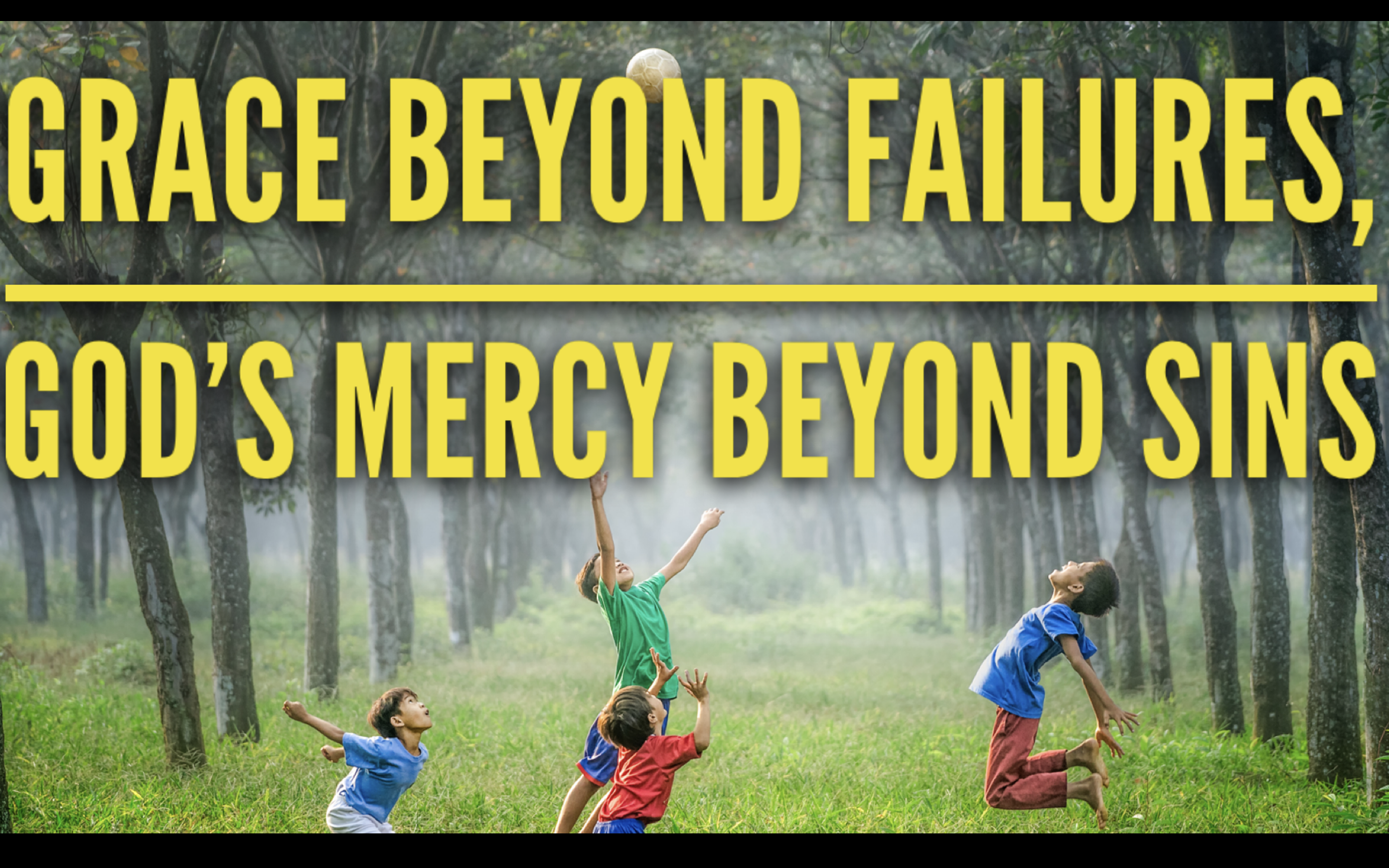
This inspired Peter to respond immediately and to come near to Jesus. Again, this was symbolically done. Peter let go again of his boat, that is, of his old self. He jumped confidently into the sea of past failures and frustrations because he knew that Jesus was waiting for him on the shore. This was how Peter showed us that there is indeed “grace beyond our failures and God’s mercy beyond our sins.” Peter embraced that grace joyfully by encountering Jesus on the shore. Again, it was not earned but freely given.
There is also another moving encounter of Peter with Jesus that gives us more perspective on how mercy and friendship with God will transform us. Allow me to read to you this biblical event in the Gospel of John 21:15-17.
Jesus said to Simon Peter, “Simon, son of John, do you love me more than these?” He said to him, “Yes, Lord, you know that I love you.”He said to him, “Feed my lambs.” Jesus then said to him a second time, “Simon, son of John, do you love me?” He said to him, “Yes, Lord, you know that I love you.”Jesus said to him, “Tend my sheep.” Jesus said to him the third time, “Simon, son of John, do you love me?” Peter was distressed that Jesus had said to him a third time, “Do you love me?” and he said to Jesus,“Lord, you know everything; you know that I love you.”[Jesus] said to him, “Feed my sheep.
During the funeral wake of my Papa, my mother told me about a conversation with my 5-year-old niece. She playfully asked my parents, “Tatay, do you love Nanay?” Asking my Papa if he loved Mama. And then she asked in the same way her grand mom, “Nanay, do you love Tatay?” This happened just a week before Papa died in 2019.
In the eyes of my niece, perhaps what she was doing was a mere play of asking questions and relaying the answer to both of her grandparents. Yet, the question entails commitment and faithfulness.
The question of Jesus to Peter essentially involves commitment and faithfulness. The three questions of Jesus were not of condemnation and judgment against the unfaithfulness of Peter. However, the question, “Do you love me?” was an affirmation that Peter was loved and forgiven.
Thus, the question of Jesus, “Simon, Son of John, do you love me more than these?” refers to that attitude of Peter. Jesus was basically asking Peter, “Simon, do you love me more than your fishing career? More than your fears and doubts? More than your sins and guilt? More than your insecurities? More than your dreams, desires and personal wants?”
Positively, Peter understood what Jesus was asking. Jesus asked three times to tell Peter of the great responsibility and also of the joy of the meaning of loving his dear friend, Jesus. To feed or tend the lambs and sheep basically means, “Take charge to care and love others.” This reminds us of Peter’s capacity to care and love others as Jesus did on the cross.
To each of us today, the Lord also asks us, “Do you love me more than these? More than your insecurities and fears, more than your personal wants and ambitions?” Then, the Lord also asks us to take the risk of loving him, who is our dear friend, by being able to love others, to become courageous and confident in loving others. Remember, it is in taking the risk of committing ourselves to love others that we too shall find our true selves.
The Lord knows that each of us has that capacity to love and take care of others. Never be afraid then, never be afraid to love. Never be afraid to express your care and affection towards others. It is in this way that like Peter, we will be able to follow Jesus, who invites us today, to express our love and care to others in the most concrete ways as we have experienced it from our dear friend, Jesus.
These are stories of encounter with a merciful God and of friendship that led to transformation and to a mission. Indeed, real encounter with God’s mercy and friendship would strip us from our pretensions and masks. Such encounter makes us true and without pretensions to see how sinful and unworthy we are before God.
Yet, it is in this moment of openness and honesty that we find God more merciful and forgiving to us. Let us remember this, it is when we own and claim our weakness, sinfulness and failures to God that we are also being strengthened, forgiven and empowered by the Lord.
Thus, for this second part of the recollection, these are the invitations for us.
First, we are called to be fully aware of our own sinfulness and failures, to take responsibility of our sins. Thus, stop blaming others. This, certainly, needs an amount of humility and honesty from us.
Second, we are invited to allow the Lord to transform us through his mercy, friendship and forgiveness. We can seek God’s mercy and affection then, by our constant devotion to the Eucharist, in receiving his grace in the Sacrament of Reconciliation and by reflecting and seeking wisdom from the Bible.
Third, we are called to let God empower us by allowing God to make us His own instruments of mercy, friendship and reconciliation. God calls us and empowers us in the way we live our life now. We are called to become God’s witnesses as parents, as professionals, as leaders in our community, as workers or vendors, as children and friends, as students and as young people, as senior citizens.
PRAYER
God of Mercy and Friendship, you have constantly reveal to the world your unconditional love. Through your Son, our Lord Jesus, this love is fully manifested. Grant me now the courage to love and to commit my whole life in loving and in giving so that I may become your own instrument of mercy and friendship in my own home, among my friends and in my community. Amen.
(This is the talk given during the Holy Week Reflection on Holy Monday, April 3, 2023 delivered at St. Clement’s Church, Iloilo City.)
Are we being punished? Are we being condemned because of our sins? Has God abandoned us? Has God given up on us?
When Covid-19 hit us in 2020, we were all afraid and anxious. The world seemed to stop, and the many restrictions of our movements contributed so much to our feeling of being isolated and helpless. With this health crisis, economically or financially, we were being challenged in many ways. Many have lost their jobs and the most vulnerable among us were those who worked and earned on a daily basis and the poorest of the poor, the homeless and street children.
Likewise, every day many were haunted by anxiety of being infected by the deadly virus, or we might have been so worried for those family members and friends who were at the frontline fighting against the virus and ministering the infected. Or we might have been sobbing and grieving in those days because we have lost a family member, a close friend, or a colleague because of the virus.
In total, there are about 761,071,062 cases worldwide of covid infections,[1] and a total of 6,879,644 deaths worldwide as of March 26, 2023. (Last Update)
On February 24, 2022, Russia invaded Ukraine and this war brought economic challenges worldwide especially of the inflation of oil which affected us here in the country. This war continues until now which already affected 14 Million people being displaced[2] , with 140,000 infrastructures destroyed, with 15,000 people missing and 42,295 deaths.
Just last February 6, this year, a 7.8 magnitude of earthquake struck southern and central Turkey as well as the northern and western Syria which affected 24 million people[3], 2.5 million displaced persons and 56,00 deaths.
At the local level, at least in this post-pandemic time, no natural disaster has greatly affected the whole country except Odette in 2021 or any war that has ravaged the country. Yet, what is alarming, aside from the inflation of commodities is the rise of poverty level in the country. According to the recent DSWD Listahan 3, that survey found out that there are 5.6 million Filipino Families living in poverty.[4] In terms of individual persons, there are 2 in every 5 Filipinos who are poor. This is equivalent to 30 million poor Filipinos which is 27% of the 111 million population.
These are just some figures and images of suffering in the world and beyond these, there are more pain, suffering, and deaths unknown to us, not covered by statistics or by many news media. There are many who suffer in silence.
Thus, we ask again, are we being punished? Are we being condemned because of our sins? Has God abandoned us? Has God given up on us?
Talk 1
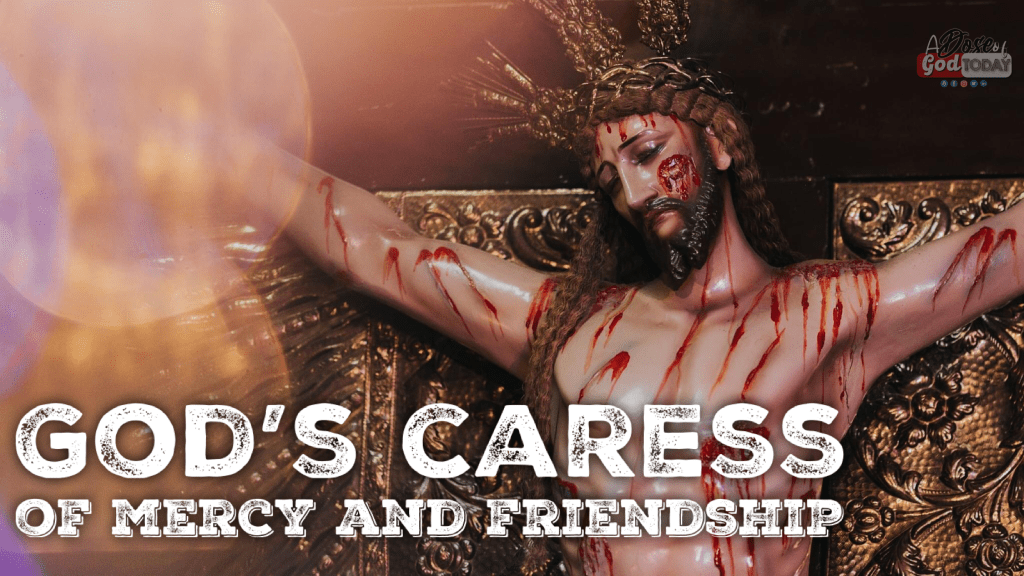
God’s Caress of Mercy and Friendship. This is the over-all theme that I would like to share with you tonight. We understand “caress” as an action that expresses, closeness, affection, love, concern and gentleness.
As Pope Francis said in one of his homilies, “God forgives not with a decree but with a caress.” And with mercy, “Jesus too goes beyond the law and forgives by caressing the wounds of our sins.[5]”
Mercy has touched the Pope so much that he led us into the Jubilee Year of Mercy in 2015-2016. Thus, Pope Francis affirmed that “mercy is God’s identity card[6].” Indeed, Mercy is the name of God.
Again, Pope Francis in his Apostolic Exhortation called, Christus Vivit addressed to the Young People and to the Entire People of God, he wrote, “Friendship is one of life’s gifts and a grace from God. Through our friends, the Lord refines us and leads us to maturity.[7]” This is how friendship that we have developed helps us to grow and become the person God wants us to be.
Moreover, an author, Fr. Ronald Rolheiser, OMI, wrote a section of his book with its title, Friendship is Liberating Too, that, “Friendship can save us. Loving, challenging friends who can melt our bitterness and free us from the need to be angry are as critical within the spiritual life… To neglect friendship is to court bitterness and perversion.[8]”
This explains to us how friendship also plays a role in making ourselves free, free from anger and hatred, from bitterness and corruption that will only bring us into isolation and sadness.
Hence, as I journey with you tonight, let us refresh our hearts and minds with scriptural texts that would bring deeper into God’s caress of mercy and friendship.
I would like to invite you now to the story of Jonah.
Jonah 1:1-3
The word of the LORD came to Jonah, son of Amittai:
Set out for the great city of Nineveh, and preach against it; for their wickedness has come before me.
But Jonah made ready to flee to Tarshish, away from the LORD. He went down to Joppa, found a ship going to Tarshish, paid the fare, and went down in it to go with them to Tarshish, away from the LORD.
Jonah was quite rebellious to God because he was sent by God to do something, which he did not want to do. If you remember, Jonah did not like this assignment to go to Nineveh because he hated the people. They were Assyrians, the traditional enemies of Israel who oppressed and attacked them. These Assyrians were known to be brutal invaders.
That is why, Jonah was so against God’s plan of sending him there to call them for repentance. Jonah was anxious that the people might believe in God and thus, God might show mercy to them and spare them from death. Jonah wanted this people to die. He wanted revenge against these people whom he thought were Godless. This was all because he was angry and he disgusted those people.
Yet, this is what really happened. When Jonah called the people to repent, they repented and believed in God and that was why, God showed mercy to them and saved them from death.
Jonah’s attitude may not be far from many of us who cultivate a narrow and vindictive mentality.[9] Like Jonah we too might have asked God, How could you love worthless, good for nothing people Lord? How could you show mercy to those who do not even recognize you as God? How could I also be merciful to them when they oppressed my people?
We might also find ourselves wishing suffering and death to those whom we hate, especially those who have caused us so much pain. We might have wished and cursed those people who did something terrible to others too. When a violence and or a crime is done to an innocent, we might have demanded also the same violence and crime to perpetrators. Like Jonah, we too might have believed that justice is attained through a gruesome death to our enemies. Like Jonah, we also could tend to believe that God should not show mercy to those who have hurt us, to our enemies and people who did terrible things to the innocent.
Yet, with Jonah, the people of Nineveh and God, there is something very interesting here. Jonah was totally honest to God about his thought and feelings against Nineveh. Jonah was comfortable enough to complain to God, to express his dismay and anger over this people. Jonah even tried to escape from God and argue with the Lord. And the Lord God, listened to him, the Lord God accompanied Jonah and allowed Jonah to grow and become mature as a person and as a prophet by being able to recognize his own limitations and biases against others. The Lord challenged Jonah to see beyond himself, beyond his pain and frustrations and to recognize that God’s mercy and friendship are for all.
Now, this exchange between Jonah and God expressed closeness and intimacy and that is evident in Jonah’s confidence to express himself before God. Is it not friendship at all? It is! Jonah was a friend of God. God is Jonah’s closest friend. And it is in this friendship that Jonah was called, challenged and was transformed. In a way, Jonah was the first to receive that caress of mercy and friendship with God which the Lord wanted Jonah to share with the people of Nineveh.
This helps me to realize now that God’s mercy and friendship are not limited to any group of people. God is a God of everybody, of bad and good people, of sinners and righteous, of criminals and law-abiding citizens.
God showed this concretely to us in the person of Jesus, the ultimate sign of God’s mercy and friendship with us. Pope Francis reminds us, “Friendship is so important that Jesus calls himself a friend: ‘I do not call you servants any longer, but I call you friends.’(Jn 15.15)[10]” Thus, in Jesus, the Father tells us that we are never abandoned, that there is always hope and goodness in each of us no matter how broken we are, and sinful we have turned to be. God always sees goodness in us, because we too are God’s friends.
This is the same invitation that we have heard from Jesus when he addressed the adulterous woman brought by the scribes and Pharisees. Like Jonah at the beginning, the scribes and the Pharisees were filled with so much hatred and anger. This made them to become condemning towards the woman. With this attitude, they refused to give another chance and opportunity for the woman to change and to redeem herself.
Thus, they wanted to stone her to death as what “the law” told them to do. But what did Jesus do? Listen now to the Gospel of John chapter 8, verses 7 to 11.
John 8:7-11
But when they continued asking him, he straightened up and said to them, “Let the one among you who is without sin be the first to throw a stone at her.”
Again he bent down and wrote on the ground.
And in response, they went away one by one, beginning with the elders. So he was left alone with the woman before him.
Then Jesus straightened up and said to her, “Woman, where are they? Has no one condemned you?”
She replied, “No one, sir.” Then Jesus said, “Neither do I condemn you. Go, and from now on do not sin anymore.”
This is what Jesus showed to the woman. Jesus said, “I do not condemn you. Go and sin no more.” God has delivered his judgment, showed His mercy and offered friendship. Jesus freed the woman and was commanded to sin no more and not to go back to her old sinful self. She had, surely, found her way to freedom and peace in Jesus.
Pope Francis in his homily on this Gospel story said, “Jesus forgives. But here, there is something more than forgiveness because Jesus goes beyond the law. Though Jesus was pure and the only person who is worthy to cast the first stone against the woman, but Jesus did not because he showed mercy.[11]”
Mercy, as the Pope says, is difficult to understand. “Mercy does not erase sins. It is God’s forgiveness that erases our sins. But then, mercy is the way in which God forgives.[12]”
Thus, unlike the scribes and Pharisees, Jesus saw more in the person of that woman. The limited awareness and refusal of the Scribes and Pharisees to see more, prevented them to discover that there was always hope in every sinner, and that there was more in a person’s weakness and imperfection. This is how Jesus defends us, sinners from the just condemnation of death.[13] Again, (because) God always sees goodness in us and offers us his friendship that we may be renewed and find peace in his presence.
PRAYER
God of Mercy and Friendship, I am confident that it is not your desire to punish and bring us to condemnation, but to caress us with your love. Allow my heart to be ever closer to you, to grow in faith and affection towards you. As you see goodness in me, let me also see the goodness in others that I may learn to caress with mercy and friendship. Amen.
[5] Pope Francis, The Name of God is Mercy: A Conversation with Andrea Tornielli, translated by Oonagh Stransky (New York: Random House, 2006), xii-xiii.
[7] Pope Francis, Christus Vivit: Post-Synodal Apostolic Exhortation of the Holy Father Francis to Young People and to the Entire People of God (Philippines: Paulines, 2019), n. 151, 64.
[8] Ronald Rolheiser, OMI., “Friendship is Liberating Too,” in Forgotten Among the Lilies: Learning to Love Beyond Our Fears (USA: Doubleday, 2005), 34-35.










 A DOSE OF GOD TODAY