Category: Bro. Karl Gaspar, CSsR

  • OMPH DAVAO PARISH GIFTED WITH BULAWANONG GASA

    OMPH DAVAO PARISH GIFTED WITH BULAWANONG GASA

    Fifty years ago in June of 1972, the Our Mother of Perpetual Help parish under the administration of the Redemptorist Missionaries was founded. These were the circumstances leading to this historic event (as quoted in the 50th anniversary commemorative publication).
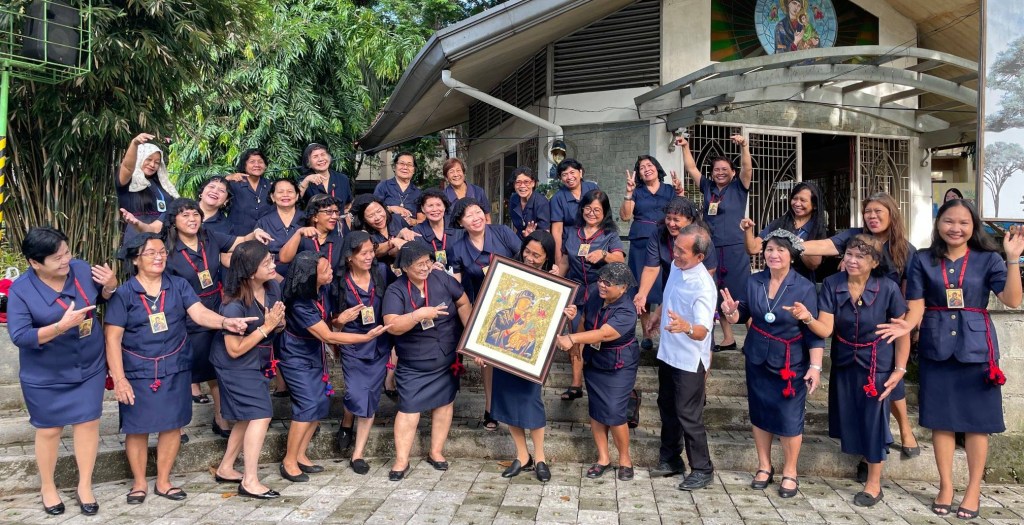
    Devotees of Our Mother of Perpetual Help

    “ It was not until the early 1970s when the idea of a Redemptorist parish in Davao again surfaced. In May 1971 this offer was made formally by the Archdiocese in writing.  On September 2, 1971 during the visit of the Vice-Provincial, Fr. Mahoney, the community (composed of Fr. Sean. Magnier as Superior, met to discuss whether a parish should be established. Some questions that arose included: Would accepting a parish be for the good of the Local Church? Would it so reduce their missionary effort as to render it ineffective? Furthermore it was to be considered that conducting missions was the  priority apostolate. At that time,  the parish of about 25,000 was being cared for by one priest.

    The community members were in a deadlock and could not reach consensus. It was then left to the Vice-Provincial and the members of his Council to make the decision and they approved the establishment of a parish. A meeting was then held at the Archbishop’s residence and among those who attended were Archbishop Antonio Mabutas, Fr. Maurice Leveille PM, other PMEs and Blessed Sacrament Fathers and Fr. Magnier and Fr. Pierse. One task at hand was to set the boundaries between the areas left with the Assumption Parish under the Blessed Sacrament Fathers and the new parish under the Redemptorists. A date was then scheduled for the date of the parish foundation which was to be a week after Easter of 1972. Officially, however, the foundation of the OMPH parish in Davao was inaugurated on July 27, 1972 with Fr. Dominic McKenna CSsR as parish priest.  When it was first established, the parish covered the areas of Callawa, Mandug, Tigatto and Buhangin.”

    Bulawanong Gasa (A Golden Gift) was decided by the Davao Redemptorist Mission Community (DRMC) as the theme for the 50th anniversary celebrations when the members met a  year ago to prepare for this event. This theme became the title of the commemorative publication which recently got published and distributed to the different CSsR units and foundations, and are not available to the parishioners and churchgoers.

    Various activities were planned and some of them have already been accomplished through the past few months. There were mass confirmations, baptisms and first Holy Communion rituals involving all of the 35 GKKs across the parish. Just these past week-ends, more than a hundred volunteers (from the DRMC members to parish staff to GKK leaders and youth) volunteered to be facilitators and resource persons for the 50th year parish missions held in the different seven zones. These missions were mainly skills training for the spotted new leaders as well as existing alagads of the GKKs.

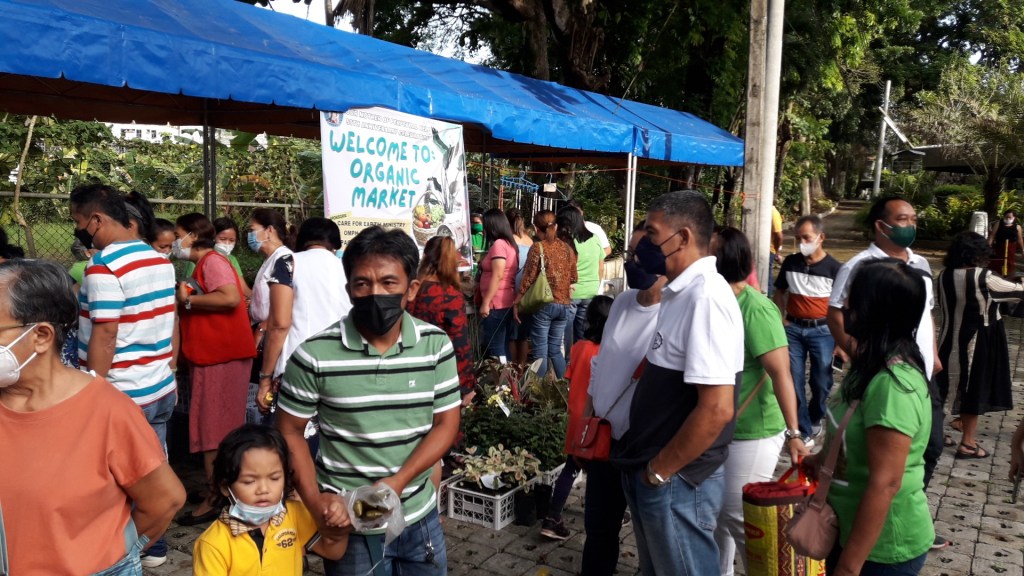
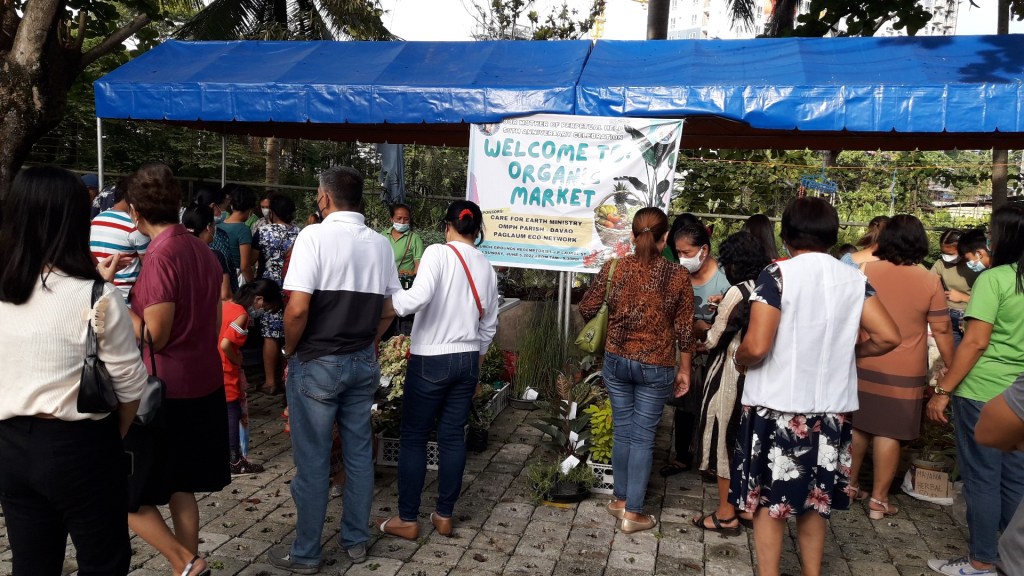
    On Pentecost Sunday, the Care for the Earth parish ministry conducted an Organic Market in the church grounds, in collaboration with the Paglaum Ecological Network which is affiliated with Sustainble Davao Movement. Through this network, the parish ministry is linked to other parishes, Catholic schools, NGOs and other ecological groups based in Davao City. They will be hosting the novena Mass on Sunday, June 12 where hundreds of trees would be distributed so parishioners and churchgoers can be actively involved in making sure the city have more trees. On the same day, a group of volunteer ophthalmologists and optometrists will provide free eye consultation to poor households of the parish.

    The nine-day novena from June 10 to June 18 will be live-streamed for both the 6 AM and 5:30 PM Masses (although on Sunday it will be at 6 PM). Each Novena Mass has its theme which relate to the Province’s missiological priorities. From June 13 to 17, the St. Alphonsus Theological and Mission Institute (SATMI) in collaboration with the parish and the MindaNews Media Cooperative Center/Institute of Journalism are co-sponsoring the Second Mindanao Book Festival, a Book Fair/Exhibit that will have a launching of all Mindanao books published during the time of the pandemic on June 13 at 3 PM. All Mindanao books published through the years are then exhibited in Rooms 5-6 at SATMI.

    A concert – Halad ni Maria, featuring Fr. Bonn Barretto CSsR and the different church choirs (Sts. Catherine, St. Blaise and St. Hildegaard Choirs) along with the Kaliwat Theatre Collective backed up by a quartet under the baton of Kruz   – will take place inside the church on Friday, June 17 at 8 to 9:30 P.M. Songs to be interpreted are all in Cebuano-Bisaya used popularly in most of our missions, especially with the Redemptorist Itinerant Mission Team.The finale are songs dedicated to the Blessed Mother.

    A dawn procession will begin the fiesta day on Sunday June 19. The Pontifical Mass will be at 10 A.M. with the Archbishop, Msgr. Romulo Valles officiating and Bishop Emmanuel Cabajar CSsR as homilist. Lunch will be served by the DRMC to invited guests. From 4 PM to evening, members of the GKK will gather inside the gym for the final activity – a grand fiesta celebration!

    All Redemptorists are naturally invited to join their confreres at this 50th anniversary of the OMPH parish, especially all those who have served the parish through the years!

  • The Rise of Decolonial Theology in the Philippines to Promote Climate Justice

    The Rise of Decolonial Theology in the Philippines to Promote Climate Justice

    (Introduction: I am delivering this talk on June 9, 2022 (at a panel from 6 to 8 PM Philippine time) for the World Theology Forum. The theme of this international conference is – ACTION AND PROMISE: STRUGGLING AGAINST VIOLENCE, BUILDING JUSTICE AND RETHINKING RELATIONALITY IN THE TIME OF CLIMATE CHANGE. It is simultaneously translated into English, Spanish, French and Portuguese).

    Today the Philippines is third in the list of countries with the most number of Catholics. Of a total of 105 million people, 89% are affiliated to the Roman Catholic Church in terms of their faith. To include those among Protestant denominations, there would be 93% of the entire population who are Christians. The rest would be Muslims and those who continue to adhere to their indigenous faith tradition and a sprinkling of Buddhists, Hindus and Sikhs. 

    In 2021, the Philippines celebrated the 500th year anniversary of the arrival of Christianity to the islands when a tribal settlement in Cebu (in central Philippines) agreed to take part in a mass baptism initiated by the captain of the colonizing expedition, led by Fernando Magellan whose journey constituted the first to circumnavigate the globe. 

    However, it was the expedition led by Miguel Lopez de Legazpi in 1565  that cemented Spanish colonial rule in the central and northern parts of the archipelago leading to the establishment of the institutional/hierarchical Church across the colony. Taking into context the close interfacing of the Vatican and Madrid (as manifested in the passage of Papal Bulls establishing the legitimacy of Patronato  Real) – in what can today be considered the union of Church and State – there was a close collaboration between the processes of colonization and evangelization.

    The colonial rule was abusive in regard to how the colonizers treated the native population. First they established the reduccion system, patterned after their colonial strategy in Central/Latin America to hasten proselytization. This led to the setting up of the encomienda with its in-built mechanisms to force the people to pay tributes, be constricted to do forced labor and be subjected to the iron rule of their colonial masters. Even the friar congregations were also provided land grants converted into haciendas.

    Unfortunately the friars (mainly the Augustinians, Recollects, Dominicans, Franciscans and the Jesuits) served as conduits of the Spanish King and rode on the colonial governance system for conversion purposes. In many pueblos, the friars served as the alcalde de mayor. Given the theological and pastoral praxis of the medieval Church, this meant an aggressive drive to vanquish all aspects of the indigenous belief system practiced by the indigenous communities for thousands of years. Worst hit were the indigenous babaylans (shamans) seen by them as Enemy No. 1.

    Eventually as a result of their brutal subjugation, there erupted hundreds of revolts across the archipelago. Some of these were led by the babaylans who had very strong influence over their constituencies.  In the course of history, a greater sense of unity evolved among some of the lowland peasant communities – especially in central Luzon in the north (the area today closest to Metro Manila) –  that consolidate the collective will of the oppressed to rise up against their oppressors.

    This led to the establishment of a grassroots revolutionary movement that eventually coalesced with those in urban Manila along with a group of intellectuals – many who were educated in Madrid including native clergy – to form the Union of the Humblest and Highest Group of  Sons/Daughters of the Nation (Kagalang-galangan, Kataas-taasang Katipunan nga mga Anak ng Bayan or KKK).The Union waged a revolutionary war against the Spanish colonial forces for five years until finally the Spanish rule was vanquished which led to the establishment of a Republic, the first to be declared in Asia.

    However, in the late 1890s, the nascent colonial power of the United States of America was in search of their own colonies which led to their interest to occupy both Cuba and the Philippines. Despite the resistance of the Filipino rebels, they were defeated by the more superior American military forces which led to the establishment of the American colonial rule in the Philippines which lasted for half-a-century (1898-1946). But this is another story.

    The colonization-evangelization campaign by Spanish colonizers in the Philippine archipelago would eventually led to the mass conversion of the indigenous people mainly in the central and northern parts of the country, which explains why today the majority of Filipinos are Catholics. The Islamized population in the south resisted Spanish rule and thus remained Muslims. Whether or not, the friars were abusive, and no matter whether they may have used coercive means in their proselytization goal,  they did manage to convince the natives to embrace the Catholic faith. This unfolded despite what can be referred to as a “chauvinist Christianity” resulting from an evangelization process which interfaced with the manner the colonizers violated the natives’ rights.

    The first seeds of what could be referred to as the beginnings of a “native liberation theology” arose in various forms with some of the insurrections that erupted against Spanish colonial rule. The one that has been fully documented by historians and now appropriated by Filipino theologians is what took place leading to the establishment of the KKK in the 1840s. Confradias were established by some of the prophetic local leaders of Christian peasant communities who began to “theologize on their oppressed situation and read the Passion narrative as a justification of their engagement in the struggle to end colonial rule” (c/o a book written by Rey Ileto – Pasyon and Revolution: Popular Movements in the Philippines 1840-1910 and Vicente Rafael’s Contracting Colonialism: Translation and Christian Conversion in the Tagalog Society under early Spanish Rule).

    This constituted the nascent decolonization of the manner of interpreting the Bible highlighting its liberation content which would reach a new height in theological circles in the Philippines in the wake of the Second Vatican Council (Vatican II). In the 1960s, the political-economic-social structures of the Philippines – which were in the hands of the native elite or the oligarchy that arose in the post-colonial rule – worsened in regard to its governance system. This led to the worsening poverty situation of the majority and the lack of social justice in all fronts. Vatican II and eventually the declaration of martial law by the late dictator Ferdinand Marcos who ruled from 1972 to 1986 heightened the development of what would be decolonial theologizing.

    The Marcos dictatorial regime was eventually vanquished through a People Power revolution which erupted in the streets of Metro Manila in February 1986 which led to the restoration of democratic practices in the Republic. However, despite the reforms which began with Mrs. Cory Aquino until today, the poverty situation worsened owing to the neo-liberal policies  imposed by the State apparatus. This was further worsened with gross human rights violations and in-attention to the need to push for ecological justice under President Rodrigo Duterte who won the elections in 2016.

    Owing to the persistence of this kind of socio-eco-political situation, a movement within faith-based institutions has once more arose with a strong decolonial with a theological perspective advocating for a militant response that listens to both the cry of the  oppressed poor and the harassed planet!