Category: Bro. Karl Gaspar, CSsR

  • THE MOST PRECIOUS CHRISTMAS GIFT!

    THE MOST PRECIOUS CHRISTMAS GIFT!

    For those who have the means, one cause of stress during the Christmas season is what gifts to give to one’s loved ones? This is especially so if they seem to have all that they need and are not wanting for anything else. We do not want to give gifts that will only end up in the cupboards or recycled as gifts to others.

                Godparents get perplexed when having to think of the appropriate gifts to their godchildren who do expect something from them during the Christmas season. It is easy enough when they were kids, as there is a variety of toys to choose from. And kids love any toy that they receive especially the ones popular at the moment.  But when they reach adolescent or early adulthood, one wonders what gift they would appreciate. To be safe, godparents resort to just giving gift cards of superstores or outright cash.

                OFW parents are even more pressured if they are not at home for Christmas. To compensate for their absence during this season, they spoil their kids and it could turn out to be expensive as kids demand gadgets that could cost a fraction of their salaries. But it is not just their children expecting gifts but the whole clan which explains the phenomenon of those big Balikbayan boxes that flood our airports at this time of year.

                And additional source of anxiety these days is the impact of inflation and the ensuing  high prices of commodities on one hand, while salaries have no correspondingly increased. Some companies even could no yet afford to give a 13th month bonus. Considering the high costs of Christmas with demands for a delicious noche buenas and other expenses, there is hardly left to buy gifts.

                On the other hand, there is also an interesting development in terms of undermining the crash commercialism that has characterized the Christmas holiday season. To make sure that they are not held captive by the pressure to go to the malls and shop till they drop, they refuse to even buy anything. Instead the more altruistic ones would rather distribute goods to the needy or give their money to charitable institutions or cause-oriented groups.  We can only hope that this kind of movement would expand and more people are involved in spreading Christmas cheer among our less fortunate sisters and brothers.

                If there is someone out there who wonders how best to respond to the question – what gifts to give to loved ones? –  let me offer this reflection. At a most recent time when I thought I was already destined to depart from this earth, I asked myself what was it that I would miss most? Or what would I have no difficulty letting go?  I realized I could let go of:

    –         Ice cream, halo-halo and all those wonderful pastries in bakeshops

    –         A really delicious meal in a fancy Vietnamese restaurant

    –         Bagel, croissant, pretzel and those freshly-baked bread

    –         A swim in the warm waters around the islets of El Nido, Palawan or in a lagoon underneath a waterfalls

    –         A fabulous sunrise or a gorgeous sunset with the wind caressing the coconut trees

    –         A climb up the mountain and then viewing a sea of clouds

    –         Travels to Baguio and Bali, Paris, New York or Rio de Janiero

    –         Films of Kurosawa and Trauffaut, concertos of Mozart and Bach

    –         The best of Filipiniana films, music, art and literature

    –         Songs of Simon and Garfunkel, the Beatles and Frank Sinatra

    –         Gardening, reading Booker prize-winning novels, writing fiction

    –         And a few more favorite things to do

    Photo by Sandino Madelo, Christmas 2021

    It goes without saying that I would not let go of my faith in the Triune God and of God’s plan of salvation that continues to unfold. To have been gifted with this faith has led many to a meaningful life allowing me a glimpse of what is God’s promise for humanity. It has also brought me to many communities where I could inter-act with peoples of great charm and generosity. It allowed me to experience moments of peace and great joy. And it brought into my life many co-believers to be able to constitute communities of mutual support, deep affection and compassion for each other.

    Then I realized there was one thing I would not let go for I would miss this very much. And it is this: the love and affection of family, confreres and the closest friends especially those whose friendships have lasted a lifetime. Who I am today and what I have accomplished in my life may be due to their support, encouragement and prayers.  The wonderful moments I have enjoyed through my life – especially at certain special occasions – were in their company. There was utter happiness that could only arise in their presence.  If there are memories to keep in my heart, their faces would appear.

    Indeed, the gifts of kinship, confrereship and friendship are the most precious gifts for me. And these are gifts given from Christmas season to Christmas season as well as throughout the years. These need not be wrapped in fancy paper and silk ribbons for these are offered from the heart. Every Christmas, I have always felt blessed because I knew I continue to receive these precious gifts. If I have these gifts, really what else do I need?

    So, dear reader, do not worry what gift to give your loved ones.  By embracing them in  your heart, wishing and praying for their well-being, assisting them in their times of need and loving them in a manner that makes them feel deeply appreciative – you would have given the most precious of gifts!

    And it is a gift that goes beyond Christmas!

    A blessed Christmas to one and all!
  • IN GOD’S OWN TIME

    IN GOD’S OWN TIME

    As we approach the end of the Advent season and embrace the spirit of the Christmas season, let me offer this reflection. 

                Because we Christians have regularly entered into the four-year period of Advent for a very long time through the centuries, there are times when we hardly give full attention to the significance of this period.  This is especially here in the Philippines where we anticipate Christmas so early that we begin to already prepare by September, looking forward to the festivities and celebrations that come with Christmas and New Year.

                I confess that I am no exception especially since our work in the missions keep us so busy that there really is very little time to do serious reflection.  However, it was different for me this year on account of a serious and life-threatening illness requiring hospitalization. As the Advent season began I went through an agonizing ordeal in an ICU in a hospital in Manila.

                The days went very slow as there were complications in the medical procedures including undergoing two operations so I could be provided the means towards a peritoneal dialysis system. This meant  having to endure the pains, the inconveniences and boredom of being confined in a room without a window. For the next three weeks, there was no end in sight, no definite word from the doctors as to when I could be discharged.

    Thus the waiting, what seemed like an endless waiting.  Waiting for the pains to subside. Waiting for the moment when I can drink water again and be fed solid food.  Waiting for the wounds to heal. Waiting for a sign that I was on the road to recovery. Waiting for the moment when I can talk and walk again. Waiting for the doctors to finally announce that I could be released from this confinement. Even as the body pains were quite excruciating, the waiting in itself was a source of agony.

                It was in the midst of these sufferings that it dawned on me that the Christian world had just entered the Advent season and I was provided a rare opportunity to reflect on its true meaning vis-à-vis my current experience of waiting.  In my mind, I recalled the biblical narrative of God’s promise to send the Messiah to God’s chosen people. However, they waited and waited and no Messiah appeared in their midst. Generations after generations from Abraham to just before the birth of Joseph  waited.

                As per the genealogical account in Matthew (which is read during the second day of the Aguinaldo Masses), there were 14 generations from Abraham to David, another 14 generations from David to the Babylonian captivity and another 14 generations from this captivity to Joseph.

    Thus, forty-two generations of the Chosen people waited and waited until finally God fulfilled God’s promise.

                Waiting is never easy, in some countries there is such value attached to punctuality that latecomers can be penalized in various ways. In countries like ours, we may not be so insistent on punctuality but still we do get pissed off if we have we wait too long.  It is so easy to become impatient once we are forced to wait.

                Today we are confronted with global, national and local problems that we hope could be resolved soonest. Thus we ask questions like: When will this pandemic totally end so that there are no more infections and we do not have to wear masks anymore? When will the Ukraine war end? When will oil prices stop increasing which has resulted in increases in costs of living not to mention causing havoc for households in need of adequate heating in countries now in the grip of winter? When will human rights violations end in authoritarian regimes? When will we stop destroying our common home and to finally cut down on the use of fossil fuels? When will there be an end to the dislocation of indigenous peoples from their ancestral domain? And so on, and so forth.

                We have prayed so long so that these problems could be resolved and yet things seem to worsen. We have stormed the heavens seeking God’s intervention and yet at times we believe God no longer listens to our prayers. We’ve waited and waited for God’s mercy but we are almost at the point of despair and there is still no sign that the light will soon take over the darkness. And like Jesus on the cross we ask God: why have you abandoned us?

                It was while lying on my hospital bed asking God when my pain and suffering would end that a thought came to my mind. Human beings have a way of reducing God into our anthropomorphic status, that is, as if God’s existence is the same as mortal beings. God is God and God’s ways are different as ours. In terms of existential reality, God is Almighty and thus is above it all. Everything takes place in God’s own time, and not within our own timeframe.

                This I thought was the significance of Advent. That God’s promise would be fulfilled in the fullness of time, in God’s own time. And it did when Joseph and Mary needed to journey and ended up in Bethlehem. Humanity just has to wait until God’s time is up!  Meanwhile, we might have to take full advantage of the moment of waiting to be ready for the eventuality of the fulfillment of our hearts’ desire.

                That became a source of comfort for me even as the agonizing ordeal in the hospital persisted. For I knew that in God’s time, my confinement would end. And it did, a month after in time for the celebration of the Christmas season!

  • CHALLENGE TO US FILIPINO REDEMPTORISTS FOR THE 2023-2028 SEXENNIUM

    CHALLENGE TO US FILIPINO REDEMPTORISTS FOR THE 2023-2028 SEXENNIUM


    The XXVI General Chapter of the Redemptorists recently concluded its deliberations on October 7, 2022 after it convened on September 11 in Rome. Three statements were given during and after the Chapter which should make us Filipino Redemptorists reflect on where we are today and the challenges we face in the future which we should face squarely during our incoming Provincial Chapters.

               First was that of Pope Francis.  On the first of October, Pope Francis addressed the delegates and he offered to them these words of inspiration and exhortation:

    Do not be afraid to tread new paths, to dialogue with the world, in the light of your rich tradition of moral theology. Do not be afraid to get your hands dirty in the service of those most in need and of the people who do not count…

    In your Constitutions there is a very fine expression, where it says that the Redemptorists are available to face any trial to bring Christ’s redemption to all.  Availability. Let us not take this word for granted! It means giving oneself entirely to the mission, with all one’s heart, dies impendere pro redemptis, unto the final consequences, with a gaze fixed on Jesus.

    The Church and consecrated life are living a unique historical moment, in which they have the possibility of renewing themselves to respond with creative fidelity to the mission of Christ. This renewal passes through a process of conversion of the heart and mind, of intense metanoia, and also through a change of structures. At times we need to break the old pots, inherited from our traditions, which have carried a great deal of water but have now fulfilled their purpose. And breaking our pots, full of affections, of cultural customs, of histories, is not an easy task; it is painful, but it is necessary if we want to drink the new water that comes from the wellspring of the Holy Spirit, the source of all renewal.”

              After reading his statement, he had an impromptu address in which he said:

    Photo from http://www.catholicnewsworld.com/

    I was struck by a phrase your group said: ‘Leave your comfort zones and go out on the mission.’ I wonder, what are the comfort zones that a congregation has, that a province has, that a community has and that each one of us has? Ask yourselves that question, because it was said that each person accommodates the vows as he pleases. And so, you can practice poverty with a bank account, you can practice chastity with a companion, and you can practice obedience by talking and deciding what you want. These are very distorted forms. But the one that always produces a distortion in the three vows is comfort. That is where the evil comes in, in trying to be comfortable, to be at ease, to live a bourgeois life, without going out, and going out on the mission…Each one of us must analyze our own temptation to be comfortable. We all have that temptation; we all face that temptation.”


    From such statements, clearly Pope Francis is exhorting all of us to reflect on where we are today in terms of our mission and lifestyle and to be engaged missionaries truly immersed among  “those in need and the people who do not count.” 

                Second was the statement of Fr. Rogerio Gomez CSsR, our new Superior General who sent this to the Union of Redemptorists of Brazil on October 12. While this statement is meant for his confreres in Brazil, it might as well be addressed to all of us Redemptorists, for in the document, he highlights the complex and challenging times in which we live and asks for courage from all of us:

    We are experiencing a phenomenon to which we must be very attentive: the erosion of democracy, the use of religion to manipulate reality and to impose fear and exclusion on the poor. This reality should make us think. We must be wise as children of light,’ says one of the excerpts from the letter.

    The spread of fake news can be related to the sin against the eighth commandment: ‘Thou shalt not bear false witness!’ It is an enormous disservice to the truth.”

    “How can we believe in the true God and defend weapons, persecute traditional religions, destroy Mother Nature, and not invest in public health, education, science and social policies for the benefit of the poorest and the country’s development? How can we believe in the motto ‘the truth that sets us free’ (Jn 8:32)? However, we live with the flood of lies that deceive people and create reality.

    How is it possible to speak out against abortion yet advocate the death of blacks, indigenous people, homosexuals, and women, the death penalty, cover up domestic violence, reaffirm machismo, promote prejudice against northerners and minorities, and cause social mistreatment? The teaching of the Church is evident in affirming ‘the inviolability and dignity of life from conception to natural death (JPII Evangelium vitae, 2)’.”

             Third is the recent letter of Fr. Gomez to all Redemptorists around the world, issued on the Feast of St. Gerard last October 16 addressed to everyone in the congregation from superiors to Council members, Secretariats to Formation Teams, professed and lay missionaries and even the formandi. In this letter he affirms the important role of the Brothers in the congregation, but is in crisis owing to lack of promotion and attention and calling on everyone to find creative ways to recruit and form Brothers to reverse the present reality of their dwindling numbers.

                All these are framed within the call for the coming sexennium, namely that we all strive to be missionaries of hope in the footsteps of the Redeemer. There are many reasons why sometimes we feel discouraged owing to the sad global realities (the impact of climate change, the repercussions of the pandemic, wars and conflicts, consumerism, secularism, individualism, etc.), the national situation (return of dictatorship, unchecked corruption, patronage politics, inflation, rising prices, etc.) and even dynamics within our own congregation.

    But we are supposed to be children of the light, filled with hope that God never abandons His people. However, that hope can only be nurtured if – through following in Jesus’ footsteps – we are truly able to witness to plentiful redemption which is reflected in our faithfulness to the mission of serving the most abandoned, and sharing a community life lived not in affluent comfort but following the model of Jesus and his disciples.

                 We pray that the Provincial Chapters that will be unfolding in our two units would lead us to the path earlier taken by St. Alphonsus, St. Clement, St. Gerard and all our confreres who through the years since we were founded followed in the Redeemer’s footsteps!

  • CONTINUING CHALLENGE TO RENEW THE CHURCH

    CONTINUING CHALLENGE TO RENEW THE CHURCH

    A REVIEW: A VISION OF A CHURCH RENEWED, Living The Ecclesiology of Vatican II and PCP II

    Fr. Amado L. Picardal  CSsR, Claretian Publications, Foundation Inc., 2022

    Amidst the disturbing news that the highly esteemed Holy Father, Pope Francis’s health is deteriorating (most of his photos these days show him seated in a wheelchair and needs to be lifted up), there are all kinds of speculations as to the consequences if he decides to resign.

                First, there is the question who can then be elected in the papal conclave where cardinals all over the world gather in Rome to elect his successor. Luis Cardinal Tagle has been named as one possibility along with a few others.  Only time will tell, however, who the next Pope will be and if he will be continuing the reforms that Pope Francis has earnestly pushed despite objections from the Roman Curia. Or following – the usual pendulum that takes place with social institutions –  the movement will be to return  to the conservative mindset of an institutional Church characterized by the likes of St. John Paul II.

                Since he got elected on March 13, 2013 – almost a decade ago – replacing Pope Benedict XVI who resigned from the papacy,  Pope Francis has opened the windows of the Vatican so that the Church can co-exist with the complexities of the post-modern world. He has issued some of the most important pastoral documents to come out of the Vatican from the Apostolic Exhortation of  Evangelii Gaudium to Laudato Si! to Fratelli Tutti.

                There was even a rumor earlier that he was set to convene Vatican III in the hope that all the recommendations that were approved by Vatican II can be more seriously pursued by Local Churches especially those who have remained indifferent to the concerns of Vatican II. As it proved to be far too controversial to organize, Pope Francis shifted two years ago to convening a Synod on Synodality.

                In order to facilitate the active participation of the laity – including those who are not practicing Catholics or even those who may feel completely alienated from the institutional Church – all Local Churches (BECs, parishes and dioceses) across the globe were tasked to hold local consultations on the theme “Journey with the Church in the Contemporary Times.”  This Synodality asks the question – what does God expect of the Church in the 21st century?  A ten-minute report was to be submitted by BECS/parishes to their Diocese and all dioceses around the world are to submit to the Vatican their 10-minute summary report.

                October 2021 to April 2022 was the allotted period for the Diocesan Phase. A second continental phase began in September 2022 until March 2023. And finally, the third or the universal phase will begin with the XVI Ordinary General Assembly of the Synod of Bishops on the theme “For the Synodal Church: Communion, Participation and Mission” to be held in the Vatican in October 2023. An Apostolic Exhortation will then be issued by the Pope. The question remains: can Pope Francis hold on to his Chair until then to preside over this Assembly?

                Meanwhile, organizers for the 17th Mindanao Sulu Pastoral Conference (MSPC) on the theme – THE GIFT OF FAITH AND NEW EVANGELIZATION AS A SYNODAL CHURCH – are gearing up for the Conference to be held from November 7 to 11,  2022 at the Chali Beach Resort & Conference Center, Cugman, Cagayan de Oro.  Once more the delegates will again assess where the Local Churches are in their quest towards their continuing renewal. Once more the focus will be what is happening at the level of the grassroots Church, namely the hundreds of BECs spread across Mindanao.

                Now comes, Fr. Amado L. Picardal’s continuing effort to provide the Philippine Church with a textbook on understanding its ecclesiological in these contemporary times. As the author writes in the book’s Prologue: “Ecclesiology is the discipline that reflects in a systematic manner the self-understanding of the Church in the light of faith. It seeks to answer the question about the Church’s identity, nature and mission. It is  a theological reflection on the mystery of the Church which is distinct from Church history. While it is possible to study the history of the Church even without faith, Ecclesiology requires a faith-perspective. It is the work of a believer for the sake of the community of believers.”

                The author contends that this book does not promote new and radical ideas about the Church. What he intended to do was “to explicate the vision of a renewed Church espoused in Vatican II and received by PCP II and explore its meaning and implication in the Philippine context.”  The writing of this book goes back to when the author was doing his dissertation – An Ecclesiological Perspective – with the Pontifical Gregorian University in Rome way back in 1995. Most of what appears in this book is the product of his research and the updating and revisions he has made through the years.

                There are 11 Chapters in this book, covering 377 pages. Before presenting again his thoughts of BECs, the first chapters involve an explanation of the ecclesiological models of the Church (Church as Communion, Institution, Herald, Sacrament and Servant); the Church as People of God (Prophetic, Priestly and Kingly People) and The Church of the Poor. After the  Chapter on the BECs, the remaining Chapters include an explanation of the Family as a Domestic Church, the Church in Dialogue (with the world, Inter-religious Dialogue, with the poor) and a Renewed Clearly in a Renewed Church.

                Across the pages of this book are quotes from the Decrees of Vatican II,  various apostolic exhortations issued by the Popes and CBCP statements. At the end of each Chapter there is a long list of citations, a testament to the persistence of the author to do rigorous research before writing the manuscript. Concrete examples of pastoral practices cover all corners of Mindanao and the rest of the world.

                There are, however, Church workers – especially in Mindanao who were witnesses to the glory days of the Mindanao-Sulu Conference – who could not help but compare how the Local Churches and BECs were in the 1970s-80s compared to how they function during the contemporary period. Then most of the bishops, clergy and religious – and a growing number of lay leaders – were actively collaborating to make their BECS truly kingly and prophetic. As a result, a number of lay leaders and priests and religious got red-tagged by the military, consequently a number of them were arrested, imprisoned and even killed.

                Today one can hardly hear of any single story of a BEC or a lay leader being harassed by the military in the same manner that indigenous communities opposing mining and other development projects have been subjected to. What is this indicating? That the State has become more tolerant of a militant Church or the fact is that the militant Church has disappeared to give way to a conservative model interested only in providing spiritual care to the faithful? For gone are the days when BECs were in the forefront of struggles for justice and peace and the integrity of creation!

                Towards the end of this book, the author contends that: “The pre-Vatican II model of the Church appears to still persist in the mind of many… There is still a gap between the vision and the reality. There are still some dioceses and parishes where Vatican II and PCP II vision of the renewed Church has not yet been fully implemented. For the new generation, Vatican II seems to be ancient history and the documents remain unread, gathering dust in the libraries.”

                The book offers some suggestions to pursue the project of a renewed Church, but it will require a pro-active commitment on the part of all – from bishops down to the BEC leaders – to break the  impasse that seems to make the members of the Church complacent and apathetic to the social and ecological issues that are only worsening. The economy is in shambles and poverty levels are again on the upsurge. Indigenous communities remain at the periphery with little assistance from the State.

    While there is peace in Mindanao for the moment, there are still conflicts that cause the eruption of violence. Corruption remains well entrenched in the State agencies demanding good governance practices. Our place in the planet remains precarious as mining, logging, expansion of plantations and inefficient waste management combine to worsen climate change.

                For the BECs to once more become fully alive and contributing to the transformation of our society, we need to double our efforts at renewing the Church. Otherwise, the future may not be too bright for Roman Catholicism in this country if and when the general population think of the Church as irrelevant in responding to the challenges of a complex society today and the days still to come!

  • WRITING MINDANAO, RIGHTING MINDANAO – ONCE MORE WITH FEELING!

    WRITING MINDANAO, RIGHTING MINDANAO – ONCE MORE WITH FEELING!

    A SOJOURNER’S VIEW by Karl M. Gaspar CSsR

    It was the best of times, it was the worst of times, it was the age of wisdom, it was the age of foolishness, it was the epoch of belief, it was the epoch of incredulity, it was the season of light, it was the season of darkness, it was the spring of hope, it was the winter of despair.”  Many of us know that these are lines from perhaps one of the most known books of all time, A Tale of Two Cities, by Charles Dickens. It is said that in this book, Dickens referred to an age of radical opposites taking place across the English Channel, in France and the United Kingdom respectively, during the French revolution more than two hundred years ago between 1787 and 1799.

    But these contrasts and comparisons we might be able to appropriate for our very own times here in our own troubled country in the post-pandemic, post-May 2022 election period and as we faced an unknown future where everything from an economic collapse (along the lines of Sri Lanka and Pakistan)  to a political turmoil to an ecological disasters with more destructive calamities can take place. It certainly can bring a season of darkness and a winter of despair. But for those who hold on to the adage that “hope springs eternal,!” this very same context could also provide us with a season of light and a spring of hope!  Who is to tell what the future brings?

    But the more pessimistic among us might see the glass half empty and fear the worst that is still to come!  A recent post appearing in social media following the Marcos Junior’s selection of the presumptive Vice-President Sara Duterte as Secretary of Education led to speculations about revising history books and getting rid of those considered critical of the Marcos martial law  regime. It would amount of what could be considered book-burning, not in its literal sense but to make sure these are kept locked and not be read by any schoolchildren anymore! As Ray Bradbury – the author of Fahrenheit 451, a science-fiction novel – wrote:  “You don’t have to burn books to destroy a culture. Just get people to stop reading them.

    Bro. Karl signing a book during the Book Festival. Photo by Leila Rispens-Noel Facebook Account.

    As an immediate response to this fear, a thousand academics across the Republic made a brave stand reported by the Philippine Inquirer on May 20, 2022 which read:

    “More than 1,000 scholars and educators based in the Philippines and abroad have issued an online manifesto calling for the defense of historical truth and academic freedom, as they expressed concern over escalating attempts to revise narratives about the martial law years and erase ‘traumatic personal and collective memories of plunder and human rights violation’ under the Marcos dictatorship.”

    Book-burning! Could it happen in this Republic considered by political scientists as a weak State constantly facing the threat of authoritarian rule? Well, this does not only take place in novels like those in Bradbury. Through history, book-burning has taken place when those who hold power fear the impact of critical minds that arise as people read. These took place as far back as the time of the Chinese Emperor Shih Huang Ti,  in 213 BCE, up to the mid-20th century e.g. during the World War II period.

    The defining moment of book burning was in 1933 in Berlin, when the Nazi forces burned tens of thousands of books, from the works of Sigmund Freud to those of Jack London. As Matthew Fishburn wrote in Burning Books:  “Along with the Nazi ideology that there existed a superior race of people came the idea that there was one true cultural and ideological canon; that which didn’t fit was consigned to the fire.”

    For the moment, however, let’s put aside our fears and face the future with a bit of optimism for, indeed, who knows the coming years will again allow us to have a glimpse of another cycle of our historical narrative. 

    What impressed me most in these past electoral exercise was how the youth of the land responded to the challenge of the moment.  Many of us elders have naturally been disappointed at how the youth of the land have shown no interest at all in regard to socio-political issues impacting on the majority of the masa. But these rallies showed another face of the youth of the land; here they were re-activated by the spirit of nationalism. Like us when we were the youth of the land, they now showed a promise that they would pick up where their elders left off the social movement in the 80s-90s.

    And it made me realize that indeed, history repeats itself again. Just like the youth of the social movement that gave rise to the likes of Hermano Pule Gregorio del Pilar, the La Solidaridad clique led by Jose Rizal and the Katipuneros led by Bonifacio, to the youth of the guerilla movement during the resistance against Japanese imperialism, and the youth resisting the Marcos dictatorial rule and now the youth of the 2020s are advancing into another stage of dissent and resistance. I have been filled with a tremendous sense of hope and pride watching all these young people at these rallies.

    There may be dark clouds in the horizon, but somehow light manages to find a crack and it is the youth of the land today that provides an opening. So we could be in for the best of times if this youthful generation like their elders through our historical cycles find the strength, courage and energy to lead the dissent and resistance movement.

    As for us – who I guess are mostly their elders –  are gathered here together at this five-day event which is our own modest way of expressing what were encapsulated in the words of the Irish poet Dylan Thomas: “Do not go gentle into that good night. Rage, rage against the dying of the light.” And who – but authors, writers and journalists – are the human beings who are best at raging so they can challenge the citizenry towards constructive action for the common good.

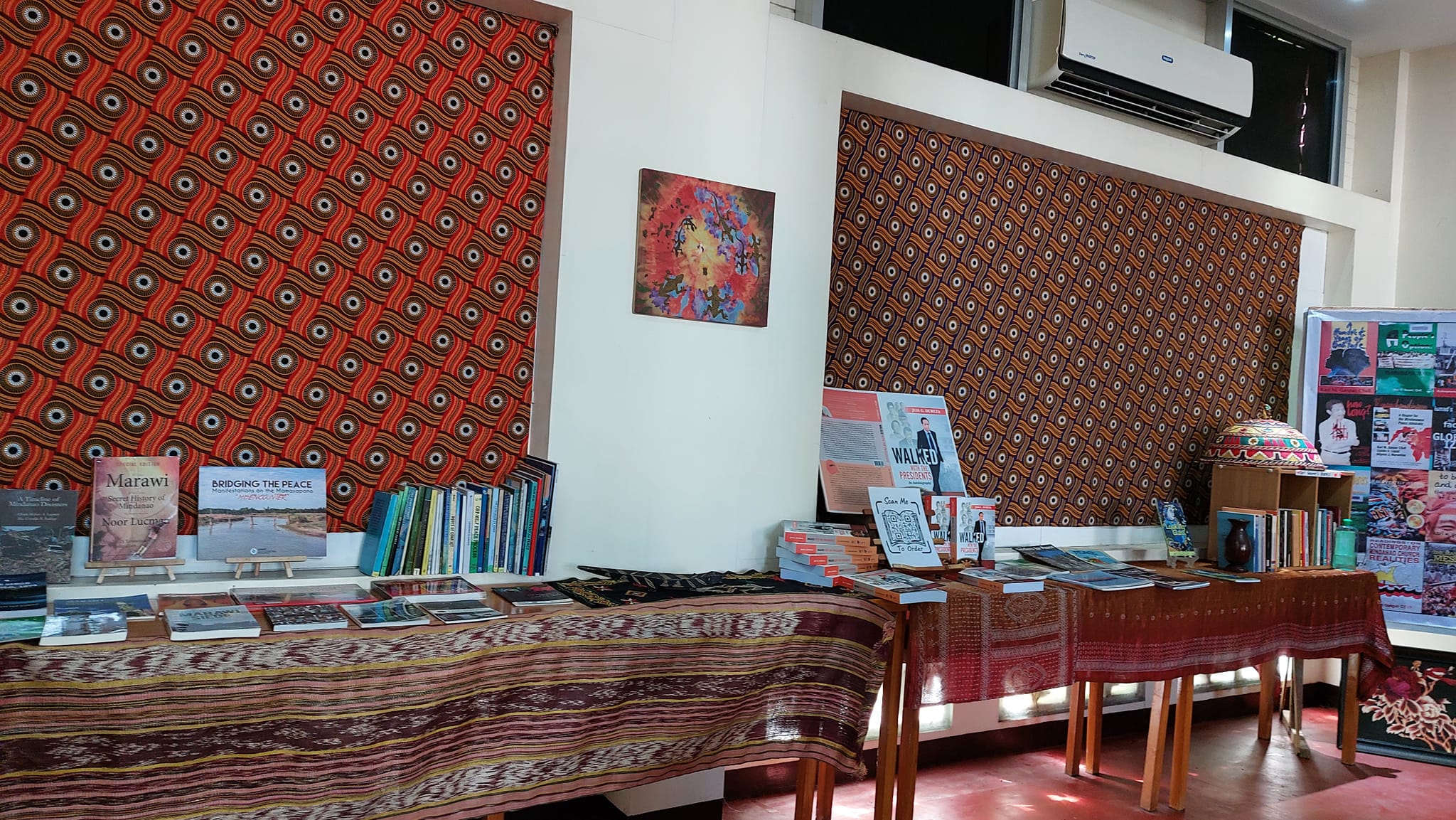
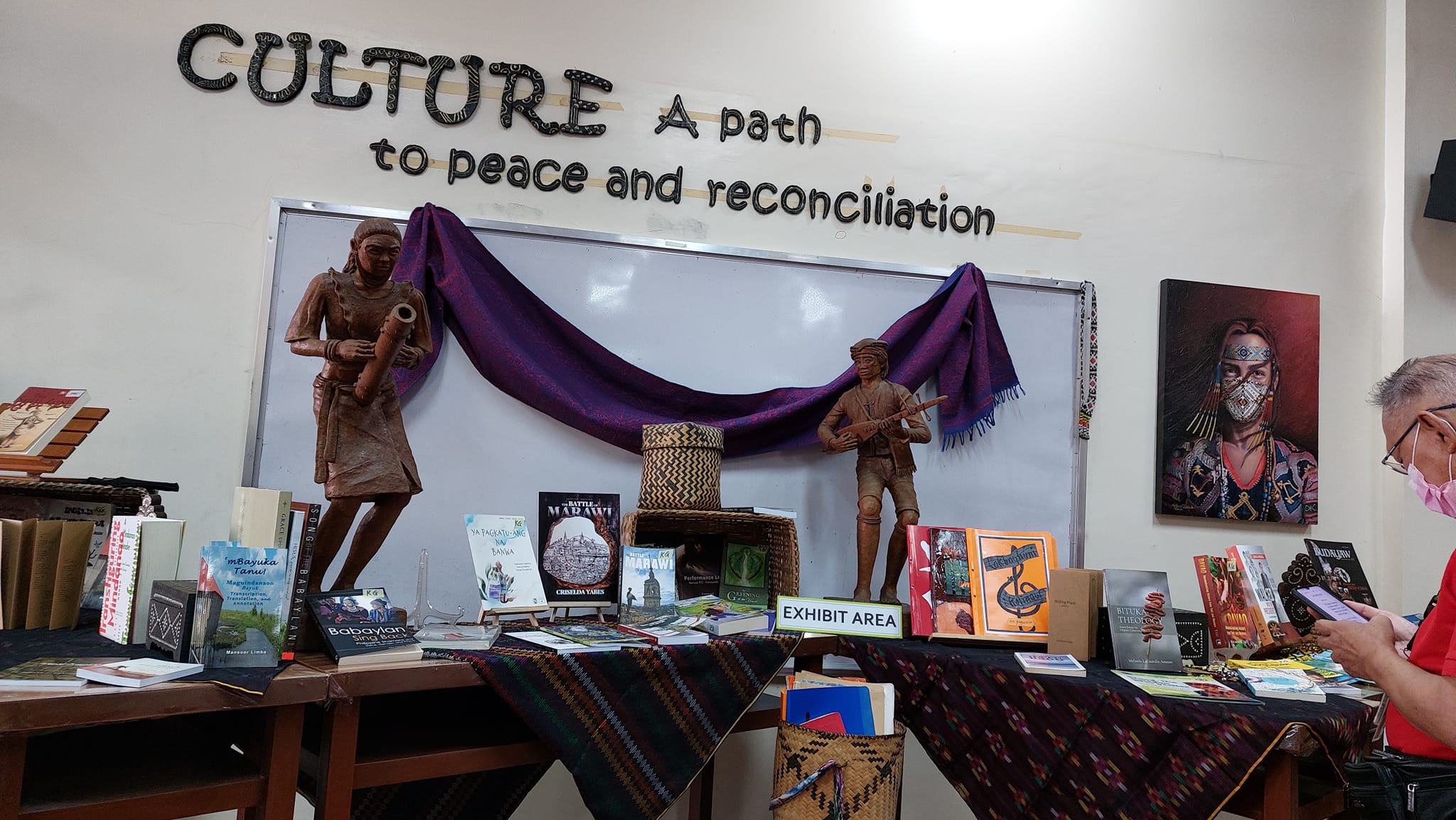
    In the next week (June 13-17, 2022), we celebrate the best that have been offered by Mindanawon authors along with non-Mindanawon authors interested to write about Mindanao.  In many of their works, their writing (WRITE)  has also led to the righting (RIGHT) of Mindanao. There was a time when Mindanao was written from a colonial  lens even as some of these – like the ethnographic studies done during the American period – tried to capture the reality on the ground.

    But viewed from biased and even discriminatory optics, the early writings about Mindanao tended to highlight that which today have been debunked. In the exhibit, you can see examples of these. This was to be expected if the authors were foreigners (with tendencies towards racism and ethnocentrism) or Filipinos from imperial Manila – who monopolized publications for a long while – who relied on secondary data with very little triangulation enriched by immersion among Mindanao’s peripheries.

    However, in the past few decades as there have been more non-Mindanawon authors who have abandoned their colonial/neo-colonial gaze and as more Mindanawons began to get involved in publications, a shift has taken place. Thus beyond the w-r-i-t-e, there has now been a movement among Mindanawon writers to r-i-g-h-t Mindanao, through advocacies for justice and peace, respect for human rights and  civil liberties, solidarity for the downtrodden especially Lumads and for a] advancing ecological concerns.

    One can find this out by goggling the available data on Mindanao Bibliiographies and there have been a few. Perhaps the first Mindanao-Sulu Bibliography was that W.E. Retana’s in 1894. It would take a long while before another one appeared, namely Alfredo Tiamzon’s Mindanao-Sulu Bibliography published in Davao City in 1970.  In the following decades, there were more attempts at compiling a more comprehensive Mindanawon Bibliography, the last one being convened by the Technical Working Group (TWG) just before the onset of the pandemic. This hopes to produce a RoadMap asserting  the importance of Mindanao histories and studies. .

    Why history? Because, in the words of the philosopher George Santaya – “Those who do not remember the past are condemned to repeat it.” And the novelist Maya Angelou posits that “the more you know of your history, the more liberated you are.”  History is of course the telling of stories of the past with the view of parceling lessons to guide us for the future. There is no question that stories are powerful.

    The author Jeff Goins wrote: “I believe in the power of story. Story is where we came from. Story is where we’re going. Story is what connects us and binds us to each other. It is in the story of humanity, amongst love and fear and failure, that we make meaning of our lives. Story is what defines us and sets us apart. It’s what allows us to connect with each other to truly know and be known.

    Stories is what brought to reality the Second Mindanao Week Festival. And privileged are we that during these rare occasions we can gather together with authors, writers and journalists – they who can conscientize, educate, inform, agitate, mobilize,  entertain and humor us through thick and thin!  They whose witness to truth and actual practice in peace-building and promoting justice and development make possible a society that will not allow stupidity, idiocy and ignorance to dominate over our knowledge and information production.

    For otherwise, we will all be living in a world of lies, corruption and power manipulation that could bring us back to the Dark Ages!  It is their presence in our midst  that help to provide us with the possibilities that despite a winter of despair we can still look forward to a spring of hope! 

    (This article was first addressed during the Mindanao Book Festival II at the Redemptorist Community in Davao City as part of the 50th anniversary of Our Mother of Perpetual Help Parish, in collaboration with the MindaNews Media Cooperative Center/Institute of Journalism, SATMI and of the Parish. The exhibit is until Friday, June 17.)