Category: Bro. Karl Gaspar, CSsR

  • THE EVERYDAY LAMENTATIONS OF MOTHER EARTH

    THE EVERYDAY LAMENTATIONS OF MOTHER EARTH

    Have you ever paused at some moment and hear the lamentations of Mother Earth? The sad whisper of the wind as it loses its coolness with the sweltering heat here in the tropics especially during summer?

    And the parched earth crying out for rain that sadly seem to abandon the usual seasons when the heaven’s tears are badly needed to make the rice grow.  And yet when winds and rains reach howling proportions owing to what has happened to the earth’s climate, Mother Earth’s children can just vanish from the face of the earth?

    All of creation today join in this tragic chorus lamenting the utter destruction of their habitat, from the polar bears in the North Pole who have lost their icebergs to the Philippine eagle who have lost their forests. Can you still hear birds twittering in the trees of our backyard or have they all gone to the moon? And are those trees able to offer the much needed canopy under which the children can still play outdoors?

    Or have you been so busy eking out a livelihood, pleasing your boss, taking care of your family members, dealing with the repercussions of the runaway inflation or dealing with mental or physical health issues, that you consider it a luxury to deal with environmental issues? Or you would rather the United Nations, the governments, the oil and mining companies and the big institutions worry and do something about this gargantuan challenge of dealing with climate change?

    I have bad news for you dear reader if you would rather bury your head in the sand and refuse to get engaged in environmental advocacy, no matter if you consider what you can do as just a drop in the bucket!  For as everyone knows now, Mother Earth’s health condition has so deteriorated that if we – all of us whether we hold a miniscule or huge amount of resources – do not act to halt the downward spiral of the earth’s destruction, we are bound to face a dystopian future where life on this planet will become intolerable!

    Lucky for us human beings that way back in January 1969, an environmental activist named Denis Hayes and Senator Gaylord Nelson of Wisconsin teamed up to shake people’s indifference to what was happening to Mother Earth. Each in his own way listened to Mother Earth’s lamentations – especially in the wake of a massive oil spill in Santa Barbara –  and instead of ignoring what they saw was a worsening problem, they acted and the rest is history.

    They knew that what was needed was to widen the public sphere that would deal with ecology and establish a civil society that would bring more awareness to the environmental issues. They began organizing teach-ins in colleges across the US and soon enough more young people go to know more about the impact of pollution on air, water and the rest of the environment. In just a short period of time, they had reached millions and inspired them to be engaged in ecological advocacy through an office that had close to a hundred staff members.

    This then encouraged Senator Nelson to propose an Earth Day and the first took place on April 22, 1970. More than fifty years later, Earth Day every year has mobilized the support of political parties, civil society organizations, academic institutions, media and people of every age, race, gender demographic and educational status. The movement spread globally, and by 1990, more than 200M people in 141 countries were highlighting environmental issues worldwide on Earth Day. EarthDay.org states what this day is all about: “Earth Day is widely recognized as the largest secular observance in the world, marked by more than a billion people every year as a day of action to change human behavior and create global, national and local policy changes.”

    Unfortunately, in a country like ours, our efforts at advancing the ecological movement have not been sustained in a manner that it creates the needed impact. Even as every year we face the consequences of climate change with our typhoons and floods, droughts and landslides, our walk has oftentimes failed to live up to our talk. From the national environmental agencies to the local government units, policies have been crafted, laws have been passed, government bureaucrats have attended environmental conferences like the COP (the one recently in Egypt) and loans have been secured for studies on how to flood control measures can be put in place.

    But if our efforts are to be weighed, quoting the bible we end up with this saying: “Tinimbang ka, nguni’t kulang!” Yes, we can say the spirit is willing but the flesh is weak! Take Davao City as a good example of how the City Hall is responding to the urgent ecological issues. Owing to the strong lobbying of civil society organizations like IDIS, there have been ordinances passed to protect the watershed, to limit the cutting of the remaining trees, to curb the use of plastics and to look into the problem of garbage.

    This is the case where the right hand does not know what the left hand is doing. On one hand, the City Hall passes these ordinances but then the citizens wake up one day and a contrary project has been approved. There are a few good examples: to deal with the problem of garbage, City Hall applies for billions of pesos to build an incinerator which is actually a pollutant and will impact the health of the communities surrounding the site of this project, to ease the traffic between the mainland and Samal Island a bridge is to be constructed and to hell with what happens to the pristine coral reefs which is the best reason to promote tourism to the island, there is a watershed code but they cannot stop the continuing logging in these areas.

    People, wake up. Mother Earth’s destruction is sooner than you think. Listen to the voices of scientists who have gotten tired warning the whole of humanity to get our act together! Is anyone listening apart from the ecological activists whose numbers don’t seem to increase exponentially?  The challenge for us today is to embrace the opportunity to encourage a sustainable future.

    Do something today and gather your family members, friends, co-workers and others that you can mobilize to do something today.  Do not let this Earth Day pass as if you don’t care where our planet is moving towards. Listen to Mother Earth’s lamentations and do something – no matter how modest its results will be – to alleviate our mother’s suffering.

    You can take this challenge into your hands and do any of the following:

    –          Update yourself on the impact of the continuing use of fossil fuels and read more about the consequences of a worsening climate change. There are tons of documents out there for you to goggle in the computer, and films and videos to watch in Netflix and other live-streaming platforms.

    –          If there is a mobilization in front of City Hall, join and carry a placard.

    –          Continue advocating for the non-usage of an incinerator, a change in the design of the Samal bridge to protect the coral reefs, monitor what’s happening to the watersheds of the city and lobby City Hall to implement watershed ordinances.

    –          Find a nearby mini-forest and walk down the canopy of the trees and experience what it is to commune with nature. Join a group who ask for volunteers to grow more trees in the watershed areas.

    –          Refrain from using plastic of any kind when shopping, when buying products and when packing food.

    –          If you are a teacher, get the students to talk about Earth Day and before they go home, ask them to show their concern through making art or reminding their parents to stop smoking and  to not buy junk!

    –          Clean up your surroundings and make sure not to burn the garbage but recycle them. If there are neighbourhood or purok clean-ups, join.

    –          When you sing a lullaby to get your child to sleep, sing Asin’s Kapaligiran song.

    And make a resolution that on Earth Day 2024, you will do much more than what you are going to do today. And in-between Earth Day 2023 and 2024 – every day if it is possible – to commit yourself to comfort Mother Earth by simple acts to alleviate her lamentations!

  • WHEN A CONFRERE TOUCHES ETERNITY

    WHEN A CONFRERE TOUCHES ETERNITY

    An Elegy to a Brother who didn’t get a chance to say Goodbye

    A dark cloud passes overhead as I write this elegy. In the past month, Cebu City has been enveloped in sweltering heat and at high noon, one runs the risk of being melted under the heat of the sun if one goes outside in the cement streets. But as the clouds hide the sun since early this morning, the city is cooler.

    One hopes the April showers will come sometime today as the parched earth is desperately hoping for some rains to fall. But even as the promise of rain brings a temporary relief, the day – with the dark clouds above – is gloomy.

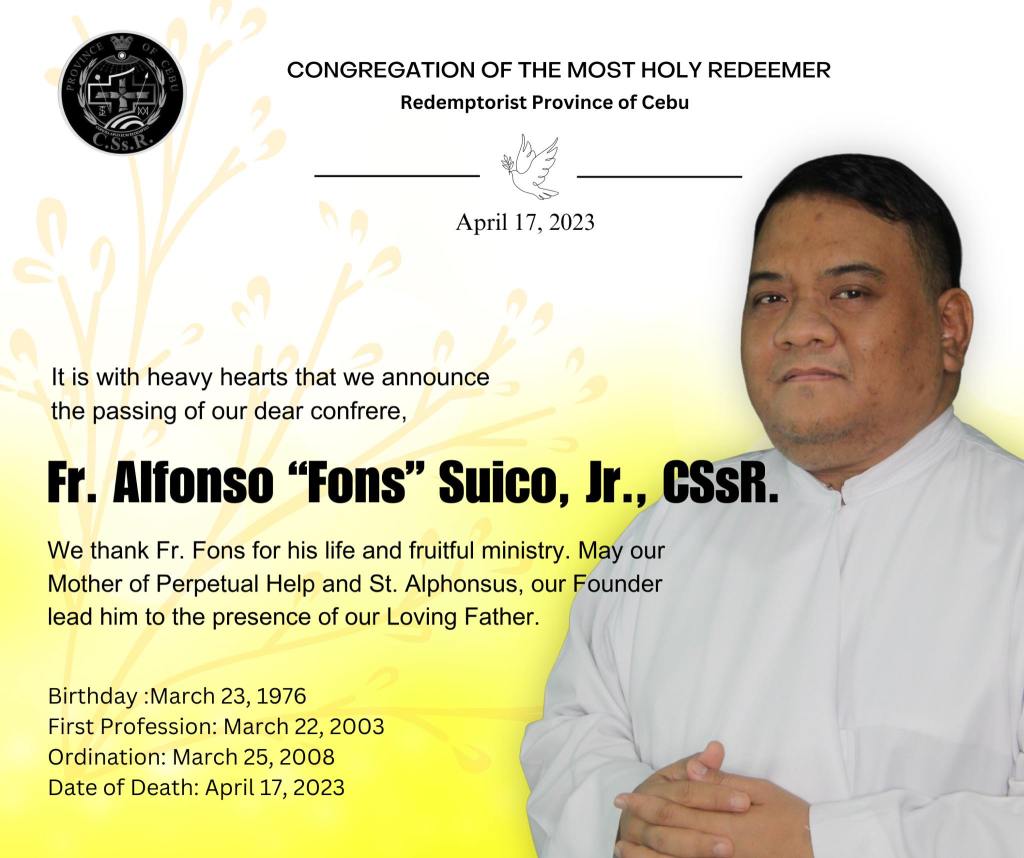
    We wake up to the news that an esteemed and highly cherished confrere-brother – Fr. Alfonso “Fons” Suico, Jr. – left our ranks at 5:38 this morning. Last Monday, April 10 the Holy Redeemer Provincial Center community members went on a post-Easter picnic at a beach outside the city. (I am a member of this community but as I had dialysis sessions during the day, I didn’t join). An accident took place as he and a few others rode a banana boat.

    He fell off the banana boat and nearly drowned at past 2 pm. It took a while before he got rescued and brought to a nearby hospital. By 9 PM, he was transferred to Chung Hua Hospital which had better facilities and was confined at the Coronary Care Unit. The doctors for a week tried to desperately keep him alive, despite the serious damage in his brain. He was on incubator and provided all the medical assistance, even as he stayed in coma and remained unconscious.

    A decision has to be made whether or not to prolong the medical interventions as he – like most of us in the congregation – had signed a document stating his wish that when there is no hope for survival, all medical interventions should cease. Eventually our superiors and the doctors left the decision to his surviving sister, Sharmaine.

    Arriving from the US past midnight of April 17, she rushed to meet Fr. Fons at the hospital and they were able to spend time together in silence. The caregivers still managed to give him a bath at past 4 AM; an hour later, he passed away. He was 47, having celebrated his last birthday with us in the community only last March 23. His family are from Mandaue, Cebu City, although most of his family members migrated to the US.

    I vividly recall that day when he celebrated his birthday for the last time. There were wonderful flowers – big pink carnations, red roses, lilies and baby breath in a beautiful bouquet placed on the table. There was a big feast to which everyone – confreres, staff, gardeners and carpenters – were all invited to partake in this banquet. The food was sumptuous with pancit, lechon, fried chicken, ice cream and a carrot cake! Fr. Fons was effusive during that meal time and we certainly enjoyed the birthday celebration!  Who knew then that less than a month after,  Fr. Fons will later partake of the feast in heaven!

    This was how the official news –  that followed shortly –  characterized Fr. Fons: “Fr. Fons was a brilliant and compassionate missionary, medical doctor and professor in moral theology who has touched and transformed the lives of many.” Professed as a Redemptorist on March 22, 2003, he was ordained a priest on March 25, 2008. Before joining the Redemptorist, he had finished his medical studies and immediately passed the Board examinations.

    He held two doctorates, as a medical doctor and later secured his PhD in Moral Theology at the Jesuit School of Theology in Berkeley. He had been teaching Moral Theology subjects at the St. Alphonsus Theological and Mission Institute in Davao City for the past decade. He has mentored many SATMI students for their synthesis papers and dissertations. He has also been giving talks at various fora and conferences.

    But for us Redemptorists, he was a well-loved confrere-brother. Much younger that those of us who are years older than him, he followed-up our health bulletins to make sure we did our regular medical check-up and followed doctors’ orders for medication.  As we shared the same kidney problems – and years after I began my dialysis in 2016 he also began to undergo the hemodialysis procedure – we constantly were in touch with the progress of our medication.

    When I had my life-threatening health issue last November, he was first to make sure I had the needed medical intervention. Up until I was released from the hospital – after a gruelling three-week stay in two hospitals – he made sure I had the best medical treatment. At the infirmary of the HRPC, he did his best to monitor the caregivers so that they offered the best help to those of us who have been sick.

    One can get used to the easy and secured manner that he looked after all of us that we can now ask the question: what happens now that he is gone? His death comes at a not so opportune time, given the changes of our assignments starting on May 1. In the list of assignments issued by our superiors after Palm Sunday, his name appeared as the next Rector of HRPC.  Those of us who were going to stay here at the HRPC were all delighted with this news and we looked forward to being with him as our Rector.

    When death claims a loved one, the heart constricts and one is at a loss of words. This is especially so if death – like a thief in the night – comes so unexpectedly! The benefit of a long illness is that we are prepared for the eventually if the loved one finally takes a step towards eternity. There is grief but a sudden death is something else; it pierces the heart as heavier emotions flood our thoughts and feelings.

    No matter if words of comfort are immediately relayed by friends and – even as confreres tighten their ranks for mutual support in this time of bereavement – the pain is deep and might linger on for a while. One can seek solace in tears and prayers and the thought that – with God’s mercy – Fr. Fons is now in a much more peaceful, happier and painless space reserved for those whose life was lived fully!

     Parting – Shakespeare once wrote – is such sweet sorrow!  But it takes on an added shade of sadness if the loved one does not get a chance to say goodbye. Lucky are we if there are premonitions of Death arriving at our doorstep; but oftentimes, our intuitions do not work. Even if we are staying in the same monastery and our rooms are just a few meters away, I have taken it for granted that I will bump into him every day.

    The last two weeks are a blur of shallow memories. On Holy Tuesday, we had taken the car, together with two ICM nuns to go to San Carlos Major Seminary for a forum on Synodality. He had arranged the sandwiches we were to share at the forum. On Holy Thursday, he joined the community for our penitential rite. On Good Friday – after I and two companions went on a visita iglesia, I met him at the corridor when we came home and casually told him our visita iglesia was most interesting.

    He had reminded me that after the Holy Saturday Easter vigil we were going to have a Gaudeamus, but the following morning as I greeted him Happy Easter I told him I couldn’t join the Gaudeamus because of my dialysis schedule. During our Easter celebration evening of Easter Sunday, he had taken full responsibility preparing the sumptuous meal and even hiding Easter eggs and chocolate for us to find in different parts of the common room. One could tell he was delighted that we all enjoyed the search for the eggs and chocolates!

    I didn’t get to thank him for the lavish meal as I needed to leave the celebration earlier due to my dialysis session. The following morning he had gone early for his dialysis procedure so I didn’t get to meet him and since I didn’t join the picnic, I was not there when the accident took place. Last time I met him was at the Coronary Care Unit of Chung Hua Hospital last Thursday, April 13, after my own medical check-up. He was unconscious and I couldn’t stay too long in the room as I was very much affected by how he looked.

    We stormed the heavens for God’s mercy so Fr. Fons could be healed. And when the doctors gave their diagnosis of the extent of the brain damage we prayed for a miracle to Our Mother of Perpetual Help!  Each day since Monday, we had waited in  bated breath for the next medical report on how he was surviving. Until finally, the sad news came at dawn today. It seems as if Fr. Fons was just waiting for his sister Sharmaine to arrive from the US so they could still have a few hours together before his departure.

    When I met Sharmaine hours later at breakfast, I embraced her so that I could condole her. But I couldn’t control my tears so she  instead was the one who comforted me. His remains will be cremated tonight and will be brought to their home in Mandaue where the will hold the wake from April 17 to 19. After that his remains will be transferred to the Redemptorist church where the wake is scheduled on  April 19 to 22, after which it will be interred at our parcel of land at the Caretas Cemetery.

    At this juncture, part of what we – the ones left behind – grapple with is to find meaning in the occurrence of an unexpected death. For some time now, I have thought that there comes a time in our lives when we become much more conscious that we are on borrowed time; that we have entered a pre-departure area and we can only be at peace if we realize that each day is a gift and needs to be lived to the full! There much be deep meanings why we are gifted with life even as this can just snap out any second. But perhaps the meaning is as simple as what Franz Kafka had written: “The meaning of life is that it stops!”

     We are still in the Easter Week and we believers are supposedly reminded that our life is like a seed; it is sown at one moment, and if lived well could produce so much fruit but only to fade away in some future time. However, as we are promised by no less than the Redeemer who offered his life so we may have life everlasting, we have no reason to fear death. And every step leading us to eternity should be taken with a deep confidence that the end of the journey is the home that we are all destined to reach when time is up!

    And in that place out there beyond the skies which Fr.  Fons right now has claimed as his own, a grand welcome awaits him and us who will follow in the fullness of time. And one is consoled at the thought that this is a truly delightful place with flowers and food, laughter and good cheer, with music and dance – all the good things that one associates with the plentiful blessings!

    And Kahlil Gibran gives us this assurance:  “For what is it to die but to stand naked in the wind and to melt into the sun? And when the earth shall claim your limbs, then shall you truly dance.”

    May the light and joy that Fr. Fons  left this world radiate through us as we continue to carry and share his beautiful memories. 

  • IN THE FOOTSTEPS OF THE RISEN LORD

    IN THE FOOTSTEPS OF THE RISEN LORD

    Footsteps.

    When we walk, we hardly take cognizant of the footsteps we take unless – like the Buddhists – we are so mindful of the here and now, the precious present moment.  It is only when one focuses on the movement of his feet while walking down a path, that one is struck with the importance of taking footsteps.  For as the Chinese proverb posits: A journey of a thousand miles begins with a single step!

    As we celebrate Easter Sunday today, it might do as good to reflect on the value of taking footsteps vis-à-vis our faith as followers of the Risen Lord. After all, his admonition – “Come follow me!” – involves literally moving our feet as we go after the Redeemer!

     Jesus lived on earth at a time when people could only move from place to place by walking. In some cases, horses and donkeys assisted them as they travelled. Unlike today when the advancement of transportation technology allows us to travel long distance through planes, boats, trains, buses, cars, even the lowly habal-habal, those living in the first century had to rely on their feet if they wanted to be in another place.

    Being an itinerant preacher-healer, Jesus himself walked practically all over Israel. While born in Bethlehem, he grew up in Nazareth. When his public life unfolded and he went out to preach the Good News, he travelled from Nazareth to Bethany, Bethesda, Capernaum, Cana of Galilee, Jerico, reaching the Jordan River and the Sea of Galilee. In his three-year public life, he walked more than a thousand miles.

    Some of the footsteps he took would take on biblical significance! Among these were those footsteps traversing the desert for forty days when he needed to get ready for his mission, his walk cum ride-the-donkey from the countryside to Jerusalem, his walk across the seashore as he met the fishermen who would become his loyal followers and later when he appeared to them after rising from the dead, and his walk with two forlorn followers on the road to Emmaus.

    The most dramatic, of course, were the footsteps he took from the garden of Gethsemane to the palace of King Herod, to the court of Pontius Pilate until he ended up on Calvary Hill. This route  – now labelled the Via Dolorosa –  has become the focal point of interest for tourists who fortunately find their way in Israel on Good Friday. 

    On top of this mournful hill, the carpenter from Nazareth – reviled by the Pharisees as a false prophet;  who hobnobbed with drunks, sinners and prostitutes;  who the powers-that-be considered a rebel out to subvert the established regime and tortured by the Roman soldiers as a means to warn other potential would-be “terrorists,” – was subjected to a crucifixion on a cross, fit for criminals!

    That last step Jesus took as he faced death, eventually ended his earthly life.

    At dawn of Eastern morn, the sound of footsteps echoed across the graveyard where Jesus and others were buried. These were footsteps first of women, later followed by a few of the more courageous apostles curious as to the women’s testimony that the tomb was empty! And most interesting, it was a woman – Magdalene – to whom Jesus first appeared as the Risen Lord!

    After Jesus appeared to more of his main followers and trusted disciples, he gathered them together for what is now known as the Great Commission (Matthew 28:19-20) and left them with these words:  “Therefore go and make disciples of all nations, baptizing them in the name of the Father and of the Son and of the Holy Spirit, and teaching them to obey everything I have commanded you. And surely I am with you always, to the very end of the age.”

    Gifted with the Holy Spirit on Pentecost, many of them, including a new convert – Paul of Tarsus – walked to many directions beyond Israel to give witness to the life and teachings of the Lord.  And despite the passage of time and the great advancement of transportation technology, in many Third World countries today, those who bring the Good News to the hinterlands, follow the way of the early disciples. They walk miles to reach the isolated villages.

    It is thus, very appropriate that in 2021 Pope Francis inaugurated what would be a synodal Church for these present times. To be a synodal church involves getting all the baptized to journey together as one in the footsteps of the Lord, with great effort exerted to make sure that those who for so long have not been afforded a place in the Lord’s banquet, can finally find themselves in the place of honor!

    This was Jesus way; moving from village to village, his focus was to journey with his society’s excluded, the sinners considered unclean and worthless. He avoided the elite, the powers-that-be, the ones who oppressed the poor even as he did not exclude them from his circle if they showed an openness to repent and make amends!  He disdained pomp and pageantry, he lived simply without benefit of having a place to stay, comforted the widows and healed the sick. In the process, the Good Shepherd smelt like the sheep!

    Alas, when Christianity shifted to Christendom and the Church’s memory of the way of life of Jesus faded, the ugly head of institutionalization and clericalism penetrated the walls of churches, monasteries and convents. Patronized by kings and emperors. ensconced in palaces to enjoy the perks of power, the Church’s heads veered away from the footsteps of the Lord! And the Gospels they preached held no relevance anymore to the lives of the majority who remained in the margins and disenfranchised of their human rights.

    If the Church today hopes to return to the dangerous memory of Jesus’ act to save humanity, she has to embrace Pope Francis’ synodal agenda. The question is: how many of our  church leaders and engaged laity are making sure that this agenda is not lost in the quadmire of a Church’s struggle to remain relevant in these post-modern times?

    In the VUCA (Volatile, Uncertain, Complex and Ambiguous) reality of the world today, Christianity is faced with a major challenge to return to its roots. Jesus presented the model of a synodal church – his footsteps made possible his journeying with society’s excluded – which challenged an established religion that was hijacked by those who would promote a faith that was blind and obedient to those in power. It was in this context that Christianity was born. If we are to redeem what Jesus founded, we, too, in our times will need to do our best to help build a synodal Church, in spite of the reluctance of our leaders to forge this kind of journey with the rest of us!

    Along with Pope Francis, we take the footsteps towards this goal buoyed by the Risen Lord! Happy Easter everyone!    

  • KUMUSTA NA, MGA MILLENNIALS?

    KUMUSTA NA, MGA MILLENNIALS?

    Last March 16, 2023, I was struck with a short item in The New York Times. It indicated  in the paper’s Opinion Essay written by Jessica Grose, the author’s opinion that millennials today are already hitting middle age. The sub-text is that it is happening much sooner than other generations of the past.

    Just to review: who are the millennials of the world today? They are those born between 1981 and 1996  (ages 27 to 42 in 2023). Previous to this group is Generation X and on the other hand, those born in 1997 onward are now referred to as Gen-Z. Ordinarily the onset of a middle life crisis hits only after 50 years old or even in the 60s. One common belief about this stage of life is that one should expect to face a crisis that brings inner turmoil about one’s identity, life choices and the question of mortality.

    What are the causes of an earlier mid-life crisis among millennials, especially in First World countries such as the USA and Western Europe. Grose lists the following: the overlapping economic crises, growing fears about democracy, multiple wars and a pandemic that lasted two years. Thus, she claims that the generation’s once-mocked optimism has been deflated and a sense of precariousness has taken root instead.

    Grose adds that despite the fact that the millennials do not have the same income level as the boomers (the one of their parents), there has been an increase in the usage of Lexapro. Lexapro is brand name of Escitalopram an antidepressant of the selective serotonin reuptake inhibitor class. Escitalopram is mainly used to treat major depressive disorder and generalized anxiety disorder. A disturbing fact, indeed, but then many psychiatrists and psychologists have complained that since the pandemic, the demand for their services have exponentially rose to higher levels.

    How relevant is this piece of information to Third World countries like the Philippines? Being underdeveloped perhaps there might be differences as to how the millennials in the Third World are coping with the global and national changes occurring. But then, the economic woes and the impact of the pandemic are worst in the Third World, so one can conclude that our very own millennials may not be too different from those in the West. Besides, especially the millennials of our urban centers (and even in rurban areas where the internet technology has reached the youth), they too have been captive to the gadgets made available by high-technology manufactured mainly from the West (and of course China!).

    What are the implications for institutions like the Church and cause-oriented groups (e.g. non-government organizations including those that are faith-based)? Specifically for the vocation recruitment program of dioceses and religious congregations? There are those who actually still recruit from senior high school to college level (who are mainly now the Gen-Z), but there are more efforts to recruit young professionals, who are mostly in the 27-42 age range, namely the millennials of today.  It is even said that where before of the boomer’s generation, at age 18 one was already considered an adult and presumed to be a matured person, today one is not even sure if some of the millennials are at this maturity level.

    Nonetheless there are more efforts now attracting the attention of this age range in the hope that they can be recruited to join the formation program to become either a priest or religious.  There goes the rub. As hard as they will try, vocation promoters may have a more difficult time these days attracting the attention of the millennials if it is true that they are into their inner turmoil! Or they will have to find more creative ways to convince those – who might consider the possibility of a vocation to the priesthood or religious life – to at least attend a search-in and hopefully to pursue a formation program.

    And once they have joined a formation program, there is great need as to how to assist them in dealing with their inner turmoil if this has remained an agenda for them.  Fortunately, formation programs today do incorporate processing through which the formands are provided psychological or other forms of assistance so they can deal with their troubled “inner child.”  The challenge, however, remains how these processing methods could be inculturated into our Philippine context.  And needless to say, the kind of formators required today are those adept at dealing with millennials with their issues, not intimidated with the peculiarities of this generation and have the required compassion to be true companions to a generation that are “wounded.”

    This, too is a challenge for those who are in civil society organizations (formerly referred to as cause-oriented groups) especially non-government organizations and faith-based agencies.  Second-liners are so much in demand as those who are still holding on to positions of authority are the remnants of the boomers generation and also the martial law babies (the Gen Xers). CSOs are greatly demanded in countries with pretensions to democracy and yet have authoritarian elements in its governance system.  However, the continuity of these CSOs is dependent on how present generations can take over from their elders. With this phenomenon of millennials faced with a crisis, how many can we hope to recruit from them to take over the leadership roles in CSOs?

    Or shall we pin our hopes on the upcoming Gen Z?  But as the world remains in a VUCA reality (Volatile, Uncertain, Complex and Ambiguous) Reality,   is there much hope for the future?  Are those in the Gen Z generation (age range from 6 t0 27) the upcoming youth  that might not fall into the same trap as the millennials and will face the future with greater optimism?  We can only hope so in the belief that in life there are ups and downs. And that possibly GenZ might emulate more the example of the boomers.

    And for as Redemptorists: if we are to be messengers of HOPE in the footsteps of the Redeemer, we can only hope that even among the troubled millennials we can still attract a few of them who would join us as they opt for a life where they can be instruments of plentiful redemption!

  • IN SEARCH OF THE TRUE MEANING OF THE FEAST OF THE EPIPHANY

    IN SEARCH OF THE TRUE MEANING OF THE FEAST OF THE EPIPHANY

    The Epiphany of the Lord

    Many decades ago as we were growing up, January 6 was celebrated by the Christian world as the Feast of the Three Kings. The event being celebrated was the arrival of Melchor, Gaspar and Balthazar in Bethlehem to offer gifts of gold, frankincense and myrrh to the newly-born child whom they came to worship.

    Today, liturgically this is known as the Feast of the Epiphany (referred to as Theophany for Eastern Christians). Epiphany means the manifestation of a divine or supernatural being and for us Christians this feast celebrates the revelation of God incarnate in Jesus. Instead of referring to the three visitors as Kings, they are now more popularly known as Magi or Wise Men.  Across the world the celebration can range from January 6 to whatever is the Sunday nearest this date.  Thus in our country, it would be celebrated on January 8.

    Except for Matthew (Mt 2: 1-23), the narrative involving the three Magi does not appear in the accounts of the three other Evangelists. It is a very brief account where the tyrant ruler Herod is also mentioned.  There are very few details that help us know the wise men better except that they were from the East and that their journey to Bethlehem was guided by a star. Otherwise, the narrative ends up as a mythical story shrouded in mystery thus leading to all kinds of conjectures.

    Consequently, many have deconstructed the text and provided a deeper meaning to this narrative. Just this year on the Feast of Epiphany (celebrated at the Vatican with Cardinal Luis Tagle presiding and Pope Francis giving the homily), the Pope provided us his own reflection of the meaning of the Epiphany. Thus, his words:

    “The Magi’s restless questioning and continuous journeying in dialogue with the Lord finds its end in the worship of God… Like the Magi, let us fall down and entrust ourselves to  God in the wonder of worship. Let us worship God, not ourselves; let us worship God and not the false idols that seduce by the allure of prestige and power…  let us love God and not bow down before passing things and evil thoughts, seductive yet hollow and empty.

    The purpose of everything is not to achieve a personal goal or to receive glory for ourselves, but to encounter  God. To let ourselves be enveloped by his love, which is the basis of our hope, which sets us free from evil, opens our hearts to love others, and makes us people capable of building a more just and fraternal world.”

    We can further reflect on how this narrative relates to our contemporary life in our own society and focus our reflection on who were these wise men? The biblical reference indicates they were from the East, which should make it interesting for us Filipinos as we are in this part of the world – the East or the Orient. Some writers theorized that they came from the nearby countries of Israel, namely Persia (now Iran) even as far as India.

    But why were they referred to as wise men? Relying on ethnographic data providing us data  on the Oriental civilizations existing long before the West entered into its Industrial Revolution, there were advanced societies already existing in the Orient from China to India to the Arab countries. They had developed the various fields of philosophy and science, much earlier than the Western world.

    Thus, we can conjecture that Melchor, Gaspar and Balthazar – as they were guided by the star – had knowledge of astronomy if science had developed to that extent during that era. There is, however, one better explanation that anthropologists would posit. Could they be shamans who had developed the gift of communing with the supernatural?

    If they were coming from the East, what faith traditions have evolved in their societies? While there were established religions already during the reign of Herod in other parts of the world and in Israel (Hinduism, Judaism, etc.), Islam and Christianity were still to evolve. But were the magi also shamans who served as ritual officiants of their communities which were ensconced within an indigenous belief system?  We know for a fact that across the world and through the centuries, shamans have developed a keen sense of understanding the mystical realm.  Could this have been the case of the three wise men?

    Perhaps it is futile to have the answer to this question even if there theologians who would like to pursue this question in dialogue with anthropologists. However, we can expand the search of meaning and link it with our attempts to better pursue some of the pastoral challenges in our post-Vatican II Church especially in the discourses of inter-faith dialogue and inculturation.

    A fundamentalist reading of the Matthew text would insinuate that as the magi worshipped the child as God, they had abandoned whatever faith tradition they belong and embraced a new faith. On the other hand, a progressive reading of the text allows for an encounter of faith traditions in dialogue with each other. Thus the Matthew narrative would be very useful for advocates of inter-faith dialogue, as one of the first events in Jesus’ early life pointed to the possibility of faith traditions entering into a dialogue with each other.

    In this day and age, when there are still countries where different groups of believers – Christians, Jews, Hindus, Muslims, Buddhists and others –  are engaged in conflicts leading to the eruption of violence, the encounter of Jesus and the Magi provide the hope that a day will come when all faith traditions would learn to embrace the gift of an encounter that brings peace!

    When that moment arises, all of earth’s people of goodwill can truly celebrate all together a feast of the Epiphany no matter what faith tradition they worship God (in whatever God’s name is invoked!).