Author: A Dose of God Today

  • NAGMAHAL AT UMASA

    NAGMAHAL AT UMASA

    An Advent Reflection by Mabie Gonzales. Mabie is the Assistant Over-All Goal Animator of RYM-Iloilo (Redemptorist Youth Ministry) and a Youth Mission Volunteer.

    Advent is a “Season of Joyful Waiting, a Season of Hope.” This is what the song, “O Come, O Come Emmanuel” beautifully describes to us. This season prepares us for Christmas.

    Well, have you realized that while we wait for Christmas to come, there is a different aura during December?

    People tend to be more generous, more smiling, more concerned and more loving. In every place, we see decorations around, we hear joyful music, we hear glad greetings. Advent indeed, prepares us for that wonderful day on Christmas. And it is because of Advent, of this time of preparation and of joyful waiting that makes our heart flutter and be full of excitement. Advent is not only the season in which we prepare for Christmas but it is also the season of loving and hoping. Tonight,  let us allow ourselves to be embraced by these two Filipino words – NAGMAHAL AT UMASA.

    For you, what does loving and hoping mean? And how do these two go?

    According to the Oxford Languages Dictionary, Love is an intense feeling of deep affection while Hope is a feeling of expectation and desire for a certain thing to happen. Now, the word MAHAL has two meanings. The Tagalog word mahal as a noun means ‘love’ but as an adjective it means ‘expensive’ or ‘costly’ or ‘dear.’

    Mahal ang tunay na nagmamahal. It is expensive to truly love. What does this mean? Why is it expensive to love? Financially speaking, we will think that it is expensive because you’ll think of what to give during, month-saries, anniversaries, birthdays, Christmas, and other occasions. This expensiveness of love doesn’t end there. Aside from the money that we spend, we also spend our time, effort, our presence, service, energy, commitment, and any other acts of love.

    In my previous relationship, I have experienced giving and receiving gifts. I would even spend my money to buy that person something for a midnight snack, would make my time free for us to be able to see each other. I would sacrifice some time just for us to be together. As time passed by, I would still receive some gifts, but unfortunately the time and presence of that person slowly faded away. At first, I was in denial, letting myself think that that person was just busy, has his own life and I was just part of it. YES, gifts do really make me happy but when I think of it, gifts are just nothing compared to the presence and time that I seek from that person.

    I can easily buy gifts, but how can I buy that person’s time and presence? It made me think that time and presence of that person is more expensive than tangible gifts.

    We measure the value of an item usually based on how much we paid for it. Some common things that we see are cheap because we can find them anywhere. But the cheaper it is, the cheaper the quality. Yet, we tend to find things that are great in value. Thus, we determine that the more expensive is more valuable.

    Love is expensive, indeed, because it is one value that we humans have. It is expensive because each and everyone of us desires it, but only few are interested and invest with true love. Love is not just all about the gifts we receive and give, but it also requires that willingness to experience all the emotions and give all our life. And that made love expensive.

    Now, from the experience that I have, it made me also think that God’s love for us is not cheap. God’s love is expensive. How? It cost the Almighty God Himself to show us what Love is. God’s love for me is unconditional and infinite. He saved me from that relationship. He picked me up when I was really down. He showered me with love through the people around me, my friends, family, and co-youth.  The time, effort, and the life of people around me are expressions of love that God has given me. And these are all expensive.

    As we love expensively, we sometimes lose what we have, lose our life, lose ourselves. This is how the Lord expressed his love for us as well. Jesus emptied himself, to become human like us and becoming vulnerable and powerless, yet, the Lord continues to hope and still hoping that we will fully embrace him, welcome him and be with him.

    As a youth, what are the things that you hope for? Ano ang inaasahan mo? I asked some of my friends and the most common answers are first, freedom. Freedom to choose, speak, stand and think on their  own, and some would live on their own – to be independent. Second, good or high grades. Pressured or not, youth hope for high grades in order to achieve with honors or with high honors. Some hope for this because they want to make their parents proud and some would just like themselves to excel. Third, the youth hope to become physically and mentally healthy. Youth hope for this because, we want to live forever young.

    Personally, those are also my hopes but in addition, at this moment, I am hoping for healing, good relationships in the future, more wisdom and success in my Teachers’ board review. Healing from what? Healing from traumas, heartaches, and pressures. If this healing would be successful, it could lead to good and healthy relationships, not just migo-miga, jowa-jowa relationships but also relationships with our family, friends, co-youth, classmates.

    I am currently in a review to take the March 2023 License Examination for Teachers, I am hoping that I will pass the exam and by God’s grace, TOP the exam. Walang masamang mangarap, walang masamang umasa.

    Hoping is a sign of life, a part of a person. You are not truly living if you are not hoping. The virtue of hope challenges us and empowers us to be determined, resolute, intentional, purposive, and steadfast. Hope is not wishful thinking or just passive waiting. It means that whatever we hope for we have an intention, we live a life with a purpose. We live hopeful lives. A person who lives knowing that there is hope in every challenge, has been shaped by the setbacks or disappointments – yet that person chose to get back in order to be a model of hope for others.

    In this time of advent, as we wait for Christmas, we can express our hope through these three points that I have.

    Give time and attention. If you want to give hope to others, listen to them just like God who listened and waited for us to come to Him. If you think you can’t help, just listen to them. The fact that you offer and give  them your time and attention, would make them feel that there is hope in life.

    Offer Help. Do a random act of kindness. For example, you can help your parents plan on what you can help for the preparation of Christmas. You can help with the house decorations or for your meal plan. Another is that you can give help to street-dwellers by giving them food or even asking them what kind of help they need.

    Be hopeful yourself. Remember, we cannot give what we do not have. Show people that you’re negative then they too will think negative but when you show them hope, joy and even love, they too would feel the same. If you want others to become hopeful, be a person full of hope. Work hard and be a source of sunshine and hope for others.

    In this season of advent, we are invited to join in God’s patient love by reaching out to those who have wounded us in the past, by giving ourselves to those who do not reciprocate our love and by caring for those who have not cared for us. In Advent, we are called to remember that this is how God has loved us. Let us also take time to remember at this time that God is both the light at the end of a long tunnel and our faithful companion who will never desert or abandon us.

    To all the youth, I have a challenge for you. Take time to sprinkle love and hope and in order for this to happen,  I  challenge you to become bearers of Love and Hope to the world. Hangga’t tayo ay nabubuhay tayo ay patuloy na magmamahal at umaasa.

  • OUR FAITH IN THE MESSIAH

    OUR FAITH IN THE MESSIAH

    December 4, 2022 – Second Sunday of Advent

    Click here for the readings (https://bible.usccb.org/bible/readings/120422.cfm)

    Have you ever encountered a leader who is filled with vanity and only thinks of himself or herself? A leader in a group or in an organization, or in a company or community or in a nation who has become pretentious but insecure can be very dangerous. It would be in this kind of leaders that we find persons who have no intentions to serve others but rather abuse the authority conferred upon them for their personal advantage and comfort. This is how we suffer because of such ruthless, incompetent and corrupt leaders which may happen even in our small groups, organizations, companies, communities, churches or even countries.

    Our failure as people is when we become indifferent, lenient and have no concern when our leaders turned against the weak and powerless. When members of an organization or even in a small community would play blind over the dishonest dealings of a leader, then, members start to condone and perpetuate such abuses.

    The Hebrew people to whom the Book of the Prophet Isaiah was written had this similar experience. The people had been through a lot of suffering and disgrace. The people suffered because of their incompetent, selfish, abusive and corrupt leaders. Both their religious and political leaders had turned against the weak and the powerless in their society. The appointed leaders who were given authority to build the nation and uplift the people, were the very ones who caused suffering to many. This was how the prophets were chosen in order to call the attention of the leaders and give hope to the suffering people.

    This is what we have heard in the first reading on this Second Sunday of Advent. Isaiah tells us of the birth of a child who will be the Messiah. This child shall restore order, peace, harmony and prosperity through reconciliation and forgiveness of sins, through change of our way of life.

    Isaiah tells us of the person of the Messiah. His arrival will be as silent as a shoot sprouts or as a bud blossoms. Many will not notice his coming for it will be completely no grandeur. It will be simple yet powerful because he has the Spirit of the Lord. He confronts the wicked and the corrupt. He defends the poor and heal the afflicted. He is just and faithful. He brings peace and harmony to all. He is gentle and not violent.

    This is the very hope also expressed in our Psalm today that, “Justice shall flourish in his time and fullness of peace forever.” This is God’s promise which reminds us of the event in Bethlehem, the place of birth of the Messiah. Holding on to this promise of the birth of the Messiah, calls us now to faith. Thus, the second candle of advent has been lit. That is why, that candle is called the Candle of Bethlehem and Candle of Faith.

    Besides, the second reading from the letter of Paul to the Romans invites us to be open and welcoming of everyone, not to be discriminating. Paul expresses this call in two points. First, Paul prayed, “May the God of endurance and encouragement grant you to think in harmony with one another.” This tells us that living in harmony is an act of giving glory to God because the Lord is a God of community. Second, Paul taught, “Welcome one another, as Christ welcomed you.” This tells us that to be able to embrace one another despite our differences, also gives glory to God. Welcoming others is an expression of God’s presence among us.

    Therefore, having harmony in our community, showing compassion, justice and concern for each one is what the Lord calls us to be. This is also what we are hoping for, a time of peace.

    Both readings from Isaiah and Paul are addressed to the unfaithful and the faithful people, to the oppressors and oppressed, to the poor and the rich, to the powerless and the powerful. Indeed, a time of peace shall come through the “birth of a child.” This is the birth of the Messiah who shall come with peace and joy. This is God’s expression of faithfulness to us.

    Yet, this promise also brings an invitation for us and that is to REPENT, to change our wicked ways, to reform our selfish and evil intentions. This is what the Gospel of Matthew tells us through the person of John the Baptist. John, a cousin of Jesus, prepares us to welcome the Lord fully and joyfully, without reserve, pretentions or conditions. John also expressed this in two points. First, to repent, for the kingdom of heaven is at hand. Second, to prepare the way of the lord and make straight his paths.

    The very life of John is a testament of that call to change our ways by “acknowledging our sins.” However, the acknowledgement of sins here is not about our petty-personal-habitual sins that we usually confess. Indeed, there is something lacking in our conscience when we can only see those petty-personal-habitual sins and limit our awareness on our failure to attend Sunday Mass, in our failure to say our prayers, or in telling white lies and our sexual fantasies. Yet, when our heart is blind and indifferent to the many “social sins” in our institutions and communities, our conscience is truly limited or worst damaged! This makes us sick!

    Social sins exist in our groups and communities that condone any structure, or belief or culture that oppresses and abuses people or even the environment, that violates human dignity, suppresses freedom and imposes great inequality.[1]

    That is why, John especially called the attention of the many Pharisees and Sadducees who came to see him. These people were leaders in their communities who cannot even get along with each other but both held power over the people. Both tend to abuse their influence over the people for their own personal advantage.

    Therefore, John calls us to acknowledge our sins of “indifference to corruption and dishonesty, in condoning and tolerating these practices in our institutions and communities, in our failure to side with the poor and the economically disadvantaged, and in our failure to uphold justice.

    Thus, this Second Sunday of Advent invites us now with these three points of reflections.

    First, to fully acknowledge our social sins as individuals and as a community.

    Second, to be more available for God and others. This means that we are called to build among us a culture that is sensitive and aware of the needs of others.

    Third, this calls us to faith, faith in the Messiah that we ourselves will become his presence today as we commit to work for justice, to defend the powerless and to resist the temptation of dishonesty and corruption in our institutions, workplaces, organizations and communities. Kabay pa.


    [1] https://www.wearesaltandlight.org/learn-together/understanding-social-sin

  • CHANCE

    CHANCE

    December 4, 2022 – Second Sunday in Ordinary Time

    Click here for the readings (https://bible.usccb.org/bible/readings/120422.cfm)

    “Repent and Believe the Gospel”, sounds familiar? When was the last time we heard those words? We usually hear those familiar words during Ash Wednesday, when we receive the ashes to mark the beginning of our Lenten observance.

    This call for repentance and faith is the first challenge Jesus posts on us when He preached to us God’s kingdom. All His life has been dedicated to preach to us the Good News that God’s kingdom and Word are upon us. And the first response expected of us is “to repent and believe the Gospel”, i.e., the call for repentance and faith.

    Once again, we hear the same call to repentance and faith as forewarned by John the Baptist in today’s gospel. “Repent for the Kingdom is at hand”. Same message and challenge is presented to us: Since the Lord at hand is coming, Repent and Believe in Him then.

    But what does repentance and faith mean? What does it mean to repent and believe in the Gospel? What does it require? What do we have to do?

    To repent and believe, First, we should realize that “there is something wrong here” i.e., something is missing or lacking, or something out of sync or tune “yabag” happening in one’s life. Second, we realize and admit that “I am the one who is wrong here” and that there is no point of blaming others. Third, we admit that “I need to change and I need help” recognizing God’s mercy and the assistance of others. Fourth, we make a resolution that “I want and choose to be better than this”. And lastly, we commit to someone and something good and better in life, i.e., we declare “I believe in God”.

    The challenge of repentance and faith requires then the realization that “There is something wrong”, the admission that “I am wrong”, the recognition that “I need help and need to change”, the resolution that “I want and choose to be better”, and the declaration that “I believe in God”.

    Somehow It is like a special person is going to visit in your house soon. You realize how messy your house is, and start to worry how to welcome your special guest. Then you begin to realize & admit that it is not only your house, but moreso yourself is at mess. Then you try to do something and ask for help. In doing so, you resolve to make your house and yourself better because you now believe that your special guest look up to you and you guest’s visit will give you a chance to make life meaningful and better.

    Somehow, repentance and faith also remind us of Peter and Judas Iscariot. Both are apostles of Jesus, even the most beloved and trusted disciples (leader-treasurer), and have sinned against the Lord (denied-betrayed). What is the difference between them? Judas killed himself. He did not wait for the risen Lord to resurrect. He did not give the Lord a chance to love and forgive him again. While Peter waited for the risen Lord. And thus gave the Lord, a chance to love and forgive him, and himself a chance to be loved & forgiven by the Lord again and anew.

    To repent and believe in the Gospel, then is our way of giving the Lord the chance to love and forgive us again and anew. It is all about giving God as well as yourself and others another chance in life.

    The sacrament of reconciliation – popularly known as confession is our Catholic faith and our church way of expressing our repentance and faith. During this Advent Season, we are encouraged to go to confession as our way of repentance and faith to God so that the Lord have a chance to love and forgive us again and anew.

    Last Sunday, on the first Sunday of Advent, we are challenged to “Stay Awake and Be Prepared for He is coming”, today we are challenged to “Repent for the Kingdom of God is at hand”.

    As we once again open our eyes, ears, minds & heart’s to prepare for the Lord’s coming into our lives, in our faith & repentance, may we always “repent and believe in the Gospel” so that His kingdom of love and forgiveness have a new chance to be with us again in our daily lives now & always. Amen.

  • We too can bring others closer to Jesus

    We too can bring others closer to Jesus

    November 30, 2022 – Wednesday Feast of St. Andrew, Apostle

    Click here for the readings (https://bible.usccb.org/bible/readings/113022.cfm)

    Who was that significant person who brought you closer to the Church and closer to Jesus? I am sure, each of us here has a particular person or people who became significant in our faith journey. Others could have their grandparents who were the very instruments for them to grow in their Catholic faith. Or perhaps a relative, a parent, a sibling or a friend, or an intimate friend who inspired us to come to Church and encounter God.

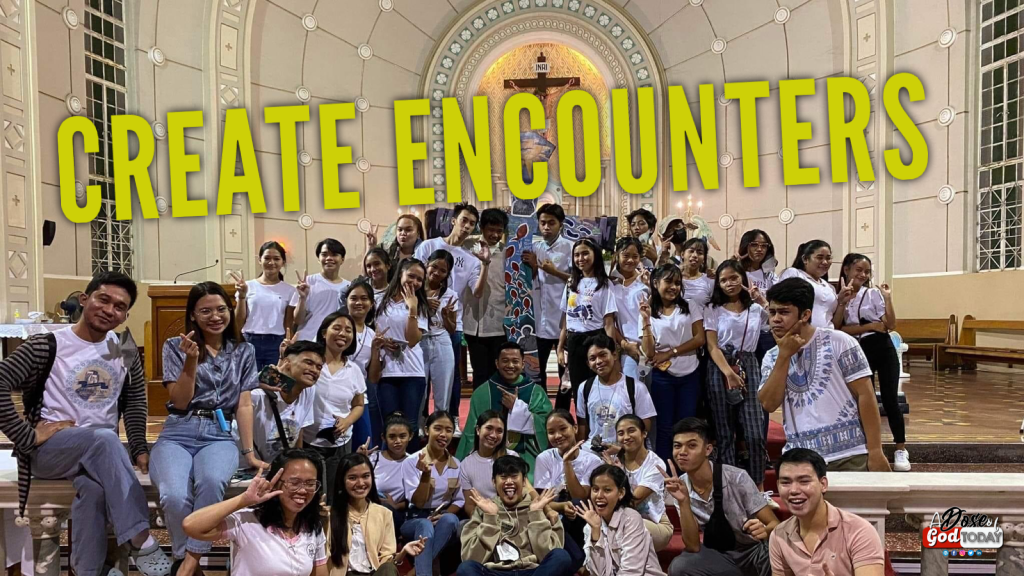
    Indeed, the celebration of our Vicariate Youth Day with its theme, “Pamatan-on: Padayon sa Misyon Kaupod si Maria,” is an expression of that experience of being inspired and motivated to come closer to the Lord. Certainly, this is a good reason to thank them for being an instrument for us in our journey of faith. So, I want you now to close your eyes and imagine that person to be in front of you and in silence, say to that person your words of gratitude for being an instrument of God for you. Say, your “THANK YOU.”

    As we express our gratitude to the people who have become significant in our journey of faith, let us be reminded as well of the feast that as a Church, we celebrate today. This is the Feast of St. Andrew, one of the original 12 apostles. So, allow me now to explore a bit this person of St. Andrew, how he has become significant to our church and on how the Lord invites us today as young people.

    You know, we know very little of St. Andrew. According to our tradition, Andrew became the first bishop in the community of Constantinople until he was martyred through crucifixion on an X-shape cross. The gospels tell us also that he was the brother of Peter. They were from Bethsaida, a town near the Sea of Galilee. In John’s gospel, we were told that Andrew was a disciple of John the Baptist at first. In the same gospel, we found that Andrew had actually brought Peter to Jesus, telling his brother, “We have found the Messiah!” In the other gospels, it was Andrew who called the attention of Jesus about the boy with 5 loaves and 2 fish. Again, it was Andrew who told Jesus that there were some Greeks who wanted to see and meet Jesus.

    From here, we can sense that Andrew was actually an apostle with a typical role. Unlike his brother, Peter, he was not able to witness the transfiguration of Jesus at Mt. Tabor. Andrew was not part of Jesus’ inner circle composed of Peter and the 2 brothers, James and John. He was in fact an ordinary guy, an ordinary apostle of Jesus.

    However, Andrew had a remarkable faith in Jesus. Remember, his brother Peter doubted and even denied Jesus three times. But for Andrew, he was the first one to realize that Jesus was truly the Messiah. In his conviction, he joyfully shared what he found to his brother. He himself became an evangelist, a preacher of the good news to his own brother. Moreover, he brought others to Jesus like the boy and those Greeks. Andrew became a bridge between Jesus and other people. Thus, Andrew became the significant person for many people to encounter and to know Jesus more.

    This is what St. Paul told us in the first reading. As there is a need but there is also beauty in sharing one’s faith in Jesus to others. And we can preach Jesus by making our faith be manifested through words and actions so that what we preach will be heard by many. Paul’s letter to the Romans would help us ponder our own call to be a kind of apostle or bearer of the good news to others like St. Andrew.

    This reminds us now of our theme in this VYD, “Pamatan-on: Padayon sa Misyon kaupod kay Maria.” Mary, is indeed, another significant person in our journey of faith. This celebration of the gift of the young people in our Vicariate of St. Peter calls us to mission by preaching Jesus through our words and actions with Mary.

    Now, we usually think that preaching is only proper to bishops, priests, and deacons. Definitely, public preaching of the gospel in liturgical occasions like what I am doing now is proper to me as a priest and not to you as lay persons. But it does not mean that you cannot preach the Gospel or share Jesus anymore to others. As young Christians, we share the prophetic role of Jesus by virtue of our baptism. It means that each of us has both the responsibility and the privilege to be God’s messenger to others, and this makes us young missionaries.

    The Gospel tells us how we are being called as young missionaries today. To each of us, Jesus says, “COME, FOLLOW ME, AND I WILL MAKE YOU FISH FOR PEOPLE! I WILL MAKE YOU MY OWN APOSTLE!” This can surely be materialized when we preach with joy by our own example. But how? These are few examples.

    First, when we are happy with what we are doing and when we are honest in our relationships and dealings with others – we preach the person of Jesus.

    Second, when we are sensitive to others and volunteer to help without any selfish motivations whenever someone needs a helping hand – then, we preach the person of Jesus.

    Third, when we become joyful givers to those who have less;  when we become more understanding and compassionate with those who are experiencing difficulties in their life; then, we preach the person of Jesus.

    Fourth, when people around us feel the deep expression of our faith as we pray in the church, in our homes or with others… then, we preach the person of Jesus.

    Fifth, when we are able to stand and fight for justice, when we are able to confront what is evil and unjust in our institutions and society, when we choose life not violence and death, then, we preach the person of Jesus.

    Friends, people will see these things and will recognize that we are Christians. Then like St. Andrew and our Mother Mary, we will be able to bring other people closer to Jesus, by becoming bearers of the Good News through our very life. Kabay pa.

  • LONGING AND HOPING IN OUR EVERYDAY LIFE

    LONGING AND HOPING IN OUR EVERYDAY LIFE

    November 27, 2022 – First Sunday of Advent

    Click here for the readings (https://bible.usccb.org/bible/readings/112722.cfm)

    Have you been so overwhelmed by your issues and enormous problems at the moment? Or by the tragedies and traumas in your life? Or are you simply so caught up with the demands of work, family life, studies and in reaching out your dreams that you seemed to be always running out of time; so engrossed with the expectations that you begin to stress out; feeling terribly anxious and pressured that you forget other important aspects of your life?

    However, in realizing such situations we are in, we also begin longing and hoping for peace, reconciliation, healing and freedom. We have begun the first day of the new Liturgical Calendar in our Church today and we are being reminded to refocus our gaze, our longing and our hope to the Lord. Hence, those aspects of our life that would incline us to lose our awareness and sensitivity of the Lord’s presence are the very areas where we are invited to grow. So, allow me now to draw out God’s call for us on this First Sunday of Advent through the Scripture readings we have heard.

    In the first reading from the Book of Isaiah, the prophet expressed wonderfully the longing of the people for the coming of the Lord. This book was written at the time when the people have suffered from being exiled in Babylon. While being captured and made into slaves, they longed for the time when all of them will come home and will be reunited. They longed for that time of peace where there will be no more wars but abundance and joy.

    Isaiah expressed this hope for the people which was meant to uplift the spirit of the people. This reminds us of the significance of the first candle that we have lighted on this first Sunday of Advent. That candle symbolizes hope. This hope is what the prophets of the Old Testament have told us. Thus, the candle is also called as the Candle of the Prophets.

    This hope as told by the prophets is reechoed in our Psalm today, “Let us go rejoicing to the house of the Lord.” This is an expression of a longing to be in the presence of God. Yet, let us also not forget our human tendency to lose hope particularly when things become overwhelming for us. Because of so much pain and of the suffering we endure, we too might feel of losing hope and forgetting our desire for God.

    This is what St. Paul in his letter to the Romans reminds us. Paul tells to be awake from sleep because of the discouraging and disappointing events that had happened in our life. We could have fallen asleep because we have become so tired from waiting for the Lord, because our prayers remain unanswered, because we have already failed several times in spite of our efforts, or your partner or a family member remains problematic despite your prayers, or until now you are not yet healed from your illness which gives you suffering, or your loved one was taken away from you because of a sudden death. Because these are discouraging, we would feel the absence of God just as the Hebrews felt when they were exiled. We could declare that we have lost our faith, because God seemed not to care for us. But, this is not true because God’s remains faithful to us and remains ever present in us. We are not just sensitive!

    Likewise, aside from the trials in life, there is another reason in losing our focus of God’s presence in life. This is basically the business of our usual days, of the demands of our everyday life, of our work, family responsibilities, studies, and everyday endeavors. This is the tendency of many who are occupied all day with many things. Indeed, the demands of everyday life are merciless. There is always more to do and not enough time to do it.[1]

    This is how Jesus reminds us today in the Gospel, “to stay awake.” This is the Lord’s invitation for us to grow in our longing and hoping for God’s presence in our everyday life. Jesus wants us to be always attentive of his presence and attentive to his everyday coming in our daily life – at home, at work or at school.

    Hence, as St. Paul teaches us in “conducting ourselves properly,” we are called to be more selfless by expressing our love for one another. When we become less self-centered, then, we also begin to recognize others and recognize God. By showing our concern for one another, we also become more aware of God. When we begin to build intimate connections with our family and friends by opening up ourselves to them, then, we also begin to open up ourselves for God. Our intimacy with others brings us, actually, into the intimacy we have with God. In other words, our closeness with those who are around us brings us into closeness with God.

    And when our routinary days are filled with demands, may we not tend to forget the Lord and lose our gaze on him and become indifferent of his presence. Thus, in the midst of our busy routinary life, let our awareness of God’s presence be intertwined in our work, in our studies, and in our activities. Therefore, it is still possible to become awake and aware of the movements of God and his invitations for us while we are working or doing something as long as we allow the Lord to be with us wherever we are. Let those moments of our awareness of God and encounters with God bring us to peace, to reconciliation, to healing, to freedom and to the fullness of life. Kabay pa.


    [1] John Shea, On Earth as it is in Heaven (Asia Trading Corporation: India, 2010), 28.