Author: A Dose of God Today

  • EPHPHATA

    EPHPHATA

    September 8, 2024 – 23rd Sunday in Ordinary Time

    Click here for the readings (https://bible.usccb.org/bible/readings/090824.cfm)

    In proclaiming us the Good News of God’s Salvation, Jesus performed lots of healing miracles. Our gospel today is one of the greatest healing miracles ever told about Jesus. Here, Jesus cured a Gentile who has both hearing and speech impediments. And somehow hearing those miracle stories sometime makes us wonder how does it feel to be healed by Jesus? In a sense, if that deaf & dumb Gentile is with us now, how he would tell us today his story? And what would be his message for us today? Does he have something to say to us today about him being healed by Jesus?

    I happen to came across once an account of Jesus’ healing ministry, which is worth reflecting on. It is called: “the healing of a deaf and mute man as may have been told…by himself”. It goes like this….

    My name is James. I was once completely deaf. I was deprived of so much that others have taken for granted, i.e. the gift of hearing. I could not hear the shouts of children at play, the singing of the birds, the sound of the wind in the trees… I could not hear words of comfort, encouragement, or advice. Most people find it tiresome to communicate with me. This made me usually feel terribly isolated. Worse, because also of my speech impediment, I could not express myself – the more I felt deprived and isolated. Usually insensitive people just laughed at my stammering.

    Also because I could not communicate and contribute anything to the community, I also felt useless and discriminated. People don’t like to communicate and touch me because I am disable and different. And when you are handicap and different, people are afraid of you. Worse, I sometimes believe that my disabilities were God’s punishment. I was full of self-pity. I longed for compassion. I was convinced that no one understood and felt sorry for me.

    That was until the day I learned about Jesus. Even though he was a Jew and I was a Gentile that did not stop me from seeking his help. And what an experience! The first thing he did was to take me aside rrom the crowd and gave me his undivided attention. This made me feel important. He did not speak to me as it would have been a waste of words. Instead he touched me. It was a tender, patient and loving touch. He made me feel what I could not hear. He put his fingers into my ears. Then spitting his finger with some of his ‘laway’, he touched my tongue with his finger. Next he looked up to the heaven to show me that what will happen is God’s saving help. Then he said to me, Ephphatha “Be opened” And suddenly my ears were opened and my speech became normal. I was cured. He then told me not broadcast what he had done for me. But I was unable to keep quiet. There was so much bottled up inside me that made me talked too much – non stop. I could not pass anyone in the street without saying “hello”. I couldn’t remain silent in the presence of someone in pain if I felt a word would help. I couldn’t bear to see an injustice done without denouncing it.

    But soon I realized that I talked to much, and was not listening, which is also hurting others. So I try to really listen to others, which meant that I had to stop talking. I listened to the sound of nature, to music, to laughter and crying. With this I discovered that everybody has certain disabilities that prevent them from making full use of their gift of speech – shyness, insensitivity, apathy… Impediments that prevent them from hearing well – prejudice, inattention, refusal to listen.

    Why am I telling you all this? It is to save you from the fate of those who have ears but cannot hear, and tongues but cannot speak. What I discovered from my experience is this: The greatest tragedy is not to be born deaf or dumb, but to have ears and yet fail to hear; and to have tongues and yet fail to speak. That is why Jesus words were: Be Opened…. Open my ear to hear His words. Open my tongues to proclaim my faith.

    Hearing and speech are indeed great means of communication. But without heart that is able to feel compassion, we will never be able to use these gifts well. It is only with the heart that we can listen rightly, and it is only with the heart that we can speak rightly. Jesus, who touched my ears and my tongue, also touched my heart. It was when he opened my heart above all that made me new. For me, that was the real miracle. He opened my heart so that I can love him and love one another. So, be opened in ears, in tongues and in above all, in heart.

    From this testimony, we learn that whatever then is our disabilities & impediments in life now & beyond, Jesus do will for our healing & well-being in life. But all these happen according to His own will, ways & purposes than ours, and usually happen not in public & hullabaloo, but privately & in silence as well. And above all, our healing & well-being are meant to make us to be more OPEN & receptive to God’s offer of better life & love with Him.

    Heal us, O Lord, from our self-centeredness that make us sick & isolated from your love & grace. Open our closed ears, mouths & hearts that we may fully be opened to enjoy our life with You and our Father now & always.

    So May It Be. Hinaut pa unta. Amen.

  • Weaving Hearts: Towards becoming a reconciling presence

    Weaving Hearts: Towards becoming a reconciling presence

    by Mark Gil I. Saverola, a seminarian of the Prelature of St.Mary in Marawi.

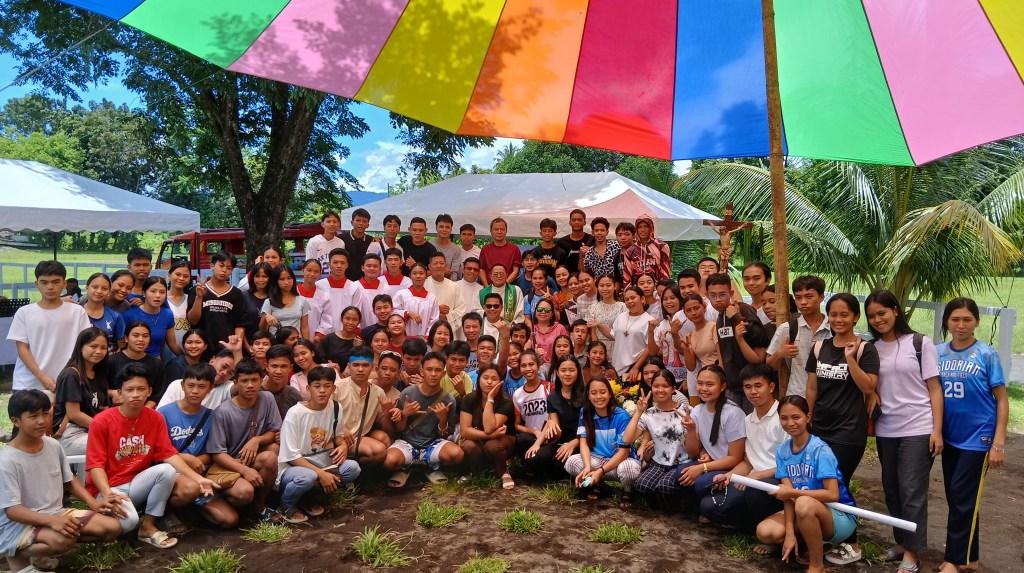
    Weaving is defined in the dictionary as the act or process of forming (cloth) by interlacing strands (as of yarn). In weaving, there has to be lots of threads, because obviously we cannot weave with just one thread at hand. This has been the image which dominates my consciousness as I recall the wonderful encounter I had with our young people of Marawi during the Kasing-Panaw. Weaving hearts; connecting hearts in its deepest sense; interlacing each other’s experiences of pain and happiness, failures and success, moments of brokenness and strength, and allowing the Spirit to form our hearts, making us into a wonderful creation – a reconciling presence ourselves.

    Weaving is a delicate process which requires the ability to choose the right thread. As evident in the Kasing-Panaw, weaving hearts, as wonderful as it is, also needs certain values and abilities for it to be genuine. This leads me to reflect on three characteristics of a heart that ushers genuine encounter, a kasing-kasing nga tinuod nga nagpanaw.

    An open heart. In our world enveloped with mistrust and suspicions, where identifying the truth from what is not is a laborious task, where passing on judgement is easier than knowing the whole truth, an open heart is an imperative. To open the heart is to be vulnerable before others. It is taking the risk of being hurt and broken. But only hearts that are open can usher genuine encounter. Our young people who were gathered in the Kasing-Panaw came from different contexts.

    They brought with them their hopes and visions, but they have also carried their burdens with them. The journey was long. The place was unfamiliar. But their hearts were open. They shared what they have deep within. They have allowed the other young people, the activities, and the environment to be part of their hearts. In the Kasing-Panaw, their struggles and burdens did not vanish, their fears were not gone, but their encounters made them face their challenges and accept their burdens with new enthusiasm.

    Their hearts became bigger, their soul enriched. Their vision is that of hope. A hope which springs out from their common experience of being loved. A hope ushered by an open heart.

    A listening heart. The world is filled with different noises. Some tends to define us; some makes us confused and discouraged. This context calls for a listening heart – a heart who listens not just to those that are spoken but most importantly to those that are kept deep within.

    The encounters of our young people in the Kasing-Panaw allowed them to listen not just to what they wanted to hear but also to the realities that young people are facing – challenges in the family, their mental health, their studies, and even challenges in terms of dialogue. These are not so pleasant to hear but they listened. Their hearts listened, with patience, with sincerity, with deep love. And in that listening heart, creativity was born. Evident in their enthusiasm, our young people found creative ways to face the challenges around them.

    In our world so much influenced with individualism and division they build friendships. In the different challenges they are facing they find inspiration in other peoples sacred stories. In the face of liminality, they were empowered by the creativity of love.

    A discerning heart. As good choice is important in weaving cloth, so as to in weaving hearts. Our choice of words, our way of relating, our perspective – these matter in our encounters with others. The energy of the young people to take on different challenges and their ability to adapt to certain situations exhibit a wonderful characteristic of a discerning heart, that is maturity.

    In the duration of the Kasing-Panaw, our young people joyfully participated in all our activities. They accepted without hesitations their foster family assignments even if they will be separated from their friends. Truly, as their hearts are discerning, there’s depth in their thoughts and actions.

    The entire Kasing-Panaw is a wonderful experience of weaving of hearts. Our experiences, hopes, visions, and even our struggles and pains are threads which were carefully and contentiously interwoven by the Spirit to form this wonderful masterpiece – The Young People of Marawi, pilgrims of hope, reconciling presence in our time.

    The Kasing-Panaw has indeed inspired us to be agents of dialogue but it also challenges us to touch the hearts that still need to be opened, the hearts that still need to learn how to truly listen, the hearts that still need to appreciate and practice discernment. This is not a light burden to bear. But it is noble task to fulfill. As what Bishop Tudtud said, it is “a plan of hundred years”[1]. And so the weaving of hearts continues… until all hearts are formed into becoming a reconciling presence.


    [1] Fr. Sebastiano D’Ambra, PIME, “Message of Silsilah Dialogue Movement”, Tatay Bido @ 25 in memoriam (2012): 76.

  • Conscience over reputations

    Conscience over reputations

    September 1, 2024 – 22nd Sunday in Ordinary Time

    Click here for the readings (https://bible.usccb.org/bible/readings/090124.cfm)

    What is more important: Conscience OR Reputations?

    The famous comic actor Charlie Chaplin once said: “Worry more about your conscience than your reputation, because your conscience is what you are, your reputation is what others think of you. And what others think of you is their problem.”

    These words of wisdom are lesson Charlie Chaplin must have learned in life, and not out of joke or humor. Somehow this is his way of telling and teaching us that whatever happens in life, we must take care of our own conscience rather than our reputation. Thus, we must give importance to what and who we are, rather than what others think and say about us.

    If you really come to think of us, in our world today we may say much is given value to our reputations than our conscience. Nowadays somehow much has been promoted in life about building our reputation rather than forming our own consciences. Many, if not most of us, define ourselves by what others think and say about us, rather than what and who we really are; and we do tend to judge others by what others think and say about them than what and who they really are.

    People have been and can fall victims of thinking more about what will people say about them, rather than what they think is right and just for themselves. In other words, people do tend to be more pre-occupied with building and protecting their reputations, rather than forming and honoring their consciences. And rightly so, as Charlie Chaplin suggests, this mentality should not be the right thinking and approach in life. It should rather be conscience first, instead of reputation over conscience.

    Our gospel today is also all about reputation and conscience. As Jesus warms his disciples then about hypocrisy and hypocrites, Jesus teaches also us now that the tendency to over-emphasize reputations over our conscience is Hypocrisy. For Jesus, hypocrites are people who do things for the sake of image & show – that is for what others will say and think of them.

    They are more concern in cleaning their hands and cups but not their hearts; more sensitive with what comes from the outside but not what come out from within. (Icing than the cake, make-up than the face, clothing than the body, packaging than the content, wrappings than the gift). Not honoring then your conscience and what and who you are, but being more concern with your reputation and what will people say and think of you is Hypocrisy. And Jesus is warning us never to fall into hypocrisy and not to be hypocrites.

    Here Jesus is also teaching us to detect hypocrisy and hypocrites in us and in others by our over-concern for reputation over and above our conscience. Whenever we give importance and become conscious more of what will people think and say about us, we fall into hypocrisy and becoming hypocrites.

    Whenever we find ourselves more concern about building and protecting our reputation, we fall into hypocrisy and becoming hypocrites ourselves. And whenever we find ourselves compromising our conscience for the sake of public approval and recognition, we fall into hypocrisy and becoming hypocrites ourselves.

    Although we might be easily fall into this mentality, we do have the capacity to detect and discern hypocrisy in us. At times we do come up to conclusions about ourselves and others like: Magpakatoo ka Brother, (Be True, My brother). Maganda nga pero pangit ang ugali (Pretty but bad personality). Mabuti ang kalagayan pero masama naman ang kalooban. (Well-off but bad person). Mayaman pero walang hiya at modo (Intelligent but disrespectful and shameless).

    Yes, we do have the instinct to read people who are hypocrites, and hypocrisy in us. So, beware of hypocrisy and of hypocrites in us and in others.

    To avoid hypocrisy in us, we must learn how to grow in righteousness. Righteousness is having right relations with God, others & oneself. It is all about forming, following, and honoring our conscience – what and who we really are. We should thus be more concern about cleaning our hearts and what is coming within us, and be true to who and what we really are. For what is conscience?

    As Thomas Merton says: “Conscience is the light by which we interpret God’s will for us in life.” Meaning, our conscience is the very working OS (operation system) for us to access, know, and communicate with God’s will for us – thus our access or signal to God. Our concern then should be strengthening and growing our consciences.

    Again as Charlie Chaplin would say: “Worry more about your conscience than your reputation, because your conscience is what you are, your reputation is what others think of you. And what others think of you is their problem.” In other words, Make your conscience as your primary concern in life… The rest is other’s problem. Remember then that God loves us not by our reputations but by our conscience.

    Help us O Lord to pay much attention to God’s still and small voice speaking within our hearts, and thus we can righteously live life in a way that will keep our consciences free and clear before God, now and always.

    So May It Be. Amen.

  • The Youth as Reconciling Presence

    The Youth as Reconciling Presence

    An article by Richly Allin King B. Vildosola, a Grade 12 student, and Youth Leader

    As I reflect on “The Youth as Reconciling Presence,” as this was highlighted in the recent Kasing-Panaw,[1] I realized that in every situation we have to look deeply for us to understand clearly, because it is easy for us to judge a person, a thing, and even a group or organization without looking on its purpose and goals. As a young person, I realized that I am called to be a bearer of hope and reconciliation, so that in all trials, difficulties, pains, and struggles, then I can be the one who would always seek for guidance, hope, healing and peace.

    Another thing, as a young person, I also realized that I need guidance, just like my co-youth as well. This will help me to good and healthy relationships with others despite the differences in cultures and traditions. Through the guidance from other people, then, this will certainly help me in making good and right decisions in the way I relate with people around me.

    Thus, there are at least two important points that I want to highlight in our role as young people in the Prelature of Marawi in promoting and becoming a reconciling presence.

    First, “as young people, we are the emergent leaders of tomorrow and crucial actors in our church as well as in the society today.” This gives the importance of the youth who are also called as a leader and  vital actors of society and church in promoting peace and reconciliation. This also means that we, as young people, should be responsible in everything that we do because this will reflect on the things that we are capable enough.

    Hence, I have indeed realized, that I am an emergent leader of tomorrow because of the skills, talents, as well as the potentials that I have. It is my call to use my voice and presence to empower my co-youth to also become more realistic and grounded.

    Second, “as young people, we are Agents of Reconciliation, with unique qualities and perspectives.” We as the Youth of today, are often perceived as the future generation, possess unique qualities that can actually serve as the catalysts for Reconciliation. We as young people, with our empathy, fresh perspectives and adaptability hold immense potential to bridge the gap caused by conflicts and biases between cultures and faith traditions. We this, we can contribute to create a kinder, just and more unbiassed world. By addressing the present challenges and embracing the opportunities for empowering Youth, our community can harness the unique qualities of our youth so that we can build and create a future where reconciliation is not just a dream but also a hope and a reality.      

    In conclusion, this moves me to always remember that we are indeed the future leaders of our nation, society, and even church. This begins now by applying all the good behaviors that can lead us achieve a peaceful and face society for all.

    However, we are just humans too, we commit mistakes but the most important is to learn from our past mistakes so that reconciliation will still be possible for us. By learning from our past experiences, this will hopefully make us more active bearer of hope and reconciliation in our small communities. Indeed,  I believe that “We, The Youth, as Future Leaders of Tomorrow” can also be “The Bearers of Hope for Reconciliation and Peace.


    [1]The Kasing-Panaw was a Youth Gathering of the Prelature of Marawi held on August 24-26, 2024 at San Isidro Labrador Parish, Balabagan, Lanao del Sur.

  • Decision to Believe

    Decision to Believe

    August 25, 2024 – 21st Sunday in Ordinary Time

    Click here for the readings (https://bible.usccb.org/bible/readings/082524.cfm)

    During the revolution in Nicaragua, it was once said that a group of Catholics seeks refuge inside a big cathedral. While praying inside as the war between rebels and army escalates,  gun-toting rebels came inside and barked at them, “Those who believed in Jesus Christ, stay and stand up for your faith. Those who don’t believe in Jesus Christ, you may now go free.” Hearing this, more than two-third of the refugees went out in a hurry and left the church, while the rest stayed behind trembling. The rebels then, closed the cathedral’s door and said, “Brothers and sisters, please continue to pray. We all need your prayers. But we rather pray with true believers than with hypocrites.”

    In his book Conversations with God, Neale Donald Walsch said: “Your decision today is a statement of who you are & a testimony of who you choose to be.” True indeed, whatever decisions we make in life reflect our very own identity as well as life-choices. Whatever circumstances we are in – whether free or limited, we do have a choice in life. What makes it difficult for us nowadays is not the lack, but rather because of the many choices & options we have. And even not to choose may also been a good choice. However, not making a choice in life now & in our life-hereafter makes our life miserable & meaningless. Thus, whatever your choice & what you decide mirrors your own identity & attitude towards life.

    In today’s reading, we hear Joshua, the successor of Moses challenging the Israelites once and for all, to make a choice. Although the Israelites were the chosen people and had experienced the mighty works of Yahweh, still some of them had worshipped idols and other gods.

    They were very influenced by the religious practices of their ancestors and of the natives who worshipped idols. Before the people, Joshua proclaimed his faith in Yahweh that he and his house decide that they would serve only the Lord. Seeing this, the people also accepted Yahweh as their Lord and God.

    In the gospel, we also hear Jesus challenging his disciples to make a choice. Many followed Jesus, some out of curiosity, some for healing and for other favors, and some out of conviction that he was the Messiah. But when Jesus began to teach them about participating in his very life and mission, by accepting his word and partaking in his body and blood as food and drink, many could not accept it.

    Many disciples withdrew and no longer followed him. They deserted him and stopped following him. That is the time Jesus asked his twelve apostles, “Will you also go away?” He asked them whether they too would leave him. He did not want to force anyone to accept him.

    He has already shown the way. Now they had to make a decision, a choice. And Peter proclaimed his and their choice: “Lord, to whom shall we go? You have the message of eternal life. We now believe and know that you are the Holy One of God.”

    Joshua, Peter & the apostles made their choice. Dear friends in Christ: “what about us?” “How about us?”

    In today’s readings, we are also challenged to make a decision. We are asked to make a choice, whether do you believe in Jesus, as the words of eternal life or not. “Are you for Jesus or against Jesus?” We know that although most of Filipinos are Catholics, some have left the Church. Some become cold or lukewarm with their faith in God and His Church. We know some of our relatives or friends have stopped going to mass, leave the church and/or joined this group or that sect.

    If Jesus now asks you: “How about you? Do you want to go away too?” What will your answer be? Will it be a definite, convincing “Yes or No”.  Or will it be a hesitant “Yes or No”?

    During Eucharist, as we recite the Apostle’s creed, we say: “I believe. I believe in God the Father Almighty. I believe in Jesus Christ, the only son of our Lord.” But do we really believe in God? Do we really believe and accept Jesus Christ as our Savior or do we desert Him like others do? Simple put, do we say what we mean & mean what we say? Are we believers in faith, or just in name?

    Our faith then is not a matter of saying words or formula out of convention, convenience, or obligation, but a matter of professing, proclaiming our own free and voluntary decision or choice to follow Christ. Remember: Your decision today is a statement of who you are and a testament of who you choose to be. Ours then is our decision to believe in our Lord Jesus Christ.

    Like the Apostles, Lord, we do say: “Asa pa man diay: to whom shall we go? You have the words of eternal life. We have come to believe and are convinced that you are the Holy One of God.” May we never be separated from you. Amen.

    Please stand, let us now proclaim our choice, our decision…