Author: A Dose of God Today

  • Pope Francis’ Message: Forgiveness, Peace, and Hope

    Pope Francis’ Message: Forgiveness, Peace, and Hope

    (A Moment of Reflection: A Talk – with Christ the King College de Maranding, Campus Ministry Office)

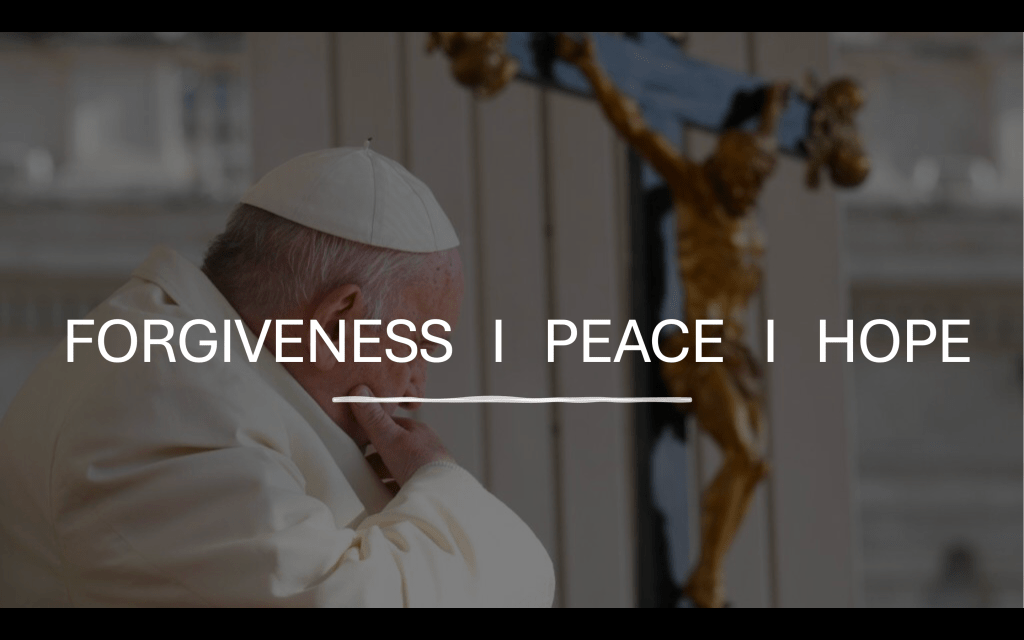
    There are three important words that I want you first to remember as we reflect today the message of Pope Francis on the occasion of the World Day of Peace published on January 1, 2025.

                First, FORGIVENESS. Second, PEACE. And third, HOPE.

                These three words served as the central theme of the message of Pope Francis addressed to world leaders and to all people of good will, including you and me. We have to understand then that the challenges and invitations set by Pope Francis are not only applicable to people who play important role in political, economic and cultural arena of our society. The call towards the path of peace is call to all.

                Hence, the theme of Pope Francis’ message reminds us now, “FORGIVE US OUR TRESPASSES: GRANT US YOUR PEACE.”

                As I join you in this short recollection, watch first this short video of the message of Pope Francis.

    From that short video presentation, it tells that Pope Francis invites us to look at the challenges that our world is facing today. These challenges are particularly those that endanger the survival of humanity and the whole creation because of human greed and manipulation for power, wealth and control.

                But how shall we look at these realities?

    We can actually look at it from the perspective of anger and hatred because of the injustices yet, that will only lead us to the cycle of violence. We can end up towards arm struggle and rebellion. Nevertheless, it will not lead us to peace but only towards more suffering and despair.

     We can also look at it with apathy and indifference. Well, the many issues and realities happening around the world are not directly experienced by us. Each of you here is not living on a war zone. You are not unemployed. You don’t have children who are undernourished, experiencing severe hunger on a daily basis. You don’t have overwhelming debt that will take you more than a lifetime to pay. And so, passivity and looking at these realities with indifference would be very easy for us to do. Yet, such attitude would only make our hearts calloused and numbed at suffering of others even with those who are nearest to us.

    Pope Francis proposes to look at the realities of the world, as well as of our own experiences of suffering from the perspective of hope, of having a heart full of hope.

    Now, for us to better understand and have a good grasped of what the Pope reminds us, let’s have a step by step moments of reflection of his message. The entire message is actually divided into four sections. In each section, let us also recognize its relevance in us, in our own context, work and status especially to you as a team of Campus Ministry in your college.

    Going back to that proposal of Pope Francis to look at the realities of the world from the perspective of hope, it triggers us to also ask, how? How do we look? And where should we start? This brings us into the first section of the message.

    The First Section

    1. LISTENING TO THE PLEA OF AN ENDANGERED HUMANITY (A CALL TO LISTEN)

    Pope Francis brings to our awareness as he greets every man and woman, and especially to those whom felt more connected – the downtrodden, those burdened by their past mistakes, those oppressed because of being judged by others, those who are desperate and hopeless.

    This is each of us! These are the experiences of many and perhaps of those students under your care. The many burdens they carry and issues they face in their own lives. This means that suffering is experienced by everyone. This is the significance of the sound of a ram’s horn (in Hebrew, jobel) calls us to listen.

    This is why the Jubilee Year of Hope becomes more relevant to each of us, individuals and as a community of faith. This is an invitation again for us that our hearts be filled with hope. This hope leads us and moves us to aspire and work for forgiveness and reconciliation, for freedom and healing.

    That is why, the Jubilee Year of Hope is meant to echo throughout the land (cf. Lev 25:9 – to every hearts and to every homes and communities) so that God’s justice will be restored in every aspect of life.

    We are called to listen and recognize now the many “desperate plea for help.” These include the exploitation of our natural and human resources in the guise of progress and profit. Pope Francis affirmed what St. Pope John Paul II called as “structures of sin” committed not only by principal agents but also by many of us who participate indirectly because of our support or because of our indifference.

    Indeed, this is a call for us to listen – to heed the plea for help of the suffering humanity for example the “inhuman treatment towards migrants, environmental decay, confusion caused by disinformation, refusal to engage in any form of dialogue, and the immense resources spent on the industry of war.” These are all “distinct yet interconnected” to each other. Do we also find these in our context? Maybe not all, but perhaps some of these.

    By acknowledging the forms of suffering in our own context, then, it calls us to work for justice. And what Pope Francis wants us to realize as well is “the cultural and structural changes” from us so that change will endure and will not be passive. This brings us now to the second section.

    Second section

    2. A CULTURAL CHANGE: ALL OF US ARE DEBTORS  (A CALL TO HUMILITY)

      After looking and recognizing at the many realities present in our communities, Pope Francis leads us to also realize the many gifts that are already in us. Yet, the many resources that we enjoy are not meant for us alone or for the “privileged few” in the case of the those whose hearts have become so wealthy and entitled.

      Pope Francis wants us to grow in gratitude, he said, “without gratitude, we are unable to recognize God’s gifts.” Certainly, we won’t be convinced as well that we are actually gifted. We will not be confident of what we have, as well of the potentials and talents that we already have. Meaning, without gratitude, it leads us to bitterness and despair. Look at how a person, you might have encountered one already, whose heart have grown ungrateful – the person becomes so stingy of many things and so mean to people around him or her.

      Indeed, when we become ungrateful this also leads us to easily get irritated or even feel unfair at the blessings of others. It makes us entitled but corrupt, even when we have received so much, in our practices because our heart is not convinced that what we have are God’s grace.

      We have to understand then, that God’s grace cannot be earned. It is a pure gift not because of our good deeds and qualities but undeserved and unmerited. That is why, the Lord would not abandon the sinful humanity, or no matter how sinful we have become, because God’s infinite mercy is a gift. In fact, God reaffirmed this “gift of life by the saving forgiveness offered to all through Jesus Christ.”

      This is how we discover the central teaching of the “Our Father.” As Jesus told us to pray : “Forgive us of our trespasses,” the Pope reminds us to recognize our collective sins that we are all indebted to the Father and with one another.

      Hence, we rely now on the mercy of God who forgave our debts, through Jesus. And through him, the gift of life, being renewed gives us hope for one another. In consequence, Pope Francis appeal echoes to every heart – “the appeal for solidarity, but above all for justice.”

      Hope becomes more alive in us now because it opens us up and lead us towards that cultural and structural change. The cultural change happens in our way of life, in the way we relate with one another and in the way we look at the world from the perspective of hope. Eventually, through this cultural change then structural change happen and begin to recognize that we are all brothers and sisters, we have a shared and diversified responsibilities and that we are not enemies or business competitors.

      This leads us now to the third section.

      Third Section

      3. A JOURNEY OF HOPE: THREE PROPOSALS (Call to Action)

        This change in us begins in our hearts. This also fuels and renews our hope, of our journey of hope, as being emphasized in this Jubilee 2025. Acknowledging God’s constant grace and mercy to all, makes us again realize God’s infinite generosity and love because we are forgiven.

        Yet, let us not also forget the challenging words in the Lord’s Prayer, “as we forgive those who trespass against us.” Forgiveness becomes a reality in us as we also learn to forgive others. From such grace, hope and peace shall overflow in our hearts. That overflow will only become concrete from our own experience of forgiveness and generosity,

        In fact, Pope Francis also said, and I quote, “Hope overflows in generosity; it is free of calculation, makes no hidden demands, unconcerned with gain, but aims at one thing alone: to raise up those who have fallen, to heal hearts that are broken and to set us free from every kind of bondage,” end of quote.

        This is the best gauge for us as we express our generosity to others. And so let us be mindful also of our attitude when our generous actions (things that we give like of materials resources, presence, our personal time and talents) are fueled by our personal agenda or selfishness then, our generosity is not from hope. Rather, it is from corruption.

        From here Pope Francis leads us to the path of peace with three proposals as our call to action.

        1. First, Forgiveness of International Debt. “Reducing substantially, if not canceling outright, the international debt which seriously threatens the future of many nations”, said Pope Francis. This is a call to world leaders especially of rich countries to be in solidarity with neighboring nations.
          1. Second, Abolition of Death Penalty. This means that we are called to have a firm commitment to respect for the dignity of human life from conception to natural death. Through this commitment, we promote a culture of life that gives every man and woman the hope of forgiveness and rehabilitation, freedom and healing.
          1. Third, To Establish a World Fund aimed at Eliminating Hunger. This is to use a “fixed percentage from armament investments to establish a global fund to eradicate hunger, facilitate educational activities in poorer countries to promote sustainable development, and to combat climate change.” This means that, certainly, war is for profit, for business and thus, it is an industry. Political conflicts or ideological beliefs or territorial disputes can easily be manipulated by profit-oriented groups in order to create war and so gain immense profits. Yet, what the world needs are not bullets but food and water, education and home.

        These three proposals though aimed at the world leaders and all those who play significant role in our global village, however, ourselves and those at the grassroots remain significant so that we may be able “to pave new paths of peace together in our communities.”

                    This brings us to the final section.

        Final Section

        4. THE GOAL OF PEACE  (Towards Freedom)

        Pope Francis quoted Saint John XXIII who convened the Second Vatican Council in 1962, “true peace can be born only from a heart ‘disarmed’ of anxiety and the fear of war.”

        This means that the goal towards peace is first directed at our own hearts that are perhaps trapped in despair and hopelessness because of our failures, or hearts thickened by indifference and selfishness, or hearts traumatized by abuse and oppression, or hearts covered with pretensions that everything is okay but not realizing the realities around, or hearts filled with worries and anxieties because of the thought of “nothing might be left for me, then I have to accumulate more” or the thought of “nothing is for me, I am pitiful” or having a heart that is constantly threatened by tensions, conflicts and wars. Then, our hearts are indeed troubled.

        Yet, know that the Lord brings us peace, grants us pardon and gives us freedom. What we are called to do now is to disarm our heart from whatever shackles of pain, trauma and imprisonment it is suffering from.

        Pope Francis wonderfully expressed the call towards freedom in these words, and I quote, “May we seek the true peace that is granted by God to hearts disarmed: hearts not set on calculating what is mine and what is yours; hearts that turn selfishness into readiness to reach out to others; hearts that see themselves as indebted to God and thus prepared to forgive the debts that oppress others; hearts that replace anxiety about the future with the hope that every individual can be a resource for the building of a better world.

                    Indeed, each of us now is a resource in building a better world. Your position as educators puts you now at the pedestal in your own context to realize peace. Pope Francis even continued to express that “disarming hearts is a job for everyone.” So that, as we heed the call to disarm our hearts, then, it will inspire us and give us hope to also become a catalyst in disarming the hearts of people around us even through our simple gestures “such as a smile, a small gesture of friendship, a kind look, a ready ear, a good deed” or having an understanding heart over a troubled student, or having a welcoming hand shake for anxious new students, or un-judging (without judgment) attitude towards a colleague who is emotionally sensitive.

                    These are small steps, simple gestures yet will also become powerful and effective as we hope to build a community in loved with peace.

                    And so as I end this reflection let us pray together the prayer for peace composed by Pope Francis at the end of his message.

        PRAYER FOR PEACE by Pope Francis

         Lord, grant us your peace!

        Forgive us our trespasses, Lord,

        as we forgive those who trespass against us.

        In this cycle of forgiveness, grant us your peace,

        the peace that you alone can give

        to those who let themselves be disarmed in heart,

        to those who choose in hope to forgive the debts of their brothers and sisters,

        to those who are unafraid to confess their debt to you,

        and to those who do not close their ears to the cry of the poor.

        Amen.

        Points for Reflection towards the Path of Peace

        Look and Listen: Recognizing the Cry for Help in my own context

        As an educator/religious/seminarian – what are the different pleas/cry for help that I can identify which I encounter with myself, with my students or community?

        Embracing our Gifts leads us to Gratitude and Generosity

        What resources/gifts/talents do I have that I can offer for others and for my community?

        Call to Action: A Commitment to make

        What do I need to change in me? What do I need to disarm from my heart? (attitudes, beliefs or perspectives) What concrete actions I can commit to promote peace?

        1. BEING With The LORD

          BEING With The LORD

          January 26, 2025 – Third Sunday in Ordinary Time

          Click here for the readings (https://bible.usccb.org/bible/readings/012625.cfm)

          Usually whenever we begin the Eucharist, whenever we proclaim the Gospels, & whenever we partake God’s blessings, we begin by saying the greetings: “The Lord Be with you” with our usual response: “And with your spirit.” Such words of greetings are not only our proclamation of our faith, but moreso our acknowledgement of how blessed we are since the Lord is present upon us.

          “The Lord Be With You… and with your spirit.” And so, how are you now?

          With such question, easy for us to reply: “Well I’m okay, I’m fine, I’m good.” However, are we not supposed to be more than just feel okay, fine and good, but be happy, glad, thankful and lucky now? Why? Simply because of the good news that the Lord is being present with us now.

          Our first reading today calls us “not to be sad and not to weep, but rejoice with the Lord” – because our Joy with Lord must be our Strength. Yes, we sometimes become so familiar with that message that it becomes so ordinary for us that we don’t anymore give value to its importance of how blessed we are for the Lord is with us. We should feel lucky and blessed, as well as be happy, joyful, and thankful because of the good news that the Lord is and be with you and us. REJOICE then for the Lord is with you & me.

          “The Lord be with you… and with your spirit”. And so, do you believe in the good news that the Lord is upon us?

          Yes, normally it is difficult for us to believe in the good news that the Lord is with us. Easier for us to accept that maybe or perhaps the Lord is with me, him, them, or us, but we at times doubt and ask: how can this be? How can the Lord be with me and us when we experience the world otherwise? Somehow it’s much easier for us to believe that we are possessed, cursed, condemned & unworthy than being blessed & graced God’s presence upon us. Same thing happened with Jesus in our gospel today. When he proclaimed to his townsfolk the message that the Lord is with Him and upon them, people doubt, cannot accept and believe in the message, asking same doubt: “How can this be?”

          However, ever since before and until now, Jesus as Immanuel always proclaim to us and the world the same message: “God is with You. God is upon us.” BELIEVE it or not, but the message and reality is still the same: Immanuel, He, the God-with-us, is with Us. Now the question is: Are we with Him?

          “The Lord be with you… and with your spirit”. Notice now our response has more conviction now than before. This is because we are now aware of the implications and consequences of this message. If the Lord is with us, what does it mean? As our 2nd reading reminds us that we are part of one body. The greetings then mean that He is with me and I am with Him – He is part of me, and I am part of Him. In other words, if He is with me, I should and have to BE RESPONSIBLE for Him as much as He has been responsible for me and us (vice-versa).

          For the past three Sundays now after Christmas we have been reflecting about the Mystery of the Light or the Luminous Mystery of the Holy Rosary. Here we recognize the public life & ministry of Jesus where it reveals to us how Jesus makes us know God the Father and shows us that through Jesus, God-is-with-us. In the Lord’s baptism, Jesus affirms and reminds us that He is God’s beloved son, as well as that you and I, we are God’s beloved children.

          With Jesus, God’s beloved children is our very identity before God. (Ako, ikaw, tayo Anak ng Dios) In the Wedding in Cana, Jesus discloses to us that God continues to bless and perform miracles in the world by the way of the Sacrament of Christian marriage and family life with the Sto. Nino, Holy Child. And today, Jesus proclaims to ever-present Good News that God, through the Lord Jesus, is upon Us – God is with us.

          May we always Rejoice, Believe and Be Responsible now for the Good News that God is upon Us, as proclaimed and shared to us by our Lord Jesus Christ.

          So May It Be. Amen.

        2. GOD IN OUR HOMES

          GOD IN OUR HOMES

          January 19, 2025 – Sunday, Feast of the Sto. Niño

          There would be times that I noticed how parents would discipline their children when they bring them to Church. There was even a time when I sat at the back before the mass and when a mother saw me, she said to her child, “Pagpuyo diha, hilom, kay naa si Father oh, masuko na siya.” Or sometimes parents would say to a naughty child with these words, “ayaw pag sigeg kiat, si Jesus naa sa krus oh, masuko na siya, monaug gyud na ron kay kusion ka!”

          Parents or those guardians of children would seem to incite fear to the little ones by introducing to them that the “Priest” would easily get angry, and the God will easily punish a naughty child.

          And this weird kind of discipline, though might have been really the experience of some in the past of having priests who easily get angry, reminds us now of the Gospel on this feast of the Sto. Niño.

          The child Jesus remained in the Temple and did not join Mary and Joseph in the caravan. This tells us that the 12 years old Jesus already felt the joy of the presence of his Father in Heaven while being at the Temple. Jesus realized that he also needed to live in his Father’s house because he also felt that it was as well his home. The Temple of God is indeed, Jesus’ home.

          Thus, Mary and Joseph saw that the child Jesus was in fact doing good and well with the teachers of the Temple despite their worries and anxieties of the event. Yet, this also gives us the reality that children also need a home where they will be joyful, will feel loved and a home that will give them opportunities for growth in health and wisdom.

          Hence, allow me now to share with you some surveys and studies that tell us about the situations of many children today.

          According to the World Health Organization[1], there are 6 in every 10 children or 400 million children, under the age of 5, who regularly experience physical and psychological violence, from their own parents and caregivers or guardians.

          Moreover, there is also 1 in 5 women and 1 in 7 men who experienced sexual abuse when they were children. In consequence, such trauma would result to lifelong physical and mental health problems especially when such shameful and painful experience is not processed and reconciled.

          These are only few of the concrete situations that many children are subjected to suffering, violence and unhealthy environment. In fact, there are many children who did not experience a peaceful and loving home because of irresponsible parents. There are many who suffer because of abuse from those people around them.

          Yet, as a Church and a Christian community, we also hope and desire that our children will have a home filled with love and freedom, life and joy. This desire is what we have heard from the readings we have today on this feast of the Sto. Niño.

          In the first reading, Prophet Isaiah proclaimed about the coming of the light, because those who walked in darkness will see the light, and those who live in gloom will be enlightened.

          In Isaiah’s prophecy, the Lord shall dispel the darkness of sin and failures, of our suffering and sadness. And in the midst of these, the Lord has come to bring light and freedom for us. Indeed, his light is our hope. This is what we also journey this time of the Jubilee Year 2025 of which we are all invited to become Pilgrims of Hope. The presence of the child Jesus, the Sto. Niño is God’s manifestation of forgiveness, of God’s mercy, of freedom and gift of life.

          In our devotion to the Sto. Niño, we are reminded of the presence of God who is among us, and who shows his power through the image of a child – through the gentle and humble image of the Child Jesus, who also calls us to grow in friendship with him.

          Indeed, Isaiah tells us of a child who is born for us and will be given to us. He is the Wonder Counselor, the Almighty God, the Eternal Father, the Prince of Peace. This is the Sto. Niño who is given to us.

          And so, we know that we have already been gifted of the presence of God. Let us allow then, God’s presence to dispel all forms of darkness in our hearts, of the pain that we feel because of violence, of the evil of indifference and corruption. Let us also allow the Magnet of Love (ang Bato Balani sa Gugma), the Sto. Niño to embrace us and to bless us now.

          With these, there are 2 challenges for us on this feast of the Sto. Niño.

          First, make a home of acceptance and love. Remember, we can make big and comfortable houses, but what is more important is for parents, for every family, rich or poor, to be able to create a welcoming and loving home. Let not our homes become a home of judgments and home of rejection, or source of unbearable pain and trauma.

          Second, allow God to be at home – so that our children will also be assured of the presence of God and that they will know God. Allow also the Lord that He will have a big space in our homes, that the Lord will become an important part in our dreams and hopes, in making decisions in life, in our concerns and problems as well as in our joys and sufferings – so that in all the days of our life, God’s presence will bless us. Hinaut pa.


          [1] https://www.who.int/news-room/fact-sheets/detail/child-maltreatment

        3. Parenting Jesus

          Parenting Jesus

          January 19, 2024 – Sunday, Feast of the Sto. Niño de Cebu

          Two brothers went for school enrollment. The school registrar found out that both of them are eight years old. However, one of them was born April 8 & the other was born April 21. When asked to explained about this, the boys just smiled & said: “We also asked our parents about it. And they just replied to us, “We don’t mind anymore who is natural & who is adopted among you. But rest assured, that we love & choose both of you.”

          This story reminds us that parenthood is a choice, and the very first people who acknowledge  us by choice as their own are our parents. Yes, to parent children is a Choice. Parenthood happens when parents choose our children &  they have chosen us as their children. We cannot be children of everybody or anybody, but we are particularly chosen by our parents to be their own. Whether by birth or adoption, our parents choose & have chosen, & is always choosing us to be their very own & not somebody else’s. Because our parents choose us as their own, we are their children because of them. And they cannot be our parents, if they would not choose us to be their own children.

          This is also the story of our salvation. God chooses us to be His own. By sending us His son Jesus into our lives, God chooses to adopt & parent us to be His own, for us to be part of His sacred & eternal family. And so also God’s blessings continues to be with us, because We also adopted Jesus to be our own & choose to parent Jesus into our lives as started by Mary, our mother. Much as salvation is God’s choice to adopt & parent us to be His own, Our salvation then is also our choice to parent & accept responsibility for Jesus as our own.

          Mary choosing to be mother & parent of our Lord Jesus in our lives paved the way for God’s holiness be upon us. And we accepting Jesus as part of our family faith-life perpetuates God’s graces to be with us always into our lives. Because of God’s choice, we are His children. Because of Mary & Joseph choice for Jesus, we are Christian. Because of our Christian faith, Jesus is our Lord & Brother.

          We also know that parenthood & parenting a child is all about persevering faithfulness. From womb to tomb, challenging & demanding it may have been – as our gospel today reminds us, Mary endures the birth, life, mission, suffering & death of our Lord Jesus Christ. From the manger to the cross & tomb, Mary did not abandoned her choice & responsibility for her son Jesus.

          In the same way, by choosing to parent Jesus to be our own, like Mary we are called & challenged to always persevere in our Christian faith for God’s salvation to continue on to happen & flourish into our lives, as we choose to parent our Lord Jesus in our day to day faith & life with our own growing chosen children.

          We take account now that we are now on the 504 years of Filipino Christianity this year. And our Filipino Christianity started when we adopted & took care of the Sto. Nino into our Filipino culture. Even without knowing much about Jesus, we Filipinos accepted to adopt & parent the Sto. Nino into our life as family & community. Because of our choice to parent Sto. Nino to be own very own, we since then, until now, & will always be God’s beloved children & Filipino Catholic Christians here & abroad.

          Daghang Salamat Maria. Thank you Mary, because by your parenting Jesus, God’s blessings thrives in our lives. And through your example & help, we also choose to parent our Sto. Nino into our Filipino life & culture that in effect, we become persevering faithfuls & believers of Jesus Christ now & forever.

          May God continue to bless us to be a blessing of Jesus to ourselves & to others.

          And above all, we invite Jesus again & anew into our lives this year as we ….SangPit Señor. HaPit Señor. Pit Senor.

          So may it be. Amen.

        4. BELOVED

          BELOVED

          January 12, 2025 – Baptism of the Lord

          Click here for the readings (https://bible.usccb.org/bible/readings/011225.cfm)

          Not so long ago, I received an inquiry about Parish guidelines on child baptism in our parish office. They are particularly asking for a so-called “Special” Baptism. Doubtless the child must be very special to the family to request for a so-called “special” baptism. But later, I found out that what they wanted is an exclusive and private celebration of the Sacrament of Child Baptism since the child is born out of wedlock. I cannot help but question their motivation for a so-called special baptism. Is it because the child is very special to them despite the circumstances OR is it because they are ashamed of themselves to admit the child as unwanted by the parents and/or the whole family themselves?

          I think we need to clarify and direct some of these distorted and questionable but trending views about Baptism in the Church nowadays. First, there is no such thing as special, exclusive, or private celebration of sacrament of child baptism. The ordained and proper celebration of baptism is and should be in public church before the congregation of Catholic faithful. Except for emergency baptism where the child is at the risk or in danger of death, baptisms should be done in the church with a lot of children to be baptized and before many baptized Catholic faithful as witnesses.  Consider then, church liturgies and sacraments are communal public church prayer-worship, and never should be an exclusive, private family, organization, or office party-program or entertainment. Second, as the child is as well as we are all baptized, we become God’s children in Christ. In baptism, we are consecrated, identified, accepted, dignified and affirmed to be beloved Children of God, like Jesus. In baptism then, more than we become the child of the family, we become God’s child before God & His church.

          When he was baptized in the river Jordan by John the Baptist, Jesus needs to hear the words and confirmation from the Father Himself saying, “You are my beloved Son; with whom I am well pleased”. Such words emphasize his very spiritual identity before God and the vision of God’s kingdom. Here, he is reminded in a deep, deep way of who He is, of his very being before God and people – that among anything else, He is God’s beloved Son. This is the very affirmation and confirmation of his being before God, as He is baptized in the river Jordan publicly – not privately, as witnessed before God’s people.

          In the same way, when he carried out his mission and public ministry, Jesus wants us also to hear the same message from the Father that not only Him, but also “You (& I & us)  are my Beloved Children, with  whom I am well pleased”. Jesus wants us to be aware and hear of the very reality & message that before God and His people, it is not only Jesus but we, you and I who believe in Jesus are also essentially God’s beloved sons and daughters. In God’s heart and eyes, we are His beloved children. And by virtue of our baptism, we are consecrated to be God’s children. We are His beloved, not because we did anything, not because we proved ourselves because of what we did and have achieved or not in life. God still and always loves us whatever we do or whatever happens in our life, whether born out of wedlock, adopted, unwanted, raised by irresponsible parents. And in our baptism or in the day of our baptism, regardless of the circumstances of our birth, we first hear God’s words saying to us all throughout our lives: “You are loved, you are beloved”. He even loves us more when while still in this world we also respond and proclaim to Him and all that, “Yes, Lord, I love you, too”, and love Him and others in return.

          Today we celebrate the feast of the Baptism of the Lord Jesus Christ. Today officially ends the Christmas season and we continue with the Ordinary Time of the Liturgical Year C. As we are now in this transition in liturgical moment, we are reminded of the Baptism of the Lord wherein Jesus publicly proclaims His identity and commitment with God’s affirmations of Him to be the Beloved Son of God. As baptized believers of Christ, we Christians today are also reminded of our identity and dignity as publicly proclaimed and acclaimed to be like Jesus, also sons and daughters – beloved Children of God ever since our baptism & always.

          As we continue on with our New Life-Year with the Lord this year, let us hear again and again, and never forget but instead be at rest always on God’s words to all of us baptized: “You are my Beloved Child with whom I am well pleased” as we claim for ourselves: “I am God’s Beloved, with whom He is well pleased.”

          So May It Be. Amen.