
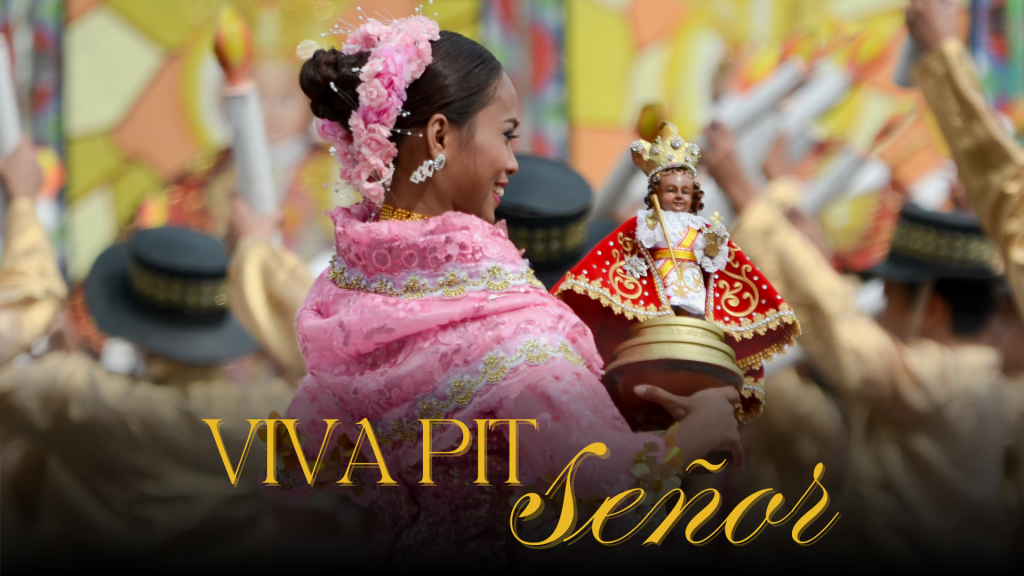
January 18, 2026 – Sunday, Feast of the Sto. Niño
Is 9:1-6; Eph 1:3-6, 15-18; Mt 18:1-5,10
Every year, around the Feast of the Sto. Niño, I remember a simple scene I once witnessed during a Sunday Mass. A young mother was struggling with her toddler who was restless, noisy, and clearly bored. Trying to control the child, she whispered, though loud enough for others to hear, “Behave. Stop it. Father will get angry. Look, he’s watching you.” The child suddenly froze, his eyes wide with fear, clutching his mother’s arm.
I gently smiled at the boy and said, “That’s not true. I’m not angry. You can move, it’s okay.” Slowly, the fear left his face.
That small moment stayed with me. Because without realizing it, many of us grow up learning to associate God, the Church, and faith with fear rather than love. We are taught to be quiet, to behave, to obey, but often through fear. In fact, a friend shared with me as well how she felt uncomfortable at first to bring their baby to the Church. She’s afraid that the grown-ups might stare harshly to her and her toddler when the boy would make some noise in the Church.
And yet today, on the Feast of the Sto. Niño, God reminds us of something deeply important: God chose not to come to us as someone to be feared, but as a child to be loved.
This is the heart of today’s feast. God chooses to be small so that no one will be afraid to come close.
In the first reading from Isaiah, we hear a message spoken to a people who were living in darkness. This darkness was caused by suffering, injustice, violence, and fear. And into that darkness, the prophet proclaimed hope: “The people who walked in darkness have seen a great light.” But how does that light come? It comes not through power, not through force, and certainly not through fear. Isaiah said clearly: “For a child is born to us, a son is given us.”
This is God’s surprising way. When the world expects strength, God gives a child. When the world uses violence, God responds with gentleness. When hearts are burdened by sin, guilt, and pain, God offers light, forgiveness, and peace. The Sto. Niño is God’s answer to our wounded world.
Saint Paul, in his letter to the Ephesians, deepened this message. He told us that we have been chosen and blessed by God in Christ even before we deserved it. God did not wait for us to be perfect. God chose us out of love. And Paul prayed that our hearts may be enlightened, that we may truly see the hope to which we are called.
This is important. Many people today live with wounded hearts. Families are burdened by poverty, stress, anger, and fear. Children grow up not always feeling safe, sometimes even in their own homes. During the pandemic, studies showed a rise in violence against children, abuse, and deep emotional distress. Many suffered quietly, unseen and unheard.
And this is where today’s Gospel becomes very concrete and very challenging.
In the Gospel of Matthew, Jesus himself brought a child in the midst of the disciples. Why? Because in that culture, children were considered unimportant, a disturbance, and a waste of time. They had no status, no voice, and no power.
Moreover, in Mark’s Gospel Jesus also said, “Let the children come to me. Do not prevent them.” And more than that, Jesus embraced them blessed them and placed them at the center.
This is not just a sweet scene. It is a strong message of the Lord for all his disciples. Jesus rejects a culture that ignores, silences, or hurts the small and the weak. He tells us clearly that if we want to understand God, we must look at a child. If we want to enter the Kingdom, we must learn the humility, trust, and openness of a child.
This is why the Sto. Niño is so powerful for us Filipinos. The image of the Child Jesus reminds us that God stands with the weak, the forgotten, and the wounded. God condemns attitudes that reject, ignore, or abuse the small especially children.
And we must be honest. Sometimes, even without intending it, we hurt children with our words, our anger, our indifference, or our silence. Sometimes, we use fear instead of love. Sometimes, we choose convenience over protection. And Jesus is very clear that this must not be so.
Yet, today’s feast is not meant to condemn us. It is meant to call us back to light, to mercy, to hope.
The world may be darkened by violence, corruption, abuse, torn by war and indifference. Our hearts may carry pain, guilt, and brokenness. But God still chooses to be born among us. God still chooses to come as a child. God still chooses to bring light.
So what does this feast invite us to do as ordinary Christians? There are four takeaways you can bring at home.
First, learn again how to see God not as someone who frightens, but as someone who embraces us. Remember, faith grows not through fear, but through love. Let us teach our children that God is safe, merciful, and close to us.
Second, let us become protectors of the small and the weak. This is not optional. It is a Gospel demand for us. Every child deserves safety, dignity, and love. Every decision we make, you as parents, leaders, neighbors, and community members, must be measured by this question, “Does this protect and nurture life, especially the most vulnerable?”
Third, never use fear to represent God. Use patience, understanding, and love. The Sto. Niño teaches us that God draws near gently.
Fourth, be a light for a child today. Do this through listening, protecting, correcting with love, or simply being present. Indeed, small acts matter as well.
Thus, today God reminds us that greatness is not found in power, but in love. Not in control, but in care. Not in fear, but in trust. May the Sto. Niño dispel the darkness in our hearts and teach us again how to live as children of light. Hinaut pa.
 A DOSE OF GOD TODAY
Leave a comment