
December 25, 2025 – The Nativity of the Lord (Christmas), Mass during the Day
Click here for the readings (https://bible.usccb.org/bible/readings/122525-Day.cfm)
One Christmas morning, years ago, after a long Misa de Aguinaldo, a parishioner shared a simple story with me. After the Noche Buena, their family was already tired and sleepy. Food was still on the table, children were dozing off, and the elders were quietly chatting. Suddenly, there was a knock on their door. It was a neighbor who lived alone and whose house had burned down a few days earlier. He did not ask for food or money. He only said, “Pwede makilingkod? Aron duna koy maka-istorya karong Pasko.” And so, they made space, reheated food, and listened. Later, the mother of the family said, “Now I understand that in Christmas, it is not only about preparing food, but preparing for someone.”
That simple moment captures the heart of Christmas Day. After all the lights, songs, and celebrations, Christmas asks us one quiet but deep question. What happens when God truly comes close to us?
The first reading from Isaiah speaks of beautiful feet, feet that bring good news, peace, and salvation. This image is very concrete. God does not shout His message from the sky. He sends messengers who walk, who travel dusty roads, who enter villages, and who speak hope where it is most needed. For a people who had known suffering, defeat, and exile, this message was life-giving: “Your God reigns. You are not forgotten. Salvation is near.”
This resonates deeply with us as Filipinos. We are a people who value presence. We walk long distances just to visit loved ones. Our students here at MSU-Marawi have to travel for many hours to get home. Thus, we show up even when it is inconvenient. And in moments of crisis like typhoons, earthquakes, and sickness, we know how powerful it is when someone simply arrives and says, “I am here.” Isaiah reminds us that this is how God comes to us, close, personal, and real.
Moreover, the second reading from the Letter to the Hebrews takes this even further. It tells us that in the past, God spoke through prophets in many ways. But now, God speaks to us through His Son. This means that God no longer sends only messages. God sends Himself. Jesus is not just a teacher of God’s word. He is God’s Word made visible. He is the image of the invisible God.
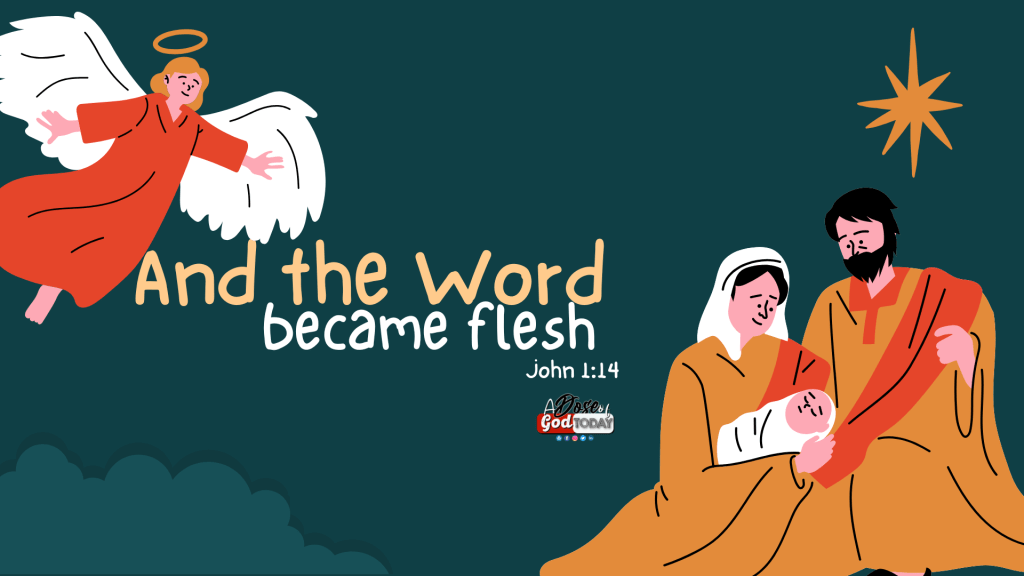
Then we hear the Gospel according to John, perhaps the most profound Christmas Gospel of all. There is no manger, no shepherds, no angels singing. Instead, John proclaimed, “In the beginning was the Word and the Word was with God, and the Word was God.… and the Word became flesh and dwelt among us.”
This is a bold declaration. God chose to enter human life fully. God accepted our limits, our struggles, our wounds, and even our rejection.
And here is the painful truth that the Gospel does not hide, John continued to proclaim, “He came to his own, but his own did not accept him.” Christmas is not always welcomed. Sometimes, God comes knocking, and we are too busy, too distracted, or too comfortable to notice.
Yet the Gospel does not end there. It says, “To those who did accept him, he gave power to become children of God.” This is the gift of Christmas Day. Not just forgiveness. Not just our comfort and good tiding. But a new identity. We are no longer strangers. We are family, sisters and brothers!
This leads us to this reality that Christmas is God choosing to walk with us so that we may learn how to walk with one another.
Remember, the Word became flesh not to remain distant, but to be encountered in our everyday life, there in our conversations, relationships, and in our choices. Jesus is present when we speak truth with kindness, when we choose honesty over convenience, and when we open space for those who feel unseen.
Today, as families and friends gather again, Christmas invites us to reflect. Why? Because it is possible to have a full Noche Buena but an empty heart. It is possible to celebrate loudly and lavishly but love indifferently. The Word became flesh so that our faith would not remain an idea, but will become our way of life.
In our country today, many people long for good news. Not slogans. Not promises. But real good news. Indeed, as Filipinos, we long for news that restores dignity, that defends truth, that protects the poor, the conversion of the corrupt leaders and that builds peace. Isaiah speaks of messengers with beautiful feet. However, this Christmas Day asks us, “Can our lives become that message?”
The Word walks with us so that we may walk with integrity. The light shines so that we may reflect it. And so, grace is given to us, so that it may be shared.
As the celebration continues beyond this Mass, let us remember that Christmas does not end today. It begins today, in how we live, speak, choose and relate with one another. Hinaut pa.
 A DOSE OF GOD TODAY
Leave a comment