
December 23, 2025 – 8th Day of Misa de Aguinaldo
Click here for the readings (https://bible.usccb.org/bible/readings/122325.cfm)
Maayong Good Morning! In many Filipino families, the giving of a name is never simple. When a woman is pregnant, there are long conversations, sometimes even gentle arguments in giving a name to the baby. Some want to name the child after a grandparent, as a way of honoring family roots. In the case of my father, he chose to name me after his nickname.
Well, others also choose the name of a saint, hoping the child will grow under that saint’s guidance. There are names inspired by faith, by gratitude, or by a story that touched the parents’ lives. And we believe that a name carries meaning. A name carries a story. A name also carries a hope.
Today, on this 8th Day of Misa de Aguinaldo, the readings invite us to reflect not only on names, but on calling. They remind us that before we were named by our parents, we were already known by God. And more than being known, each of us is called for a purpose. And so, let us journey deeper into our readings today and realize God’s invitations for us.
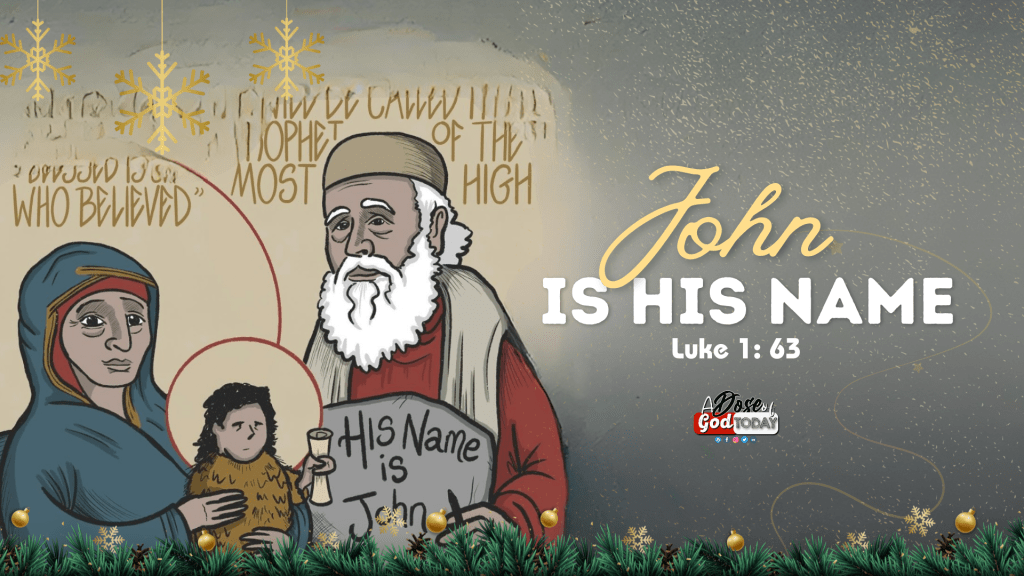
In the Gospel, we have heard the story of the birth of John the Baptist. Elizabeth gave birth, and the neighbors rejoiced with her. On the eighth day, the child is to be named. According to their custom, they want to call him Zechariah, after his father. That was the normal way. That was what people expected. But Elizabeth spoke firmly, “He will be called John.” The people were confused because no one in the family had that name. So they turned to Zechariah.
Here, something important happened. Zechariah, who had been silent for many months, wrote on the tablet, “John is his name.” At that moment, his mouth was opened. His tongue was freed. He began to speak, praising God. And so, silence ended as he began to praise God. Yet, fear and wonder filled everyone who witnessed this moment.
To understand this better, we need to remember that Zechariah doubted God’s graciousness. He asked for proof. Because of that doubt, he lost his voice. His silence was not just physical. It was also spiritual because it because a time of waiting, listening, and learning to trust again.
When Zechariah finally obeyed God’s word and named his son John, something was healed. His obedience opened his mouth. His trust restored his voice. This teaches us a powerful lesson that indeed, when we align ourselves with God’s will, even after doubt or failure, God gives us a new beginning.
Hence, God’s graciousness was revealed in John. He is the one spoken of in the first reading from the prophet Malachi. John is the messenger who will prepare the way of the Lord, who will purify hearts and turn people back to God. John’s life will not be easy. He will live simply but will speak boldly and will call people to repentance. And his mission is clear and that is to point not to himself, but to the One who is coming.
This is why the people ask in wonder, “What, then, will this child be?” They sensed that God’s hand is at work. They knew that this child has a purpose beyond ordinary expectations.
Here, the Word of God gently turns toward us now. Like John, each of us has been called by name. We are not accidents. We are not forgotten. Our lives are not meaningless. God knows us deeply, even more than our parents do. And like Zechariah, we sometimes struggle to trust that calling.
Indeed, many of us today are perhaps carrying silent doubts. We doubt our worth. We doubt our ability to change. We doubt that God can still use us after our mistakes. Some of us have lost our voice. Not literally, but spiritually. We stop speaking about what is right. We stop standing for truth. We stop working for justice. We stop expressing faith because we are tired, afraid, or disappointed.
However, the story of Zechariah today gives us hope. Silence does not have to be the end. Waiting also does not mean abandonment. God uses even our silent seasons to shape us. When the time is right, God can open our mouths again, not to complain, but to praise. Not to defend ourselves, but to proclaim His goodness and graciousness.
The psalm today echoes this message, “Teach me your ways, O Lord.” It is the prayer of someone who knows that life is a journey. Hence, we do not always see clearly and so we need guidance. We need humility. God leads the humble in what is right. He teaches those who are willing to listen.
As Christmas approaches in two days, John the Baptist stands before us as a reminder of our role that we are not the Savior. But we are called to prepare the way. In our homes, workplaces, schools, and communities, we can help make hearts ready for Christ. Not through loud words, but through honest lives. Not through perfection, but through our sincerity.
Like the parents who choose a name with hope for their child’s future, God has placed hope in each of us first. Our names, our lives, our stories matter to God. And even when we have doubted, like Zechariah, God patiently waits for us to trust again.
So, remember this, we are called by God not just by name, but for a mission. When we listen and obey, our lives become a voice that points others to Christ. I leave you now your two takeaways.
First. Live your name and calling with intention. Ask yourself: How can my words and actions today help prepare a place for Christ in the lives of others?
Second. Use your voice for good. Speak words that heal, encourage, and tell the truth, especially in situations where silence allows harm or indifference to grow.
As we continue our Misa de Aguinaldo, may John the Baptist remind us that even before Christ arrives in Bethlehem, God is already at work, calling us by name and sending us with purpose. Ok lang? Sana All.
 A DOSE OF GOD TODAY
Leave a comment