
December 20, 2025 – Fifth Day of the Misa de Aguinaldo
Click here for the readings (https://bible.usccb.org/bible/readings/122025.cfm)
In our Filipino culture, we are very familiar with signs. We look for signs before making decisions. Some ask for a sign before saying yes to a relationship. Others ask for a sign before leaving a job, migrating, or in forgiving someone. I have a friend whose constant prayer would be, “Lord, kung para ni nako, taga-i kog sign.” (Lord, if this is for me, give me a sign.)
And so, sometimes we look at coincidences, messages, dreams, or even the words of other people and call them signs. Asking for a sign is part of our faith and also part of our human weakness. We want assurance. We want certainty because we want to feel safe. On this fifth day of Misa de Aguinaldo, the Word of God invites us to reflect deeply. To guide us there are two questions that I would like you to dwell. First, what kind of sign do we ask from God? Second, what kind of sign does God actually give?
In the first reading, there was King Ahaz. God invited him clearly and said, “Ask for a sign.” It was God Himself who opened the door. But Ahaz refused and sounded very religious and upright. He said, he did not want to test the Lord. Yet deep inside, his refusal was not humility but fear. He already decided to trust his own plans, his own political alliances, and his own power and influence.
So, Ahaz did not want a sign because a sign might change him and change his own plan. And so God gave a sign anyway. Not the kind Ahaz expected, but the kind the people truly need, “The virgin shall conceive and bear a son, and shall name him Emmanuel.”
From here, we realize that God’s sign is not a spectacle. It is a child. It is presence because Emmanuel means “God is with us.” The greatest sign is not control and power, but closeness and gentleness. The sign is not to escape from problems, but God entering into them.
The Psalm continues this message. “The Lord’s are the earth and its fullness.” Everything belongs to God. And then comes the question, “who can stand before the Lord?” The answer is simple but challenging because only those with clean hands and pure hearts can stand before the Lord.
The Psalm reminds us now that the real preparation is not looking outward for signs, but looking inward at our hearts. The real sign that we belong to God is not in our success, wealth, or power, but a heart that is open, honest, and ready to receive the Lord. Hence, advent is not about forcing God to speak louder. It is about making our hearts quieter so we can listen.
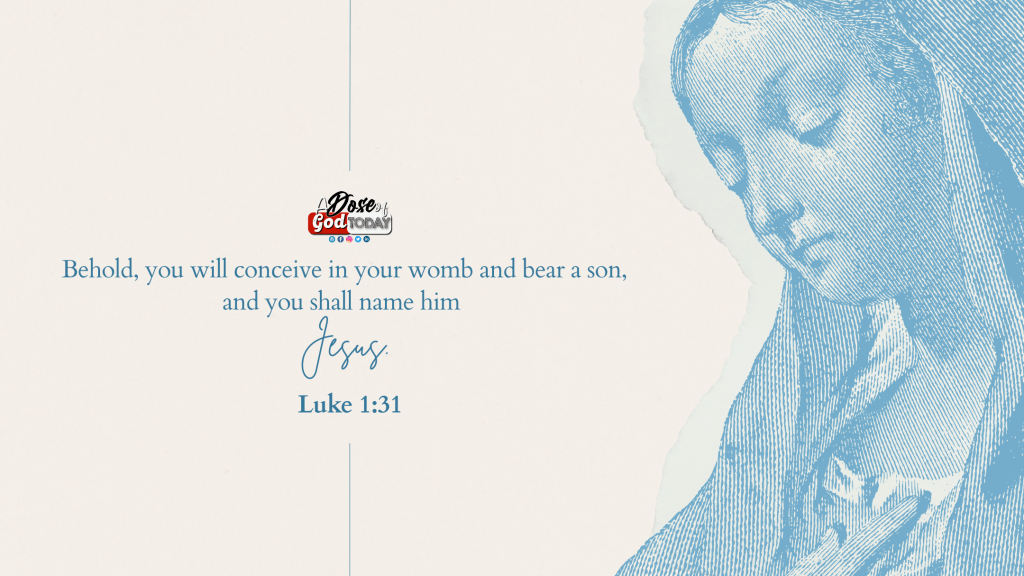
Moreover, the Gospel brings us to a small house in Nazareth, to a young woman named Mary. Unlike Ahaz, Mary did not refuse the sign. She also did not demand one. The angel greeted her with words she never expected.
Yet, Mary was also disturbed, confused, afraid. Her question was honest, “How can this be?” This was not doubt. This was faith seeking understanding. And God’s answer was clear, “the Holy Spirit will come upon you.”
God did not remove the mystery. The Lord, rather, invited Mary to trust within the very mystery. And so, Mary said yes. Not because everything was clear to her, but because God is present. That is why, her “fiat,” the “yes” of Mary becomes the doorway through which Emmanuel enters the world.
All these point us now to this message that God’s greatest sign is His presence, and it calls for our trust. In fact, we often ask for signs to avoid risk, to delay commitment, or to protect ourselves. But, God gives a sign that asks us to move forward in faith. Emmanuel means God-with-us, not “God-who-fixes-everything-immediately.”
The Lord is God-with-us in our fears. God-with-us in our waiting. And God-with-us in our ordinary and messy lives.
Many of us may have come to Misa de Aguinaldo carrying prayers that have been with us for years. Healing. Work. Peace in the family. Direction in life. Sometimes we say, “Lord, give me a sign.” And God gently says, “I have already given you My Son, the Emmanuel.”
Indeed, Jesus is the sign. His presence in our life is the answer. The question now is not whether God is speaking, but whether we are willing to say yes like Mary.
Mary teaches us that faith is not having all the answers. Faith is trusting the One who is with us. She did not know the full journey ahead. She only knew that God was asking her to trust today. And that is enough.
This is also the invitation for us today. Let us not wait for a perfect sign before loving, forgiving, serving, or choosing what is right. God is already with you, with me, with us.
Let us remember this, the Emmanuel is not only a truth we celebrate. It is a reality we live. God is with us in the darkness of early mornings, in our tired hearts, in our silent struggles, and in our small acts of goodness that no one notices. If we open our hearts like Mary, we will begin to see that the sign we were waiting for has been there all along.
I leave you now two simple takeaways we can bring home.
First, when you are tempted to ask God for a sign, pause and ask instead: “Lord, where are You already present in my life today?” Learn to recognize Emmanuel in the ordinary.
Second, imitate Mary’s simple prayer through your actions this season, say yes to one concrete act of faith each day, even if you are afraid. That yes may become a sign for someone else.
Hence, this is the sign we often miss that God is already with us. And that is more than enough sign for us. Ok lang? Sana all.
 A DOSE OF GOD TODAY
Leave a comment