
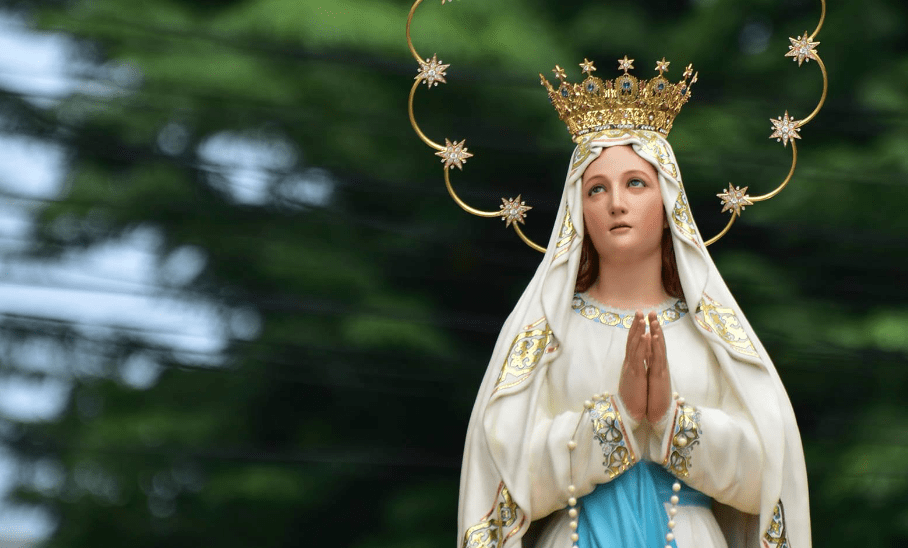
February 11, 2025 – Tuesday of the Fifth Week in Ordinary Time, Our Lady of Lourdes, Memorial
Click here for the readings (https://bible.usccb.org/bible/readings/021125.cfm)
Illness or being ill is not only limited to the ailments that we feel in our physical bodies. In fact, there is also a so called spiritual illness or psychological/emotional illness. For this reason, our desire for healing, completeness and restoration should involve the whole aspect of our life.
Yet, we also know that detecting our own illness can also be difficult at time especially when such illness is beyond the physical. Indeed, illness of the spiritual, psychological/emotional sickness can be challenging to identify and admit. When it is the mind, the heart or soul that becomes sick, we could easily hide our illness from the pretentions and facades that we develop.
This is in particular what our readings bring to light today as we celebrate the Feast of Our Lady of Lourdes in France and the World Day of the Sick. Certainly, there is a need for us to ask for that grace of healing in all aspects of life that begins in acknowledging our own illness. And so, to help us better understand and appreciate the wisdom of the today’s liturgy let us discern together the wisdom behind the Holy Scriptures.
In Mark’s Gospel, it was understood that the Pharisees were known in the Jewish society at that time of Jesus to observe strictly the traditional and written law of Moses. They too were known to follow the law up to its most trivial practices like that of washing of hands before meal, washing the dishes and even the beds. With such strict observance of the laws, these people seemed to be filled with pretentions and feeling of superiority. These mindsets where already symptoms of their spiritual illness which they find difficult to admit.
However, despite their strict observance, the integrity of their faith was in question. The sincerity of their action was doubtful. This was something that Jesus wanted them to realize so that they too will be healed from such wrong belief.
Jesus wanted these people to see that our relationship with God is not tied up in following the minutest detail of the law and of human-made traditions and rituals. Having faith is not about making others look us up because of the many rituals that we do or the many prayers that we have memorized. To have faith is never about becoming self-righteous and superior from others.
Hence, Jesus confronted the Pharisees and some of those scribes with them because Jesus knew their hearts. Citing Prophet Isaiah, Jesus said referring to them, “This people honors me with their lips, but their hearts are far from me; in vain do they worship me, teaching as doctrines human precepts.”
This was how Jesus pointed out the illness, plunder and evil in the heart of these people. This means that what they were really after was not to please and worship God but to make people worship them. Again, Jesus said about them, “You disregard God’s commandment but cling to human tradition.”
Thus, what is more important, then, is not our good image before the public or the praise that we get by being righteous and upright in front of the people but our heart that expresses our goodness, generosity, concern and love. God is also not after how much titles and recognitions we have gathered and received but the sincerity of our words and actions, the capacity of ourselves to embrace others and to give ourselves for others. These capacities are expressions of a healthy and well-rounded heart and soul.
In fact, this is what our first reading reminds us today. The Book of Genesis told us that as God created every creature on earth, God created us in his own image and likeness. We, certainly, possess the divine image of God in us. God’s nature of creating and giving life, of nurturing and developing life are in us as well. God’s nature of loving, of unity and creativity are with us as well. Hence, suppressing or hiding those qualities given to us would be a form of injustice to the Divine Giver.
Moreover, when we lose these very natures in us which have been shared by God to us, this might mean that we are sick because our hearts have become away from the grace of God. What causes us to be that sick is when we distance ourselves from the grace of the Lord, when we fill more our heart with selfish desires, when we foster hatred and anger and indifference in our heart.
Therefore, Jesus calls us today to rather express the Divine Image in us by participating in the on-going work of God in us and in the world. That means that God has actually never stopped creating and giving life. God continues to work in us, with us and through us so that the fullness of life may be fully manifested.
This is manifested today in the two sacraments that we are celebrating, the Eucharist and Anointing of the Sick that bring healing and restoration to our physical body and spirit. And we are more assured today, as we celebrate the Feast of Our Lady of Lourdes, because we are given extra confidence that Mary, our Mother is there with us, praying for us and desiring for our healing and completeness.
Therefore, as we pray and ask for the grace of healing, let us also listen and respond to the call of Jesus today to express freely the divine image in us that gives life, that inspires life and that creates life.
As we receive God’s grace of healing, let us allow the divine image in us to flow into our relationships, into our families and friends, into our commitments and endeavors, into our work and profession and into our organization and communities so that we too will become bearers of healing. Hinaut pa.
 A DOSE OF GOD TODAY
Leave a comment